

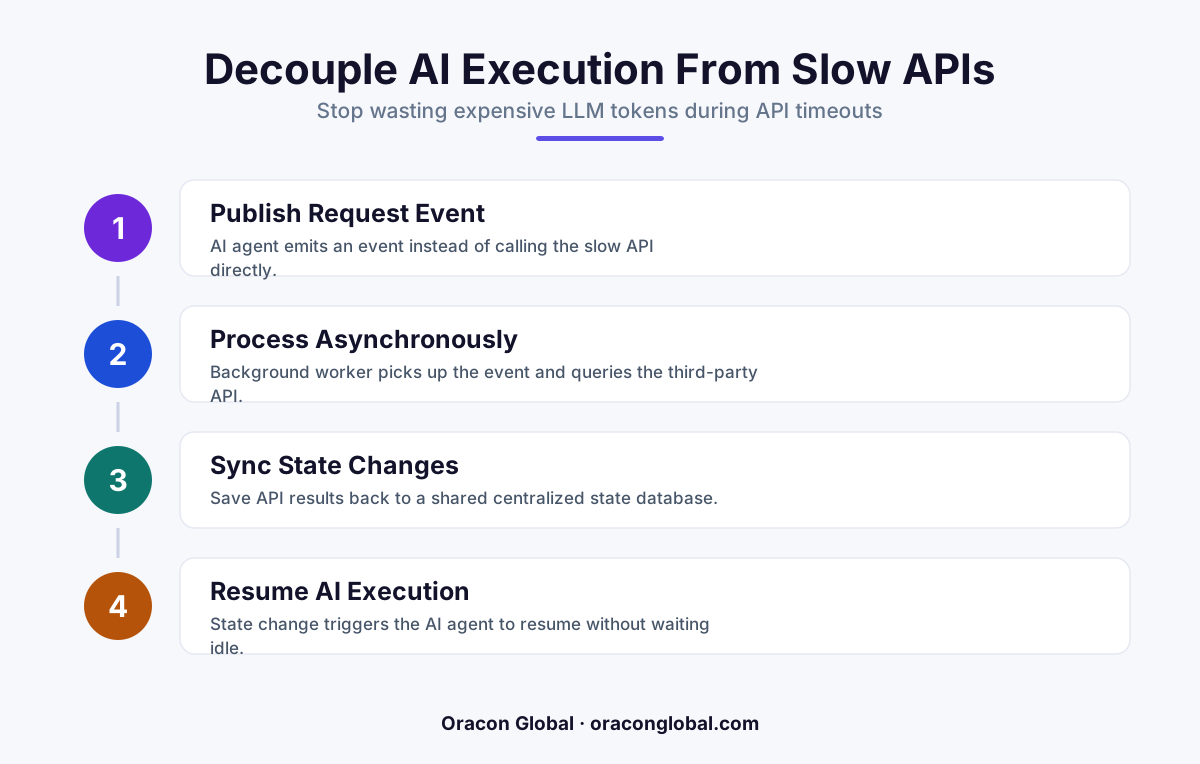
AI digital employees often stall when waiting for slow, legacy third-party APIs to respond. By implementing an event-driven state sync layer, you can decouple the AI's reasoning engine from external dependencies, ensuring continuous operations, lower API costs, and a highly resilient automated workforce.
Imagine hiring an assistant who freezes and stops working entirely every time they place a phone call and get put on hold. That is exactly what happens to most custom AI digital employees when they interact with the legacy software tools your business uses every day.
When an AI agent needs to fetch data from a slow third-party API—such as a legacy logistics system, a customs database, or an old enterprise ERP—it usually makes a synchronous request. The agent pauses, waits for the response, and hangs. If the external system takes twenty seconds to respond, the connection often times out, the workflow crashes, and expensive LLM tokens are wasted in a loop of retries.
To build reliable enterprise AI performance, you must decouple your AI's reasoning engine from the speed of external systems. The solution is an event-driven state sync layer. This architecture allows your digital employees to assign tasks to background processes, move on to other work, and resume safely once the data arrives.
The Stalling Problem in Autonomous Workflows
Most basic AI setups are built on a simple request-response model. The AI agent generates a plan, calls a tool (like an API), waits for the output, and feeds that output back into its next prompt. This works perfectly when APIs respond in milliseconds.
However, real-world business APIs are rarely that fast. A legacy inventory database might take ten seconds to run a complex SQL query. A shipping carrier's API might take thirty seconds to generate a custom bill of lading. In these situations, synchronous AI agents suffer from three major issues:
- Timeout Crashes: Standard HTTP connections usually close after 10 to 30 seconds, causing the entire agent workflow to fail mid-step.
- Token Bleed: If an agent has to constantly poll a slow system to see if a job is done, it reads and writes to the LLM over and over, rapidly inflating your API bill.
- State Corruption: If a network blip occurs during a long wait, the agent loses track of what it was doing, leading to duplicate actions like double-booking shipments or sending duplicate invoices.
To solve this, we need to transition our systems from synchronous execution to an architecture built on asynchronous AI agents.
The Architecture of an Event-Driven State Sync Layer
An event-driven state sync layer acts as a buffer between your AI digital employee and the outside world. Instead of allowing the AI to call external systems directly, we introduce a state machine and a message queue to manage the handoff.
The architecture relies on three core components working together in harmony:
1. The Central State Ledger
Before any API call is made, the AI agent writes its current intent and context to a local database. This state ledger acts as a single source of truth. If the system crashes, the agent can look at the ledger and instantly know exactly where it left off without needing to ask the LLM to reconstruct the history.
2. Asynchronous Message Queues
Instead of executing slow API queries directly, the AI agent publishes a task to a background message queue (using technologies like Redis or RabbitMQ). The AI then immediately releases its active LLM thread, going into a "listening" state. It is no longer waiting on hold.
3. Callback Handlers and Webhooks
A background worker picks up the task from the queue and manages the slow interaction with the third-party legacy API. Once the legacy system finally returns the data, a callback handler validates the payload and updates the central state ledger. This update triggers an event that wakes up the AI agent, handing it the freshly retrieved data to finish the job.
Step-by-Step: How the Sync Layer Keeps Agents Moving
To understand how this looks in practice, let us trace a workflow where an AI digital employee is processing a complex shipping order that requires a legacy customs clearance check.
- The Intention Phase: The AI agent decides it needs to verify customs documents. It writes a record to the state ledger:
{ task_id: 409, status: "pending_customs_api" }. - The Handoff: The agent pushes the request parameters to the message queue and suspends its own active execution context. The agent is now free to process other inbound customer emails.
- The Background Wait: A lightweight background worker reads the queue and sends the request to the slow third-party customs database. The API takes 45 seconds to compile and return the data.
- The Wake-Up Call: The worker receives the 45-second response, formats the data cleanly, writes it to the state ledger, and updates the status to
"customs_data_ready". - The Resume Phase: The change in the state ledger fires an event. The AI agent receives this event, reloads its saved context from the database, digests the customs data, and completes the customer order instantly.
Why Decoupled Systems Are Cheaper and More Stable
Building an event-driven state sync layer does more than just stop your AI from freezing. It fundamentally changes the economics and reliability of your software.
Because the AI is not actively processing during the wait times, you are not paying for idle LLM context windows. You only pay for the exact tokens needed to plan the query and process the final result. Additionally, if the third-party API goes down entirely, the background queue can handle automatic retries and exponential backoffs silently. The AI agent does not even need to know a temporary outage occurred; it simply receives the data a few minutes later than usual and proceeds without a single error.
"True software automation is not about making every system fast; it is about building architectures that remain incredibly stable when external systems are slow."
Partnering with Oracon Global to Build Production-Grade AI
Moving your AI initiatives from a fragile prototype to a resilient, production-grade system requires deep engineering expertise. At Oracon Global, our senior in-house team specializes in building custom web applications, AI agents, and robust backend architectures designed to scale seamlessly.
When you work with us, you retain 100% ownership of your code and intellectual property. We build custom integrations, API throttles, and event-driven state layers that ensure your software remains stable under any operational load. You can even test our live, interactive systems yourself by visiting the live AI demos and interacting with our "Aria" assistant on our website.
If you are ready to build robust, latency-insensitive AI systems that never stall or drop tasks, reach out to the engineering team at Oracon Global today for an honest, practical discussion about your project.
Frequently asked questions
Why do slow third-party APIs cause AI digital employees to stall?
When an AI agent calls an external API synchronously, the LLM-powered execution loop must pause and wait for the response to keep its state updated. If the API takes several seconds or minutes, the connection times out, tokens are wasted, and the entire agentic workflow halts.
What is an event-driven state sync layer?
It is an architectural design that decouples the AI's core decision-making brain from external API execution. Instead of waiting directly for a response, the AI writes a state change to a local database and hands off the API query to an asynchronous worker queue, allowing the agent to perform other tasks in the meantime.
How does this state sync layer save on LLM token costs?
Traditional synchronous loops keep the LLM context active and repeatedly poll the system while waiting, consuming extra tokens. An event-driven state sync layer suspends the active LLM run and only resumes the context once the database ledger registers a verified callback payload.
Do we need to rewrite our entire backend legacy system to implement this?
No. A custom event-driven state sync layer can be built as a lightweight middleware wrapper. It sits cleanly between your existing database, your AI digital employees, and the external third-party APIs without requiring a complete database overhaul.
Read next
Beyond Chatbots: How to Build AI Agents That Actually Do Work for Your Business
Most businesses use AI to answer questions. Here is how to build custom AI agents that actually take action, connect to your internal tools, and handle complex workflows.
Beyond the Wrapper: How to Build Custom AI Agents for Business That Actually Work
Many businesses invest in basic AI wrappers only to find they lack the security and context needed for real work. Here is how to build custom AI agents that integrate deeply with your workflows and databases.
Enterprise AI Maintenance Costs: Budgeting for Year Two and Beyond
Building an AI system is only half the battle. Discover the practical, ongoing operational costs of enterprise AI, including token management, model drift, and continuous security audits.
Oracon Global builds production-grade AI agents, automation and apps — and you own the code and IP. Tell us what you want to automate.
Book a call →See our work