

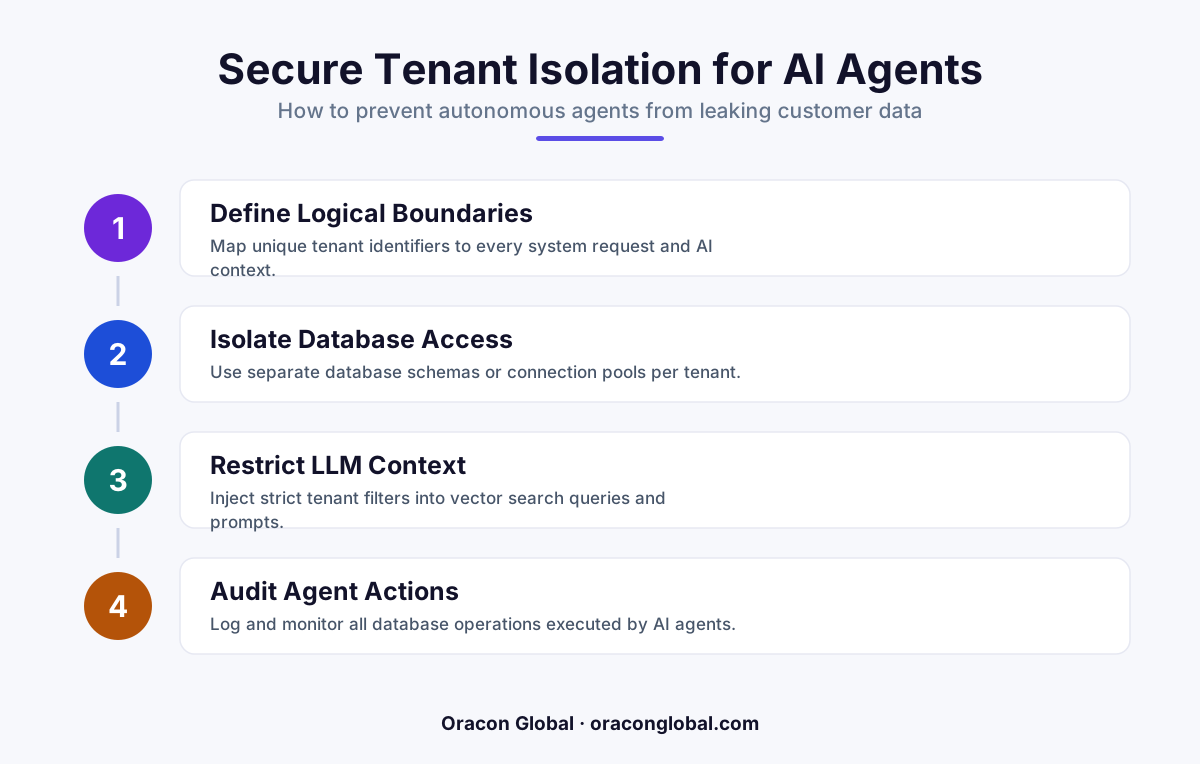
Standard multi-tenant software relies on application-level filters to keep customer data separate. For agentic SaaS platforms, where autonomous AI agents run raw database queries and execute dynamic tools, you need a strict, infrastructure-level tenant isolation system to guarantee that one customer's agent can never access another customer's database.
In a traditional Software-as-a-Service (SaaS) application, keeping one customer’s data safe from another customer is relatively straightforward. Your developers write code, apply database filters like WHERE tenant_id = x, and trust that the application logic will keep things separated. But when you introduce autonomous AI agents into the mix, this traditional model breaks down completely.
An agentic SaaS platform doesn't just read and write static data based on pre-defined buttons a human clicks. It deploys AI agents that autonomously plan tasks, write dynamic queries, and call external tools to fetch business data. If your platform relies on simple, application-level filters, a single prompt injection or a minor logical bug in the AI's planning loop could allow an agent to query data belonging to a completely different customer. To build a secure, enterprise-grade AI product, you must design a robust multi-tenant tenant isolation system that keeps customer databases separated at the infrastructure level.
The Hidden Danger of Shared Databases in Agentic SaaS Platform Security
Most early-stage SaaS platforms start with a shared database architecture where all customer data lives in the same tables, separated only by a tenant ID column. While this is cost-effective, it introduces massive risks for AI-native software. Here is why traditional methods fall short in an agentic environment:
- Dynamic Query Generation: If your AI agent uses text-to-SQL or dynamic vector searches to find information, it is writing its own database queries. A user could trick the agent into ignoring the tenant filter entirely.
- Context Window Contamination: If an agent pulls data from a shared index, a bug in your retrieval pipeline could load Tenant A's private financial data into the context window of Tenant B's agent.
- Tool Execution Risks: AI agents use tools (APIs and database connectors) to execute tasks. If those tools run on a shared connection string with global read-write access, the agent has the keys to the entire kingdom.
To achieve true agentic SaaS platform security, you need to move the security boundary away from your application code and down to the database and infrastructure layers.
Three Architectural Blueprints for Database Separation for AI Agents
When engineering a multi-tenant database isolation system, there are three primary patterns you can implement. The right choice depends on your compliance requirements, budget, and performance needs.
1. The Database-per-Tenant Model (Physical Isolation)
This is the gold standard for security. Each customer gets their own physically isolated database instance. The application layer routes the AI agent's connection requests to that specific database and nothing else. Even if the AI agent is completely compromised via a prompt injection, it physically cannot read data from another customer because it does not have the network path or credentials to access any other database container.
2. The Schema-per-Tenant Model (Logical Isolation)
In this model, all tenants share a single database instance, but their data lives in isolated schemas (or namespaces). PostgreSQL, for example, allows you to create separate schemas for each tenant. You can then configure your database connection pool to restrict the agent's active user role to a single schema, preventing it from executing cross-schema queries.
3. Row-Level Security with Dedicated Database Roles
If you must use a single shared table, you cannot rely on your web framework to append tenant IDs. Instead, you must use your database engine's native Row-Level Security (RLS) features. When an AI agent initiates a workflow, the system must open a database connection using a restricted database user role tied directly to that tenant. The database engine itself then rejects any query that attempts to bypass the tenant boundary.
Building the Isolation Layer: Step-by-Step
To implement a secure, automated isolation system that keeps your customer databases separated, your engineering team should focus on building three core components.
Step 1: Implement an Ephemeral Token Exchange Service
Never give an AI agent a permanent connection string. Instead, build a central Authorization Gateway. When an agent is spun up to perform a task, the gateway should generate a short-lived, single-use token or database credential that expires the moment the agent's current run is complete. This limits the blast radius of any potential security compromise.
Step 2: Isolate the Vector Database and RAG Pipeline
Most AI agents rely on Retrieval-Augmented Generation (RAG) to fetch context from vector databases. To prevent LLM data cross-contamination, you must partition your vector storage. If you use a vector database like Pinecone, Milvus, or Qdrant, ensure you are using separate namespaces or entirely separate collections for each tenant, enforced by strict metadata filters at the query coordinator level.
Step 3: Sandboxed Tool Execution Environments
When an agent executes code or calls an API on behalf of a user, that action should happen inside a sandboxed micro-container. This container must be configured with environment variables that only contain the API keys and database credentials of that specific tenant. Once the agent completes its task, the container is destroyed.
Balancing Strict Security with Platform Performance
The primary objection to building a highly isolated multi-tenant system is often performance and operational complexity. Spinning up hundreds of database connections or managing separate database schemas can introduce latency. However, you can mitigate these issues by using dynamic connection pooling utilities (like PgBouncer for PostgreSQL) and automated database provisioning pipelines during your customer onboarding flow.
At Oracon Global, our senior in-house team specializes in architecting production-grade AI applications, custom ERPs, and secure SaaS platforms. We build systems where security is baked into the infrastructure from day one, ensuring you own 100% of your code and intellectual property.
Are you designing an AI-native SaaS platform and want to ensure your architecture is secure enough for enterprise clients? Let's discuss how to design a secure, scalable database isolation system for your product.
Frequently asked questions
Why is standard row-level security not enough for agentic SaaS platforms?
Standard row-level security relies on the application code correctly appending tenant IDs to every query. Because AI agents generate queries dynamically or call tools autonomously, a minor code bug or a clever prompt injection could bypass these filters, leading to catastrophic cross-tenant data leaks.
What is the safest database architecture for an AI-native SaaS?
A database-per-tenant architecture is the safest approach. By physically separating customer data into distinct database instances or schemas, you ensure that even if an AI agent goes rogue, it physically cannot access another customer's data store.
How do you authorize AI agents to access specific databases securely?
You should use dynamic, short-lived database credentials generated on the fly for each agent execution. By linking these ephemeral tokens to a strict IAM role for the specific tenant, the agent's connection pool is completely isolated from other tenants.
Does implementing strict tenant isolation slow down the AI agent's response time?
If designed correctly with pre-warmed connection pools and efficient token exchange microservices, the latency overhead is negligible (typically under 10-15 milliseconds), which is imperceptible compared to the generation time of the LLM itself.
Read next
Beyond Chatbots: How to Build AI Agents That Actually Do Work for Your Business
Most businesses use AI to answer questions. Here is how to build custom AI agents that actually take action, connect to your internal tools, and handle complex workflows.
Beyond the Wrapper: How to Build Custom AI Agents for Business That Actually Work
Many businesses invest in basic AI wrappers only to find they lack the security and context needed for real work. Here is how to build custom AI agents that integrate deeply with your workflows and databases.
Enterprise AI Maintenance Costs: Budgeting for Year Two and Beyond
Building an AI system is only half the battle. Discover the practical, ongoing operational costs of enterprise AI, including token management, model drift, and continuous security audits.
Oracon Global builds production-grade AI agents, automation and apps — and you own the code and IP. Tell us what you want to automate.
Book a call →See our work