

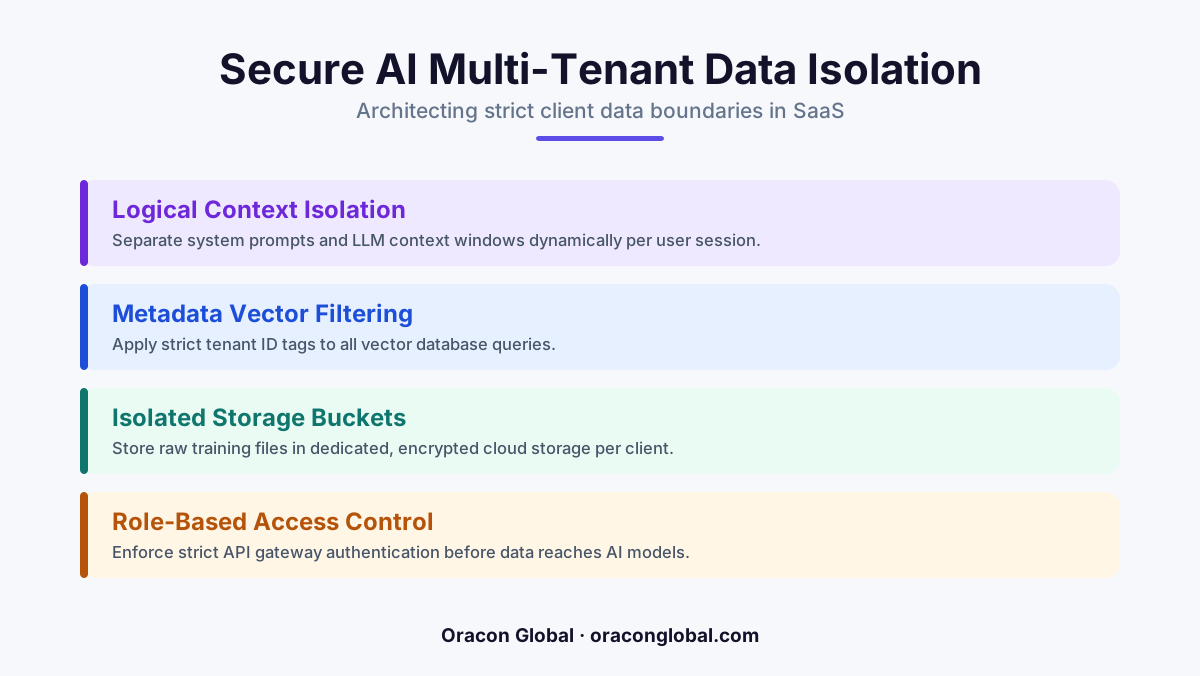
To keep client data secure in an AI-native SaaS, you must implement strict multi-tenant partitioning at the database, vector, and LLM orchestration levels. Relying on simple metadata filters is a massive security risk; instead, look to connection-pool isolation, dedicated namespaces, and runtime security context validation to guarantee complete tenant isolation.
Building a standard Software-as-a-Service (SaaS) platform is challenging enough, but building an AI-native SaaS introduces an entirely new layer of risk. In a traditional system, a database leak might mean a user sees another user's invoice. In an AI-native system, a leak could mean your AI model retrieves proprietary intellectual property, financial forecasts, or medical records from Tenant A and presents them as an answer to Tenant B.
Because large language models (LLMs) and vector databases operate on unstructured data and natural language queries, standard row-level security is no longer enough. To build a secure, enterprise-grade platform, you need a robust multi-tenant data partitioning system. This architecture ensures that every client's vector embeddings, prompt histories, and documents remain strictly isolated within their own secure boundaries.
Here is how to design and build a secure, scalable multi-tenant architecture for your AI-native SaaS, protecting both your business and your clients' most sensitive data.
The Hidden Risks of Shared Context in AI Platforms
In traditional web development, securing tenant data is relatively straightforward. You write a database query with a simple clause like WHERE tenant_id = current_tenant. If the developer writes the query correctly, the data remains safe.
With AI-native SaaS platforms, however, data flows through several highly dynamic, non-relational systems:
- Vector Databases: High-dimensional embeddings representing semantic meaning.
- LLM Context Windows: The temporary working memory sent to the foundational model during a query.
- Agentic Memory: Long-term and short-term logs of how an AI assistant has interacted with a specific user over time.
If you rely solely on application-level filtering to separate this data, a single bug in your code or a minor prompt injection attack could bypass your filter. The LLM could search across the entire database, pulling in confidential data from other tenants to formulate its response. To prevent this, you must build multi-tenant data partitioning directly into your infrastructure, not just your application logic.
Three Approaches to Multi-Tenant Partitioning
When designing your data architecture, there are three primary ways to isolate tenant data. Each offers a different balance of security, operational cost, and complexity.
1. The Silo Model (Logical or Physical Isolation)
In this model, every tenant gets their own dedicated database instance and vector index. In some cases, they may even run on dedicated virtual machines. This is the gold standard for enterprise security. Because the databases are physically or logically separated at the infrastructure level, it is virtually impossible for Tenant A's data to leak into Tenant B's environment.
The downside is cost and maintenance. Running hundreds of individual database containers or vector indexes can become incredibly expensive and difficult to manage. This model is best reserved for high-value enterprise clients with strict compliance requirements.
2. The Namespace Model (Isolated Schemas)
This approach uses a single, shared database cluster but partitions the data using logical namespaces or schemas. Most modern vector databases allow you to create distinct namespaces within a single index. When querying, the database engine enforces isolation at the driver level, ensuring queries are strictly run within the specified namespace.
This provides a strong balance between security and cost. It is highly scalable, keeps infrastructure costs manageable, and offers excellent protection against accidental cross-tenant data leaks.
3. The Shared-Index Model (Metadata Filtering)
In this model, all tenant data lives in the same index, and every vector or database row is tagged with a tenant_id metadata field. When a user runs a search, the application applies a filter to restrict results to that specific ID.
While this is the easiest and cheapest model to implement, it is also the least secure. It places the entire burden of data isolation on your application code. If a developer forgets to apply the metadata filter in a new feature, or if a complex API call bypasses the filter, your system will expose sensitive data across tenants. We generally advise against this model for any SaaS handling sensitive business data.
Implementing Secure RAG Tenant Partitioning
Retrieval-Augmented Generation (RAG) is how modern AI systems ground their answers in custom business data. If you are building a RAG-enabled SaaS, keeping your search index secure is paramount. Here is a step-by-step approach to securing your RAG pipeline:
- Isolate at the Ingestion Phase: When a client uploads a document, process it through an isolated worker. Ensure that the text chunking and vector generation processes run within a secure runtime context that is hard-coded with that specific tenant's credentials.
- Use Partitioned Vector Indexes: Store the resulting embeddings in a dedicated namespace or schema inside your vector database. Never mix raw embeddings from different companies in a single, unpartitioned index.
- Inject Rigorous Context Guards: Before sending retrieved document chunks to the LLM, use a secure middleware layer to verify that every single piece of retrieved text belongs to the authenticated tenant. If even one chunk lacks the correct cryptographic signature or tenant ID, discard the entire payload and log a security alert.
Securing LLM Session Memory
AI assistants and digital employees rely on chat history to maintain context over long conversations. This memory must be protected as fiercely as your primary database.
To keep conversation histories private, store all chat sessions in an encrypted, multi-tenant relational database. When a user sends a message, pull their specific history using a secure connection pool that is scoped strictly to that user's organization. Never cache chat histories in shared global variables or unencrypted redis instances, as these can easily leak across concurrent user requests in a high-traffic production environment.
Partner with a Senior Team to Build Secure AI SaaS Architecture
Building a scalable, secure AI-native SaaS requires deep architectural expertise. You cannot rely on basic tutorials or generic wrappers when handling proprietary enterprise data. Security must be baked into your database schemas, API gateways, and LLM orchestration layers from day one.
At Oracon Global, our senior in-house engineering team designs and builds secure, production-ready AI agents, custom web apps, and AI-native ERP systems. We ensure you retain 100% ownership of your code and intellectual property, giving you total control over your digital assets.
Are you planning to build a multi-tenant AI platform that requires uncompromising data security? Get in touch with us at Oracon Global today to discuss your architecture and see how we can bring your product to market safely and efficiently.
===Frequently asked questions
Why is standard database multi-tenancy not enough for AI-native SaaS platforms?
Traditional databases rely on simple row-level filtering, but AI platforms use vector databases, dynamic LLM prompts, and long-term memory systems. If an LLM retrieves data without strict, runtime-enforced tenant boundaries, one client's proprietary data can easily slip into another client's session.
Can we just use metadata filtering to isolate different tenants in a vector database?
While metadata filtering is easy to set up, it is highly prone to developer error and software bugs. If a developer forgets to apply the tenant filter in a single API query, the system will expose other clients' vectors; dedicated namespaces or separate indexes are much more secure.
How do we prevent our LLM cache or history from leaking data to other users?
You should never use a global, shared memory state for your AI. Every API call to the LLM must be wrapped in a secure session context that dynamically loads only the current tenant's chat history from an encrypted, isolated database instance.
Does implementing strict tenant partitioning slow down our AI SaaS application?
When architected correctly, the performance impact is negligible. Using connection pools that dynamically swap tenant credentials and caching tenant-specific public keys for JWT validation keeps your application fast, scalable, and highly secure.
Read next
Beyond Chatbots: How to Build AI Agents That Actually Do Work for Your Business
Most businesses use AI to answer questions. Here is how to build custom AI agents that actually take action, connect to your internal tools, and handle complex workflows.
Beyond the Wrapper: How to Build Custom AI Agents for Business That Actually Work
Many businesses invest in basic AI wrappers only to find they lack the security and context needed for real work. Here is how to build custom AI agents that integrate deeply with your workflows and databases.
Enterprise AI Maintenance Costs: Budgeting for Year Two and Beyond
Building an AI system is only half the battle. Discover the practical, ongoing operational costs of enterprise AI, including token management, model drift, and continuous security audits.
Oracon Global builds production-grade AI agents, automation and apps — and you own the code and IP. Tell us what you want to automate.
Book a call →See our work