

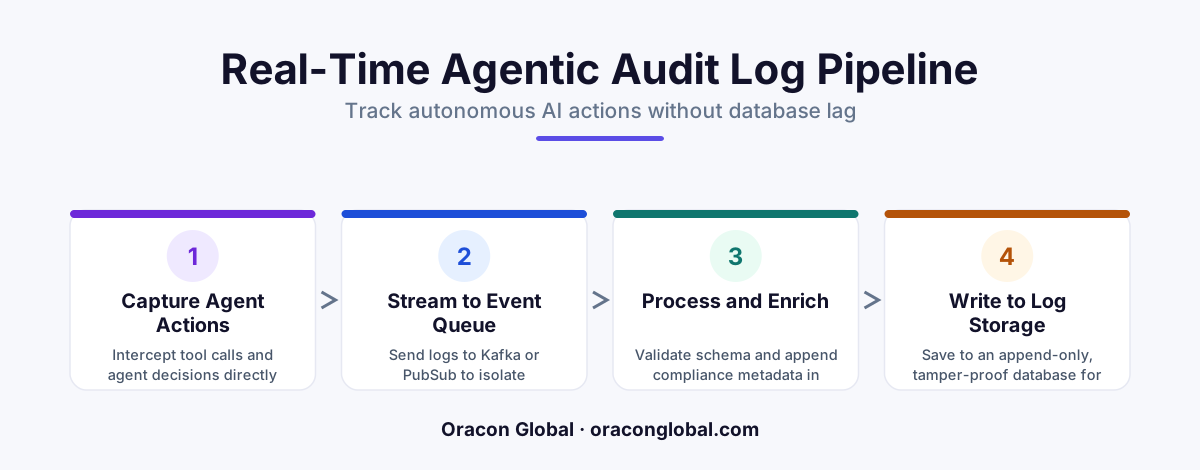
Proving compliance for autonomous AI actions requires capturing the complete reasoning path, prompt state, and API payload of every decision. To prevent this massive volume of data from locking your production databases, you must decouple the audit trail using an asynchronous event-driven queue and a dedicated append-only write store.
When an autonomous AI agent updates an inventory ledger, drafts a shipping manifest, or executes a high-value customer workflow, it is no longer just a software helper. It is acting as a digital representative of your business. In highly regulated environments, every single one of these actions must be traceable, verifiable, and permanent.
For operations and risk officers, this means having a reliable agentic audit log. You cannot simply log "User updated record." You must log the entire cognitive sequence: what the agent planned, the exact context retrieved from your databases, the tool payloads it sent to external APIs, and the final deterministic logic applied.
However, logging this massive mountain of unstructured JSON data in real time can quickly cripple your software. If your AI agents write these dense audit logs directly to your primary transactional database, you risk database locks, latency spikes, and system-wide slowdowns. Here is how to build a highly performant, real-time autonomous AI audit trail that guarantees compliance without sacrificing production database performance.
The Data Overhead of Autonomous AI Actions
Traditional application logs are tiny. They typically record a timestamp, a user ID, and a simple action flag. An agentic audit log is fundamentally different. To satisfy compliance officers and regulators, you must capture the entire execution context. This includes:
- The System Prompt State: The exact system instructions, guardrails, and model temperature settings active at the moment of execution.
- The Retrieval-Augmented Generation (RAG) Context: The precise database entries and vector search results that were injected into the LLM context window.
- The Chain-of-Thought (CoT) Logs: The raw reasoning steps the model took before choosing to execute a specific API tool.
- The API Payload Exchange: The exact JSON payloads sent to and received from external legacy software or ERP systems.
Storing this data creates a massive volume of writes. If your agents are running hundreds of parallel tasks, pushing these large text blobs into a transactional relational database (like PostgreSQL or MySQL) will saturate your disk I/O, leading to sluggish user experiences on your front-end apps.
Step 1: Decouple Log Generation from the Core Transaction
To keep your production software fast, the first architectural rule is to never let the AI agent write directly to the primary transactional database. Instead, you must decouple the logging layer using an asynchronous event-driven architecture.
When an AI agent executes an action, it should publish an event containing the audit payload to an in-memory message broker or queuing service, such as RabbitMQ or Redis Streams. The agent can then immediately continue its next step without waiting for a database confirmation. A dedicated background worker service subscribes to this queue, processes the payloads, and writes them to an isolated, append-only data store.
The Asynchronous Flow
- The AI agent executes a tool (e.g., updating a shipping status).
- The agent fires a lightweight, non-blocking asynchronous event containing the telemetry metadata.
- The message queue absorbs the burst of write activity, keeping production response times fast.
- An independent log-consumer service pulls the event from the queue.
- The log-consumer writes the rich audit data into a dedicated, read-optimized compliance database.
Step 2: Choose the Right Database Structure for Compliance Logs
Because compliant logs are read-rarely but written-constantly, your primary database engine is the wrong tool for the job. For a robust agentic audit log, you need a write-optimized database that excels at handling large JSON payloads and semi-structured text.
Document databases (such as MongoDB) or dedicated NoSQL stores are ideal for capturing raw LLM payloads because they natively support flexible schemas. As you update your AI models or add new tool integrations, the structure of your logs will inevitably change. A schema-less or highly flexible document store allows you to append new log formats without running complex database migrations that could take your system offline.
To ensure enterprise AI compliance, this secondary database should be configured as append-only. No user, system administrator, or AI agent should have the database permissions required to run UPDATE or DELETE queries on the audit tables. Once an action is recorded, it remains permanent.
Step 3: Hash Your Log Chains for Tamper-Proof Security
Regulators do not just want to see logs; they want proof that those logs have not been altered after the fact. To guarantee absolute integrity for your secure audit trails, you can implement a simple cryptographic verification layer.
Every time a new audit entry is written, the background worker can generate a unique SHA-256 hash of the current log entry, combined with the hash of the immediately preceding log entry. This creates a continuous, unbroken cryptographic chain.
If an intruder or a rogue process attempts to alter an older log entry to hide a failed action or unauthorized data access, the cryptographic chain will break. A simple daily validation script can run in the background to verify the integrity of the chain, providing your compliance team with verifiable proof of system security.
Building for Long-Term Traceability
As you scale your operations, maintaining a clean distinction between transactional data and compliance telemetry is what separates enterprise-ready systems from fragile prototypes. By offloading your AI's reasoning streams to an isolated, asynchronous data pipeline, you satisfy your legal requirements while keeping your core software fast and responsive.
At Oracon Global, our senior in-house engineering team designs and builds secure, production-grade AI agents, workflow automations, and custom database architectures. We ensure your AI digital employees act within strict regulatory guardrails, keeping you in complete control of your data and your source code.
Are you planning to deploy autonomous agents and need a reliable architecture to handle compliance tracking? Contact our team at Oracon Global today to discuss your system architecture needs.
Frequently asked questions
Why can't I write AI agent logs directly to my primary production database?
AI agents generate massive, unstructured payloads including system prompts, vector search results, and API states. Writing these heavy JSON blocks to a primary transactional database in real time creates table locks and IOPS spikes, slowing down your core business operations.
What data must be captured in a regulatory-grade agentic audit log?
A compliant log must store the raw user input, the system prompt state, the exact tools executed, the API payloads returned, the model's reasoning chain, and the final output, all wrapped in a cryptographic hash to prevent tampering.
How do you prevent the audit log itself from becoming a system bottleneck?
By using an event-driven architecture with an asynchronous message queue (like RabbitMQ or Apache Kafka) that offloads the write operations to an isolated, append-only document store or time-series database.
Can this architecture be used to audit financial or healthcare compliance?
Yes. Because the architecture captures the immutable state of every deterministic and non-deterministic step, it provides a transparent, verifiable paper trail that meets stringent regulatory standards like SOC 2, HIPAA, and GDPR.
Read next
Beyond Chatbots: How to Build AI Agents That Actually Do Work for Your Business
Most businesses use AI to answer questions. Here is how to build custom AI agents that actually take action, connect to your internal tools, and handle complex workflows.
Beyond the Wrapper: How to Build Custom AI Agents for Business That Actually Work
Many businesses invest in basic AI wrappers only to find they lack the security and context needed for real work. Here is how to build custom AI agents that integrate deeply with your workflows and databases.
Enterprise AI Maintenance Costs: Budgeting for Year Two and Beyond
Building an AI system is only half the battle. Discover the practical, ongoing operational costs of enterprise AI, including token management, model drift, and continuous security audits.
Oracon Global builds production-grade AI agents, automation and apps — and you own the code and IP. Tell us what you want to automate.
Book a call →See our work