

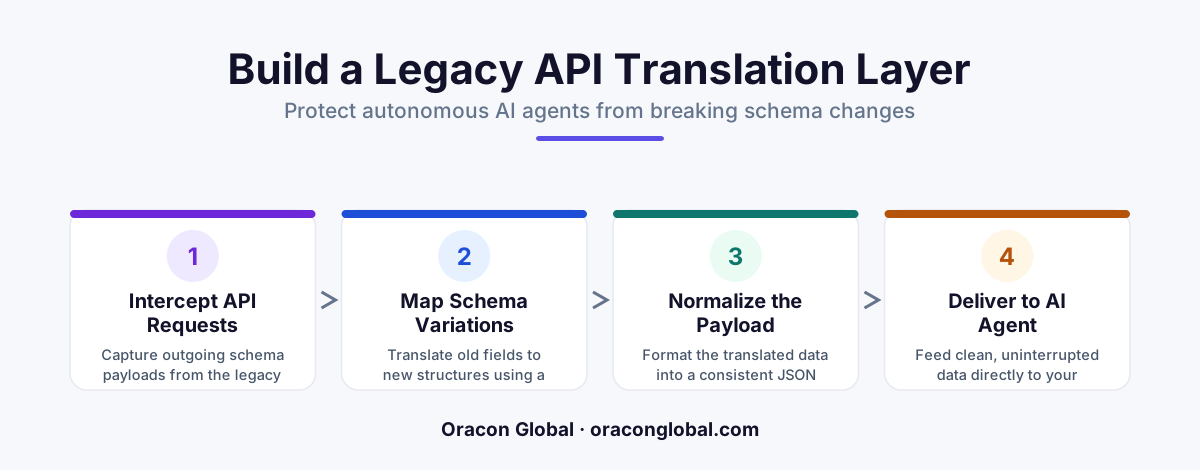
Legacy mainframe updates often change field formats and structures without warning, instantly breaking the strict API tool schemas that AI agents rely on to function. By building an intermediary, real-time API payload translator with dynamic schema mapping, enterprise teams can programmatically catch, validate, and convert mismatched payloads before they disrupt agent workflows.
Modern enterprise operations increasingly rely on autonomous AI agents to handle high-volume workflows, from parsing complex invoices to updating inventory. However, behind these modern frontends often lies the bedrock of enterprise computing: legacy mainframe systems. These mainframes run core databases that have been quietly operating for decades, governed by strict, unforgiving schemas.
When IT teams perform routine maintenance or update a legacy database schema, they rarely think about how it will impact an upstream AI agent. But for an agent, even a minor change—like shortening a ZIP code field or renaming a customer ID column—is catastrophic. While a human operator can intuitively adapt to a slightly altered database output, an AI agent relying on strict tool parameters will instantly fail. To solve this, technical teams must build a robust API payload translator that acts as a shock absorber between modern AI reasoning and legacy core infrastructure.
The Schema Mismatch: Why Mainframe Updates Paralalyze AI Agents
To understand why these failures occur, we must look at how AI agents interact with external software. Unlike traditional, hardcoded software integrations, an AI agent uses large language models (LLMs) to dynamically decide which API tools to call based on the user's intent. To do this safely, developers must provide the LLM with highly specific JSON schemas outlining exactly what inputs a database tool requires.
When an agent attempts a system integration task, it maps its internal reasoning to these predefined schemas. If a legacy mainframe update suddenly alters the database response structure, the agent encounters several immediate issues:
- Parameter Hallucination: Finding unexpected fields, the agent may attempt to guess missing values or pass empty arguments that violate mainframe constraints.
- Validation Failures: The API gateway rejecting the payload because the structure does not match the newly updated mainframe schema, halting the entire workflow mid-execution.
- Silent Data Corruption: If the agent successfully writes data but maps it to the wrong modified columns, it can corrupt vital enterprise records without triggering an explicit system error.
Rewriting the mainframe code is rarely an option due to the extreme risk and cost involved. The solution is to build a dedicated, middle-tier API translation layer that insulates both systems from each other.
Step 1: Establishing a Dynamic Schema Registry
The first step in building an effective translator is decoupling the schemas used by your AI agents from the raw endpoints exposed by your mainframe. Instead of pointing your AI tools directly at legacy APIs, you route all traffic through a centralized schema registry.
This registry maintains two distinct versions of every data contract:
- The Agent-Facing Schema: A highly stable, simplified JSON schema designed for clean, predictable LLM tool calling.
- The Mainframe-Facing Schema: The exact, often complex layout required by the legacy system, including strict byte-lengths, padded strings, or XML structures.
By keeping these schemas separate, your legacy database team can update mainframe tables, alter column names, or change data types without forcing you to re-train, re-prompt, or redeploy your AI agents. The translator handles the differences behind the scenes.
Step 2: Building the Real-Time Translation Pipeline
With the registry in place, you must build the processing pipeline that handles payload transformations in real time. This middleware layer sits directly between your AI agent's tool execution framework and the legacy API gateway. When the AI agent triggers an action, the translation layer executes three distinct phases:
1. Payload Interception and Validation
When the agent sends a request, the translator intercepts the payload and validates it against the stable, agent-facing schema. This ensures that the agent has generated logically sound, well-structured parameters before any attempt is made to contact the mainframe.
2. Declarative Mapping and Parsing
Using the rules defined in your registry, the translator parses the clean JSON input from the agent and reconstructs it into the exact layout the mainframe expects. For example, if the AI agent passes a simple string for a billing address, the translator can programmatically split, format, and pad that string to fit into the legacy system's rigid, fixed-width character fields.
3. Real-Time Response Normalization
When the mainframe responds, the translation layer performs the reverse operation. It intercepts the raw mainframe payload—which might contain cryptic column headers and legacy codes—and translates it back into friendly, context-rich JSON that the AI agent can easily read and reason about.
Step 3: Implementing Self-Healing Fallbacks for Unexpected Changes
Even with an API payload translator, there will be times when mainframe updates occur without the registry being updated in advance. To prevent these unexpected changes from breaking your production workflows, your translation layer must feature self-healing logic.
When the translator detects an unrecognized field or a validation error from the legacy mainframe, it should not simply throw a hard error and crash the agent. Instead, the translator routes the payload through a validation fallback loop:
"If the payload structure deviates from the active schema registry by less than a predefined threshold, the translator can employ a lightweight, deterministic translation routine to normalize the fields safely, logging the variance for developer review while keeping the live system online."
If the schema deviation is too severe to resolve automatically, the translator gracefully pauses the agent's specific tool execution, reverts the database transaction, and alerts your engineering team. This prevents the agent from entering an infinite retry loop or polluting your database with misaligned writes.
Keeping Your Enterprise AI Workflows Resilient
Building high-performance AI agents is only half the battle; the real challenge lies in ensuring those agents can survive in complex, ever-shifting enterprise environments. Relying on direct, unbuffered connections between dynamic AI models and rigid legacy systems is a recipe for frequent, costly downtime.
By implementing a dedicated API translation layer, you protect your digital employees from the realities of legacy infrastructure maintenance. Your IT teams remain free to update and modernize core mainframes on their own schedules, confident that your AI agents will continue to execute seamlessly without missing a beat.
At Oracon Global, our senior in-house engineering team specializes in building robust, production-ready AI agents and custom middleware designed to connect modern intelligent systems with complex legacy architectures. If you want to build resilient AI integrations that stand the test of time, contact Oracon Global today to discuss your architecture needs.
Frequently asked questions
Why do legacy mainframe updates break AI agents so easily?
AI agents rely on highly precise, strict JSON schemas to understand how to read and write to APIs; if a mainframe update changes a database field length, name, or format, the agent can no longer parse the data or construct valid requests.
What does a real-time API payload translator actually do?
It acts as an intelligent intermediary buffer that intercepts data traveling between the mainframe and the AI agent, automatically converting outdated or modified payloads into the exact format each system expects.
Do we need to rewrite our legacy mainframe code to support AI agents?
No, building an external API translation layer allows you to keep your legacy mainframe code completely untouched while safely translating its outputs for your modern AI tooling.
How does this translation layer handle unexpected schema changes?
The translator uses a schema registry and dynamic mapping rules to catch structure anomalies, automatically normalizing the payloads or flagging them for manual review before they cause the AI agent to crash.
Read next
Beyond Chatbots: How to Build AI Agents That Actually Do Work for Your Business
Most businesses use AI to answer questions. Here is how to build custom AI agents that actually take action, connect to your internal tools, and handle complex workflows.
Beyond the Wrapper: How to Build Custom AI Agents for Business That Actually Work
Many businesses invest in basic AI wrappers only to find they lack the security and context needed for real work. Here is how to build custom AI agents that integrate deeply with your workflows and databases.
Enterprise AI Maintenance Costs: Budgeting for Year Two and Beyond
Building an AI system is only half the battle. Discover the practical, ongoing operational costs of enterprise AI, including token management, model drift, and continuous security audits.
Oracon Global builds production-grade AI agents, automation and apps — and you own the code and IP. Tell us what you want to automate.
Book a call →See our work