

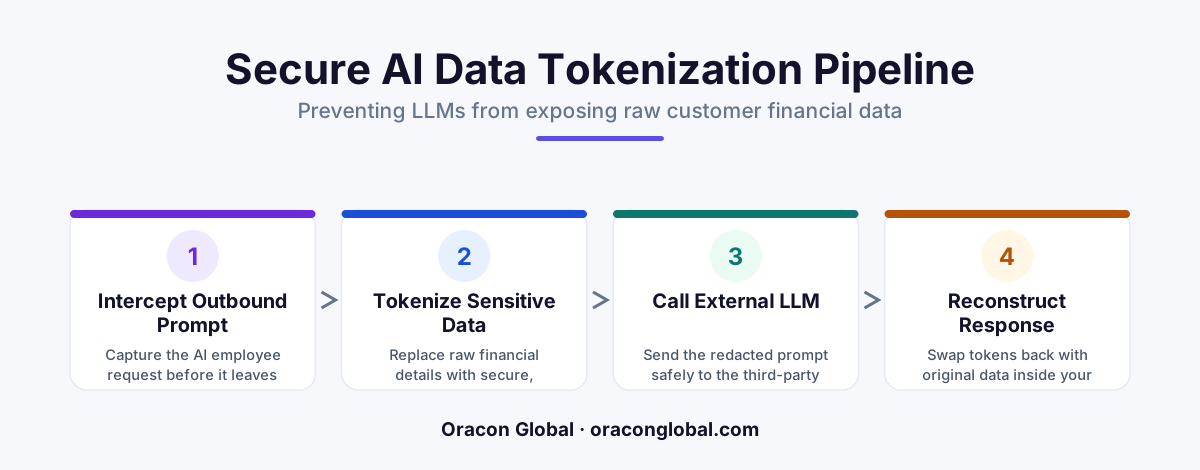
To prevent AI digital employees from leaking raw financial data to third-party LLMs, businesses must implement an intermediary cryptographic tokenization layer. This system intercepts outgoing LLM payloads, replaces sensitive fields with reversible tokens, and restores the original data only when the LLM returns its structured response.
When you deploy AI digital employees to automate financial workflows, they must interact with your core business systems. A digital employee processing a loan application, reconciling an invoice, or resolving a billing dispute needs access to bank account numbers, tax identifiers, transaction histories, and customer names. However, sending this raw data directly to third-party Large Language Model (LLM) providers creates a massive compliance and security bottleneck.
Every piece of data sent to an external API leaves your secure perimeter. For businesses in regulated environments, this exposure is a non-starter. Standard data masking or permanent redaction does not work because it strips away the vital relationships between numbers and names, leaving the AI unable to complete its work. To solve this, you need a way to pass data to the LLM so it can reason over the information without ever seeing the actual sensitive values.
The solution is to build a real-time cryptographic tokenization layer. This security middleware sits between your internal databases and the LLM APIs, ensuring your AI digital employees can execute complex workflows while you completely protect financial data.
The Core Challenge: Why Standard Redaction Fails AI Workflows
Standard data loss prevention tools usually rely on simple regular expressions to find and redact Personally Identifiable Information (PII) or financial data. They replace a bank account number with a generic label like [REDACTED_ACCOUNT]. While this keeps the data safe, it destroys the semantic context of the data.
If an AI agent needs to reconcile three different transactions across two separate accounts, and all accounts are labeled [REDACTED_ACCOUNT], the AI cannot tell them apart. It cannot verify if Account A transferred money to Account B, or if a duplicate transaction occurred on the same account. The AI’s reasoning engine breaks, leading to errors, hallucinations, or outright workflow failures.
A cryptographic tokenization layer solves this by replacing sensitive values with unique, structurally valid, and reversible tokens (for example, replacing a real routing number with TOK_ROUTING_88492). The AI digital employee can track, compare, and reason about these tokens across the conversation. Once the LLM returns its decision, the tokenization layer reverses the process, swapping the tokens back for the real data before updating your internal databases.
The Architecture of an Inline Tokenization Layer
To implement this successfully, the tokenization system must operate as an isolated, high-performance proxy. It should follow a clear three-step cycle:
- Interception and Tokenization: The application state machine triggers a call to the LLM. The tokenization layer intercepts the outgoing payload, identifies sensitive data fields using deterministic schemas, encrypts the raw values, stores them in a secure temporary vault, and replaces them with unique tokens.
- Model Processing: The external LLM receives the tokenized prompt. It processes the instructions, runs its reasoning algorithms, and generates a structured response referencing the tokens.
- Detokenization and Execution: The response from the LLM is intercepted by the tokenization layer on its way back. The layer looks up the tokens in the secure vault, decrypts the original values, replaces the tokens with the real data, and hands the clean payload back to your local application for database writes or API execution.
By keeping the tokenization process completely external to the LLM, you ensure that no raw customer financial data ever touches third-party servers, keeping your operations fully compliant with SOC2, GDPR, and HIPAA standards.
How to Map and Tokenize Financial Data in Real Time
Building this architecture requires a robust strategy for identifying, storing, and mapping data. Let us break down the technical components needed to make a real-time cryptographic tokenization layer functional and secure.
1. Schema-Based Parsing vs. Heuristic Scanning
While scanning unstructured text with machine learning models can find hidden PII, it is too slow and unpredictable for structured financial operations. Instead, define strict, developer-controlled JSON schemas for your database outputs. When your AI digital employee pulls data from an ERP or core banking system, the tokenization layer uses these schemas to know exactly which keys (such as routing_number, ssn, or account_balance) must be tokenized before transmission.
2. Deterministic Token Generation
To preserve relationships between data points, use deterministic tokenization within a single session. If a customer's name appears four times in a complex prompt, it should map to the exact same token (e.g., TOK_USER_9912) every time. This allows the LLM to understand that the same entity is being discussed across different paragraphs without knowing who the actual person is.
3. High-Performance, Ephemeral Key-Value Vaults
The mapping between tokens and raw data must be stored in an ultra-secure, in-memory key-value database (like Redis) configured with strict Time-To-Live (TTL) policies. Since these mappings are only needed for the duration of a single LLM request-response cycle, the vault should automatically delete the keys after a few minutes, drastically reducing your data storage footprint and attack surface.
Maintaining Speed and Minimizing API Latency
One of the biggest concerns when adding a security layer to secure AI agents is latency. LLM calls are already relatively slow; adding an encryption and decryption step can make the user experience feel sluggish if not optimized correctly.
To keep latency under 15 milliseconds per request, you must use lightweight symmetric encryption algorithms, such as AES-256-GCM, handled directly in memory. Avoid external, slow API calls for token generation. Keep the tokenization engine physically co-located in the same cloud region and virtual private network as your primary application backend to eliminate network hop delays.
Future-Proofing Your AI Security Posture
As regulatory bodies increase their scrutiny on how businesses share data with artificial intelligence platforms, owning your security infrastructure is critical. Relying solely on the privacy policies of external LLM vendors exposes your business to third-party policy shifts, legal audits, and sudden platform changes.
By building a custom cryptographic tokenization layer, you retain 100% control over your data flow. If you decide to switch from one LLM provider to another, your security protocols remain untouched. Your data security is governed by your own code, running on your own servers, ensuring continuous compliance and peace of mind.
At Oracon Global, our senior in-house engineering team designs and builds secure, production-grade AI applications, custom ERPs, and advanced integration layers for companies worldwide. We build systems where you own 100% of the code and intellectual property.
Ready to build secure, robust AI agents for your business? Contact Oracon Global today to discuss your project requirements with our engineering team.
Frequently asked questions
What is a cryptographic tokenization layer for AI?
It is an inline security middleware that intercepts data payloads sent from your business systems to third-party LLMs, swapping sensitive customer data with secure, reversible tokens in real time.
Why can we not just use standard PII redaction?
Standard redaction permanently destroys data context, which breaks the LLM's ability to perform logical reasoning on financial numbers or matching entities. Tokenization preserves the relational context while hiding the actual raw values.
Does this security layer add significant latency to AI agents?
When built with highly optimized, in-memory key-value stores like Redis and lightweight symmetric encryption, the tokenization and detokenization process adds fewer than 15 milliseconds of latency.
Do we need to retrain or fine-tune our LLMs to support tokenization?
No. The tokenization layer is entirely external to the model. It works with any off-the-shelf, third-party LLM API by delivering safe, tokenized text structures that the model processes normally.
Read next
Beyond Chatbots: How to Build AI Agents That Actually Do Work for Your Business
Most businesses use AI to answer questions. Here is how to build custom AI agents that actually take action, connect to your internal tools, and handle complex workflows.
Beyond the Wrapper: How to Build Custom AI Agents for Business That Actually Work
Many businesses invest in basic AI wrappers only to find they lack the security and context needed for real work. Here is how to build custom AI agents that integrate deeply with your workflows and databases.
Enterprise AI Maintenance Costs: Budgeting for Year Two and Beyond
Building an AI system is only half the battle. Discover the practical, ongoing operational costs of enterprise AI, including token management, model drift, and continuous security audits.
Oracon Global builds production-grade AI agents, automation and apps — and you own the code and IP. Tell us what you want to automate.
Book a call →See our work