

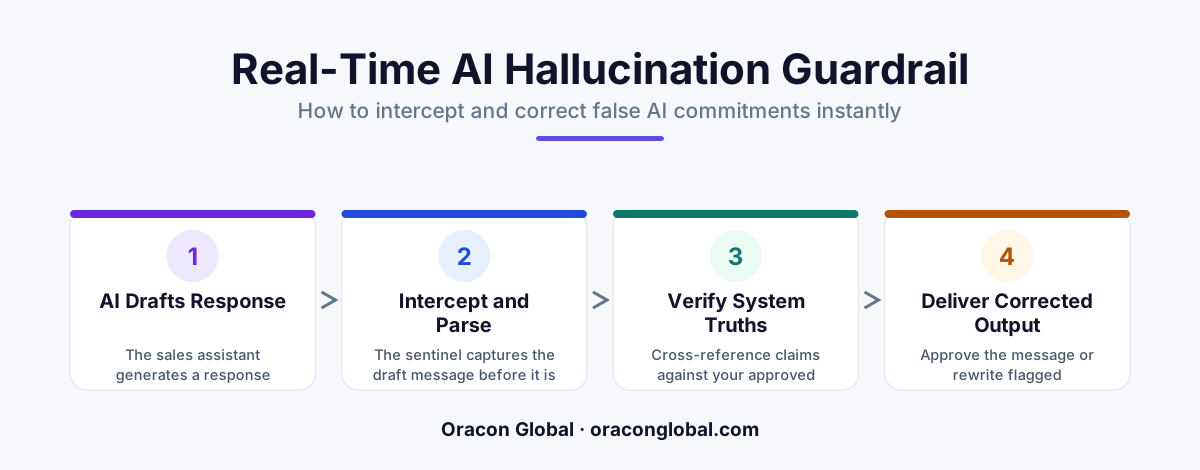
An AI hallucination sentinel acts as an independent validation layer between your sales LLM and the customer. By cross-referencing generated responses against live ERP and pricing databases in real time, it silently blocks and rewrites unauthorized commitments before they are transmitted.
In high-value B2B and enterprise sales, every word matters. When a human sales representative discusses pricing, service-level agreements, or product roadmaps, they operate within strict corporate boundaries. If an autonomous AI agent takes over these conversations, a single unverified promise can lead to severe consequences. A slight slip in language—such as promising a custom feature delivery within weeks or quoting an unauthorized discount—can legally bind your company or destroy hard-won client trust.
To deploy AI in customer-facing, high-stakes environments, relying solely on creative system prompts is a massive business risk. You need a dedicated, deterministic system designed to enforce compliance. Building a real-time hallucination sentinel provides an automated validation layer that acts as a silent editor, checking every outbound response against your actual business data before the customer ever sees it.
The Anatomy of a High-Value AI Sales Hallucination
AI models do not understand truth; they understand probability. In a long, multi-turn sales conversation, an LLM can easily suffer from context drift. The model might combine two distinct pricing tiers, confuse a standard feature with an add-on, or invent a shipping timeline to satisfy a frustrated buyer. This issue is magnified when using prevent AI hallucinations strategies that rely purely on prompt engineering.
Consider a scenario where an enterprise prospect asks: "Can your software integrate with our on-premise inventory system by next Monday?" An unmonitored AI agent might confidently reply: "Yes, our technical team can set up that custom integration for you by Monday at no extra charge."
If that message reaches the client, your team is backed into a corner. Retracting the offer looks unprofessional, while fulfilling it might require dozens of unbilled engineering hours. A real-time validation layer steps in precisely at this moment to intercept, analyze, and rewrite the message.
How the Real-Time Hallucination Sentinel Works
A real-time hallucination sentinel is an isolated microservice that sits directly between your conversational AI engine and your customer communication channels (such as web chat, WhatsApp, or email APIs). It does not generate conversational responses; its sole job is to audit them.
The architecture operates in a simple, three-step pipeline:
- Intercept: The conversational AI drafts a response but does not send it to the client yet. The draft is routed straight to the sentinel.
- Verify: The sentinel parses the draft for commitment markers (such as numbers, dates, prices, names of features, or integration promises) and cross-references them with your CRM, ERP, and product databases.
- Deliver or Redraft: If the response aligns with your business facts, it is approved and sent to the customer. If a discrepancy is found, the sentinel blocks the message, flags the error, and requests a corrected draft from the AI.
Step 1: Identifying Commitment Markers
To keep latency low, the sentinel does not analyze the entire conversation structure from scratch. Instead, it uses a lightweight, highly optimized classification model to scan the draft for specific risk-prone categories. These include price points, timeline commitments, SLA percentages, and specific product feature claims.
Step 2: Deterministic Database Lookups
Once a commitment marker is detected—for example, a quoted price of $1,200 per month—the sentinel bypasses LLM reasoning entirely. It queries your SQL database or ERP API directly using the customer's unique account ID. If the official price book states the minimum price is $1,500, the sentinel instantly registers a validation failure.
Step 3: The Silent Redraft Loop
When a validation failure occurs, the sentinel does not crash or show an error to the user. Instead, it sends an internal system message back to the primary LLM, saying: "Validation failed. You quoted $1,200, but the official price for this customer segment is $1,500. Correct your response without mentioning this system check." The LLM regenerates the response, passes the check on the second attempt, and the customer receives accurate information seamlessly.
Engineering for Sub-Second Latency
The primary challenge when building AI sales guardrails is latency. In live chat environments, users expect a response within one to two seconds. Adding an extra verification step can easily push response times into frustrating delays if the architecture is poorly designed.
To keep the entire validation process under 150 milliseconds, senior development teams implement several critical optimization strategies:
- Parallel Schema Parsing: While the primary LLM is streaming its response, the sentinel can analyze the chunks in real time, preparing its database queries before the sentence is even fully completed.
- In-Memory Caching: Frequently accessed business data, such as standard pricing tiers, active promotions, and feature lists, are cached in an in-memory database like Redis. This eliminates the need for slow database queries during active chats.
- Asynchronous Logging: Any logging, audit trailing, or safety scoring is handled asynchronously. The sentinel verifies the text, releases it to the user, and then logs the transaction details in the background.
Building vs. Buying Your Guardrail Infrastructure
Many off-the-shelf security tools offer generic toxicity filters or prompt injection barriers. However, generic software cannot understand your specific business logic. A pre-packaged tool does not know that your enterprise tier requires a minimum three-year commitment, or that your logistics team cannot ship to a specific region on weekends.
A custom-built LLM validation layer is designed to map directly to your unique business operations. It acts as an automated compliance officer that understands your pricing matrix, inventory limits, and service-level agreements inside out. This custom approach ensures that your customer-facing AI safety protocols are absolute, protecting your bottom line while allowing your sales automation to scale safely.
Let Us Build Your Custom AI Safeguards
Deploying AI in high-value environments requires more than just clever prompts; it demands engineering discipline, secure data pipelines, and robust validation layers. At Oracon Global, our senior in-house development team builds enterprise-grade AI agents, workflow automations, and custom applications tailored to your exact business constraints. Crucially, when you work with us, you retain 100% ownership of your code and intellectual property.
If you are planning to deploy customer-facing AI agents and want to ensure they never make unauthorized commitments, let us discuss how to build a robust validation system for your business. Contact our team at Oracon Global today to discuss your project.
===Frequently asked questions
What is a real-time hallucination sentinel?
It is an independent, low-latency microservice that sits between your customer-facing AI agent and the user interface to validate all outgoing promises, pricing, and commitments against your source of truth.
How does this prevent latency or delays in the chat interface?
By using highly optimized, single-purpose validation models and parallel database lookups, the sentinel inspects outbound text drafts in under 150 milliseconds, maintaining a natural conversation flow.
Why can we not just rely on better system prompts to stop hallucinations?
System prompts are probabilistic. Under complex, multi-turn sales conversations, even the most advanced LLMs can experience context drift and invent terms, making deterministic programmatic validation necessary.
Do we need to retrain our core AI model to implement a sentinel?
No. The sentinel operates as an external, decoupled validation layer, meaning you can keep your existing LLM orchestration intact while adding this protective boundary.
Read next
Beyond Chatbots: How to Build AI Agents That Actually Do Work for Your Business
Most businesses use AI to answer questions. Here is how to build custom AI agents that actually take action, connect to your internal tools, and handle complex workflows.
Beyond the Wrapper: How to Build Custom AI Agents for Business That Actually Work
Many businesses invest in basic AI wrappers only to find they lack the security and context needed for real work. Here is how to build custom AI agents that integrate deeply with your workflows and databases.
Enterprise AI Maintenance Costs: Budgeting for Year Two and Beyond
Building an AI system is only half the battle. Discover the practical, ongoing operational costs of enterprise AI, including token management, model drift, and continuous security audits.
Oracon Global builds production-grade AI agents, automation and apps — and you own the code and IP. Tell us what you want to automate.
Book a call →See our work