

When AI agents execute high-volume parallel queries, they often trigger legacy system crashes by exhausting database connection pools. Building an event-driven API buffer layer decoupling the agent's speed from your backend's capacity solves this issue, ensuring stable enterprise operations without performance degradation.
Deploying your first autonomous AI agent is a milestone for any business. Watching a digital employee read emails, analyze spreadsheets, and update your internal records in seconds feels like magic. But for many operations teams, that magic quickly turns into a headache when the legacy database goes offline.
The problem is simple: human employees work sequentially, clicking through screens one page at a time. AI agents, however, think and act in parallel. When an agent is tasked with auditing thousands of inventory lines or reconciling hundreds of invoices, it doesn't wait its turn. It generates and executes high-volume parallel queries all at once. Without a protective barrier, this sudden surge in traffic can easily trigger legacy system crashes, stalling your entire business operations.
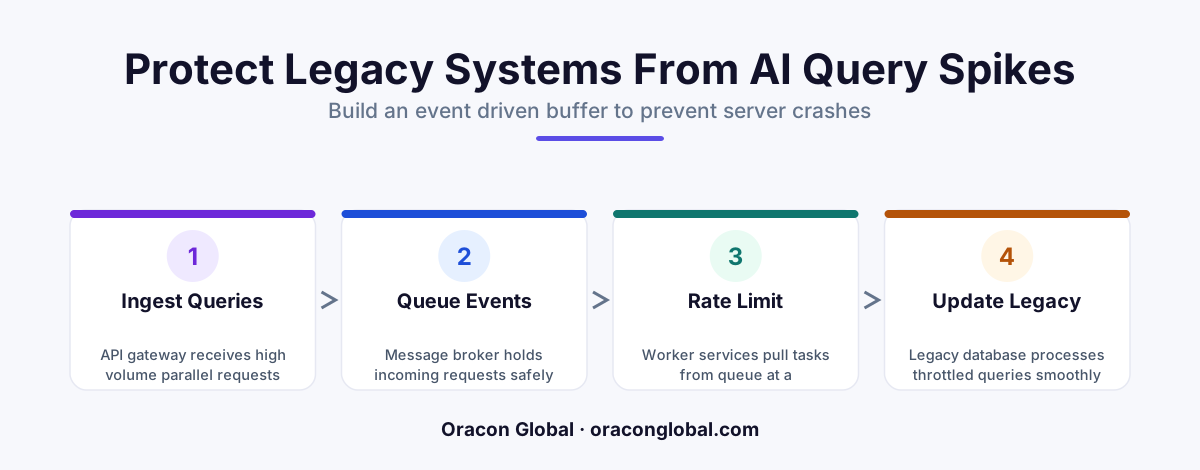
To safely bridge the speed gap between high-speed AI workers and older enterprise databases, you need a dedicated event-driven API buffer layer. This architectural middle layer acts as a shock absorber, protecting your legacy systems while allowing your AI agents to run at full speed.
The Root Cause: Why AI Agents Break Legacy Databases
Traditional business software was designed for human users. Database connection pools, server memory allocations, and API rate limits are typically configured around the expectation that a user will make a few requests per minute.
When you connect an AI agent directly to these legacy APIs, the dynamic changes entirely. To answer a single complex prompt, an agent might:
- Spawn dozens of parallel sub-tasks to gather background context.
- Query multiple database tables simultaneously to cross-reference historical data.
- Attempt to write hundreds of updates back to the system within a few seconds.
This behavior leads to rapid connection pool exhaustion, CPU spikes, and database deadlocks. Traditional rate limiters do not solve the issue either; they simply return error codes (like HTTP 429) that can confuse the LLM or cause the AI agent's workflow to fail entirely. To handle AI agents parallel queries safely, you need a system that accepts the agent's requests immediately but processes them at a speed your legacy backend can actually handle.
What is an Event-Driven API Buffer Layer?
An event-driven API buffer layer is an architectural pattern that decouples your AI agents from your legacy systems. Instead of allowing the agent to query the database directly, all data requests are converted into "events" and sent to a highly scalable message queue.
Think of it like a busy restaurant. If every hungry customer ran into the kitchen to shout their order at the chef, the kitchen would collapse into chaos. Instead, customers give their orders to a waiter, who writes them down on tickets and lines them up on a physical rack. The chef works through the tickets one by one at a sustainable pace, ensuring every dish is prepared correctly without burning down the kitchen.
In this scenario, your AI agent is the customer, the message queue is the ticket rack, and your legacy database is the chef. The buffer layer ensures that no matter how many requests the agent makes simultaneously, the legacy system only processes a controlled, safe volume at any given moment.
Step-by-Step Architecture for a Safe API Buffer Layer
Building a robust buffer layer requires a few key technical components working together seamlessly. Here is how a standard enterprise-grade buffer layer is structured:
1. The Ingestion API (The Waiter)
The AI agent sends all database and API requests to a lightweight, highly available ingestion endpoint. This endpoint does not perform any heavy database lookups. Its only job is to validate the structure of the request, assign it a unique tracking ID, write it to the message queue, and immediately return a "202 Accepted" status back to the agent. Because this step takes milliseconds, the agent never times out.
2. The Message Queue (The Ticket Rack)
The heart of the buffer layer is a message broker (such as Redis, RabbitMQ, or Amazon SQS). This queue holds the incoming requests in order. Because these brokers are built for high throughput, they can easily ingest tens of thousands of messages per second from your AI agents without breaking a sweat.
3. The Throttled Consumer (The Chef)
On the other side of the queue runs a dedicated background worker (the consumer). This worker pulls tasks from the queue and executes them against the legacy database. Crucially, the consumer is hard-coded with rate-limiting rules that match the exact capacity of your legacy system. If your legacy database can only handle 10 queries per second safely, you configure the consumer to never exceed that limit, regardless of how many thousands of tasks are waiting in the queue.
4. The State and Result Store
Once the legacy system processes a query, the consumer writes the results to a temporary database cache. The AI agent can then poll this cache or receive a webhook notification when its data is ready. This asynchronous loop keeps the agent moving forward without ever locking up your primary operational database.
Key Benefits of Decoupling Your AI Infrastructure
Implementing an enterprise AI infrastructure with a built-in buffer layer provides several immediate benefits to your business operations:
- Guaranteed System Stability: Your core business software, ERPs, and legacy databases remain online and highly responsive for your human employees, even when AI agents are running heavy background automation tasks.
- No Lost Requests: If your legacy system does experience a temporary outage or routine maintenance window, the buffer layer holds all AI-generated requests safely in the queue and processes them automatically once the system comes back online.
- Easier Troubleshooting: Because every database interaction is recorded as a discrete event in the queue, your engineering team can easily monitor, audit, and debug the exact queries your AI agents are making.
- Scalability Without Refactoring: You can continue to build and deploy more AI agents across your organization without needing to rewrite or upgrade your legacy backend databases.
Taking the Next Step in Your AI Journey
As businesses transition from simple chat interfaces to fully autonomous workflows, the pressure on underlying IT systems increases dramatically. Protecting your legacy software from the demands of modern AI agentic workloads is not just a performance optimization; it is a necessity for keeping your daily business running smoothly.
At Oracon Global, our senior in-house development team specializes in building robust, production-grade AI agents, custom integrations, and event-driven architectures designed to scale. We build systems where you own 100% of the code and intellectual property from day one.
If you want to deploy powerful AI agents without risking your system's stability, reach out to the team at Oracon Global today to discuss your architecture and see how we can help you build custom solutions that last.
Frequently asked questions
Why do autonomous AI agents cause legacy database crashes?
AI agents do not think like human users; they can generate and execute hundreds of complex, parallel database queries in seconds to complete a single task, quickly exhausting connection pools and CPU cycles on older systems.
What is an event-driven API buffer layer?
It is an architectural middle layer that sits between your fast-moving AI agents and your slower legacy backend, using message queues to throttle, sequence, and manage incoming data requests safely.
Can rate limiting alone prevent legacy systems from crashing under AI workloads?
Traditional rate limiting usually returns immediate error codes (like HTTP 429) back to the caller, which can break an AI agent's execution loop; a buffer layer queues and processes requests instead of flatly rejecting them.
Do we need to rewrite our entire legacy database to support enterprise AI tools?
No, building a dedicated event-driven buffer layer allows you to keep your existing legacy software completely intact while safely opening it up to modern AI agent automation.
Read next
Beyond Chatbots: How to Build AI Agents That Actually Do Work for Your Business
Most businesses use AI to answer questions. Here is how to build custom AI agents that actually take action, connect to your internal tools, and handle complex workflows.
Beyond the Wrapper: How to Build Custom AI Agents for Business That Actually Work
Many businesses invest in basic AI wrappers only to find they lack the security and context needed for real work. Here is how to build custom AI agents that integrate deeply with your workflows and databases.
Enterprise AI Maintenance Costs: Budgeting for Year Two and Beyond
Building an AI system is only half the battle. Discover the practical, ongoing operational costs of enterprise AI, including token management, model drift, and continuous security audits.
Oracon Global builds production-grade AI agents, automation and apps — and you own the code and IP. Tell us what you want to automate.
Book a call →See our work