

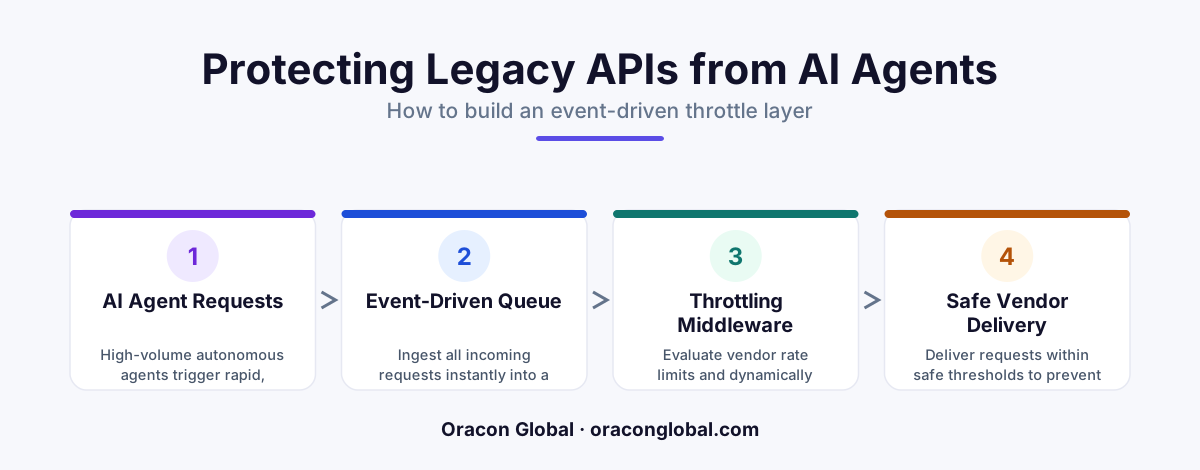
When autonomous AI agents run loops at machine speed, they inevitably crash legacy APIs and trigger vendor security blocks. Building a custom event-driven API throttle layer acts as an intelligent, asynchronous buffer that queues, prioritizes, and spaces out requests to keep your operations compliant and active.
Autonomous AI agents operate at machine speed. Unlike human employees who click through interfaces, fill out forms, and wait for pages to load, an AI digital employee can run hundreds of parallel reasoning loops and execute thousands of API calls in seconds. While this speed is a massive advantage for operational efficiency, it introduces a severe technical bottleneck: it instantly overwhelms legacy software systems and third-party vendor APIs.
Most legacy databases, ERP platforms, and niche industry APIs were never built to handle agentic traffic. When an AI agent attempts to sync inventories, process bulk invoices, or verify data across external portals, it frequently triggers HTTP 429 Too Many Requests errors, service outages, or worse, permanent IP and account bans from vendors who mistake the automated activity for a denial-of-service attack. To deploy reliable AI solutions, businesses must implement a dedicated API throttle layer to act as an intelligent buffer between high-velocity AI workflows and sensitive legacy systems.
The Hidden Friction Between Machine-Speed AI and Legacy Infrastructure
Traditional API rate limiting is punitive. When a user or system exceeds a set number of requests per minute, the server simply blocks the traffic and throws an error. While this protects the host server, it breaks the autonomous execution of your AI agent. When an agent receives a rate limit error, its cognitive loop often breaks, leading to halted tasks, incomplete data syncs, or endless retry loops that only worsen the congestion.
To integrate AI agents safely with legacy endpoints, developers must transition from rigid rate limiting to intelligent, event-driven throttling. Instead of dropping excess requests, an API rate limit middleware should gracefully queue, prioritize, and trickle outbound requests at exactly the maximum speed the target vendor allows.
Core Architecture of an Event-Driven API Throttle Layer
Building a resilient throttle layer requires moving away from synchronous API calls. When your AI agent needs to write data to an older CRM or retrieve records from a legacy supplier portal, it should not call those APIs directly. Instead, it should publish an execution event to an asynchronous middleware layer designed to manage downstream flow control.
A production-ready throttle layer relies on four essential components working in tandem:
- The Event Ingestion Queue: A high-throughput message broker (such as Redis or RabbitMQ) that immediately accepts outbound API tasks from the AI agent, freeing up the agent to continue its reasoning tasks without waiting for slow, synchronous external responses.
- The Dynamic Token Bucket Controller: An algorithm that tracks the precise API consumption rules for each specific vendor endpoint, holding and releasing "tokens" in real time to match target rate limits.
- The Priority Router: A classification system that distinguishes between time-sensitive tasks (like real-time customer lookups) and background tasks (like nightly inventory reconciliation) to ensure critical operations are executed first.
- The Smart Re-Queueing Engine: A mechanism that catches unexpected downstream errors and implements exponential backoff strategies to safely retry failed requests without triggering vendor security alarms.
Step-by-Step: How the Throttling Workflow Operates
To understand how this architecture prevents system bans while maintaining high agent performance, let us trace a single high-volume batch operation through the system:
1. Asynchronous Task Decoupling
Instead of executing a direct POST request to a legacy vendor, the AI agent dispatches a structured event payload to the internal ingestion queue. The payload contains the target endpoint, request parameters, a priority score, and a correlation ID. The agent instantly receives a 202 Accepted confirmation, allowing it to remain highly responsive and continue executing other parallel workflows.
2. Token Bucket Evaluation
The controller continuously monitors the rate limits for every legacy destination. If a target vendor allows a maximum of 10 requests per second, the token bucket for that vendor refills at a matching pace. When a message reaches the front of the ingestion queue, the throttle layer checks if a token is available. If yes, the request is dispatched immediately. If not, the request remains securely in the queue, paused until the bucket replenishes.
3. Handling Dynamic Rate-Limit Headers
Many modern and semi-legacy APIs return response headers indicating how many requests remain in the current window (e.g., X-RateLimit-Remaining and X-RateLimit-Reset). A robust API throttle layer reads these incoming headers from every successful response and dynamically adjusts its token generation speed on the fly, optimizing throughput without risking a hard block.
4. Backoff and Jitter Management
If a legacy vendor experiences temporary internal lag and returns a rate limit error despite the throttling layer's best efforts, the re-queueing engine takes over. Rather than retrying immediately, it calculates a delay using exponential backoff with randomized "jitter." This prevents a synchronized "thundering herd" of retries from hitting the legacy server all at once when it recovers.
Key Business Benefits of Dedicated Throttle Middleware
Investing in a custom, centralized throttling layer yields immediate operational benefits that extend far beyond simply keeping your AI agents online:
- Preservation of Vendor Partnerships: Repeatedly crashing a supplier's database or triggering security alerts can damage valuable business relationships. A throttle layer guarantees you remain a well-behaved consumer of external data.
- Zero Data Loss: When legacy systems go down for maintenance, or when rate limits are breached, standard systems drop messages. An event-driven queue preserves every single transaction, holding them safely until the target system is ready to receive them.
- Simplified Agent Development: Your software engineering team does not need to write complex rate-limiting and retry logic inside every individual AI agent. The agents can be built simply to output actions, leaving the infrastructure layer to handle safe delivery.
- Consolidated API Audit Logs: Centralizing outbound traffic provides a single point of visibility to monitor vendor performance, API latency, and overall agentic data consumption costs.
Building vs. Buying Your AI Integration Infrastructure
While generic API gateways offer basic rate-limiting policies, they lack the stateful awareness required for autonomous agent workflows. Standard gateways are designed to say "no" to excess traffic; a dedicated throttle layer is designed to say "wait, then execute." For enterprises deploying custom AI agents and digital employees across multiple business units, a custom-built, event-driven middleware is the safest path to reliable scalability.
At Oracon Global, our senior in-house development team builds robust, custom AI architectures that bridge the gap between high-performance AI models and sensitive legacy business software. We design and deliver custom middleware, stateful workflow automation, and agentic platforms where you retain 100% ownership of the code and intellectual property.
Ready to deploy high-volume AI workflows without risking system crashes or vendor blocks? Contact the team at Oracon Global today to discuss your integration architecture and see how we build software that lasts.
Frequently asked questions
Why can't standard API gateways handle rate limiting for autonomous AI agents?
Standard gateways usually drop or reject traffic when limits are exceeded. An agent-aware throttle layer needs to pause, queue, and dynamically re-schedule those tasks without failing the agent's overall execution loop.
What is the difference between a rate limiter and an API throttle layer?
A rate limiter rejects excess requests with errors like HTTP 429. An event-driven throttle layer actively buffers, queues, and trickles those requests out over time, ensuring zero data loss and zero vendor-side blockages.
Does building a throttle layer slow down the performance of my AI agents?
It introduces controlled micro-delays for external integrations, but it prevents catastrophic failures, manual retries, and account suspensions, making your overall system far more reliable and stable in production.
What technologies are typically used to build an event-driven throttle layer?
We build these systems using high-performance in-memory stores like Redis for token bucket tracking, combined with robust message queues like RabbitMQ or AWS SQS to buffer execution payloads.
Read next
Beyond Chatbots: How to Build AI Agents That Actually Do Work for Your Business
Most businesses use AI to answer questions. Here is how to build custom AI agents that actually take action, connect to your internal tools, and handle complex workflows.
Beyond the Wrapper: How to Build Custom AI Agents for Business That Actually Work
Many businesses invest in basic AI wrappers only to find they lack the security and context needed for real work. Here is how to build custom AI agents that integrate deeply with your workflows and databases.
Enterprise AI Maintenance Costs: Budgeting for Year Two and Beyond
Building an AI system is only half the battle. Discover the practical, ongoing operational costs of enterprise AI, including token management, model drift, and continuous security audits.
Oracon Global builds production-grade AI agents, automation and apps — and you own the code and IP. Tell us what you want to automate.
Book a call →See our work