

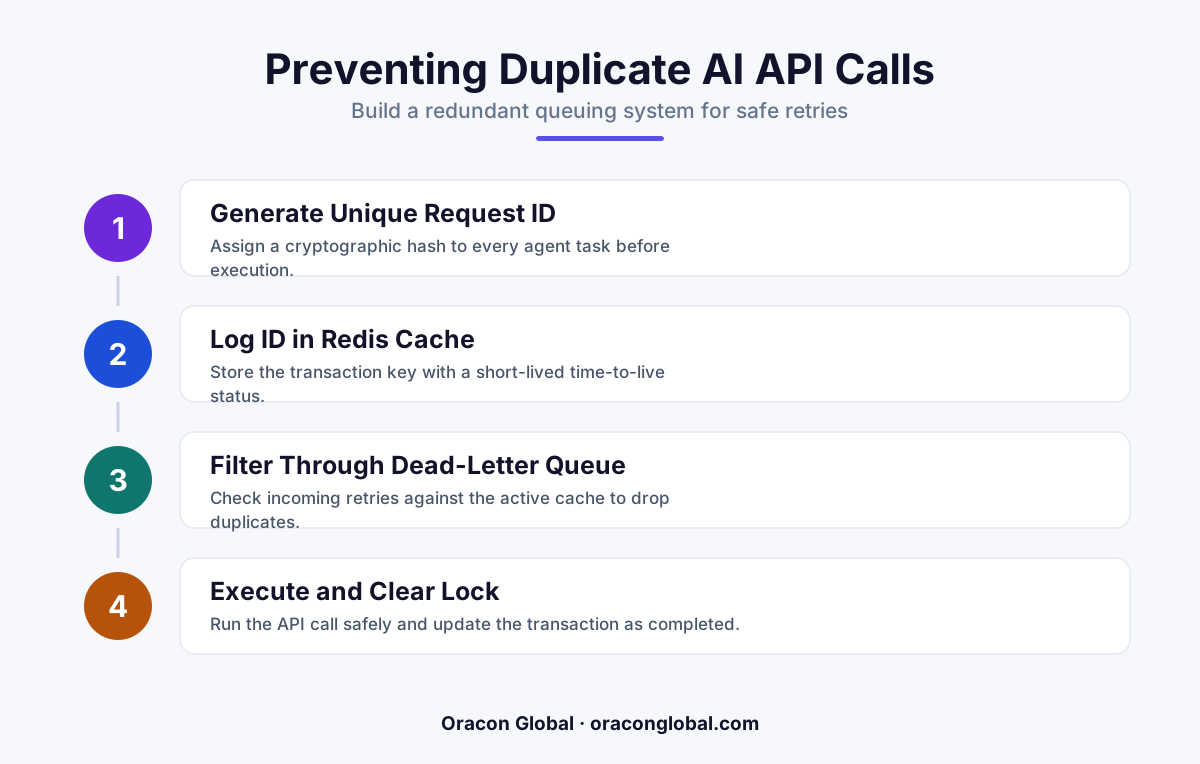
To prevent AI agents from executing duplicate API calls during network retries, you need more than simple timeouts; you must implement an event-driven redundant queuing system with a distributed lock and an idempotency key layer. By pairing a fast-access cache with a reliable message broker, you can guarantee that every agent action executes exactly once, even during high-volume traffic spikes.
When an AI agent runs a multi-step workflow, it behaves very differently from traditional software. Instead of following a rigid, linear script, an autonomous agent continuously evaluates its progress, reads API responses, and decides its next move. This flexibility is what makes AI agents incredibly powerful for complex business operations.
However, this autonomy introduces a severe technical risk when things slow down. During high-volume traffic spikes, destination servers often experience temporary network delays or brief timeouts. A traditional system might safely wait or surface an error. An AI agent, programmed to achieve its goal at all costs, will often interpret a delayed response as a failure and immediately trigger a retry. Without a dedicated redundant queuing system in place, this behavior results in dangerous duplicate API calls, leading to double-booked inventory, duplicate credit card charges, or corrupted ERP records.
To build reliable, production-ready AI applications, you must design a system that guarantees exactly-once execution. Here is a practical guide on how to build an event-driven redundant queuing system that keeps your autonomous agents safe, predictable, and highly efficient.
The Anatomy of an AI Agent API Duplicate Error
To understand why standard software guardrails fail here, we must look at how an AI agent processes actions. Suppose you have an automated procurement agent designed to order office supplies when stock runs low. The agent identifies the shortage, compiles an order, and sends a POST request to a vendor's API.
Under normal circumstances, the vendor's server processes the order and returns a success code in 200 milliseconds. But during a high-volume period, the vendor's server takes 8 seconds to process the order. The network connection times out before the success confirmation travels back to your agent.
Because the agent's context window does not show a confirmed success, its internal decision loop concludes that the request failed. It immediately retries the action. Because the vendor's server already executed the first order, this retry creates a second, duplicate order. Traditional retry libraries cannot prevent this because they lack insight into the state of the external system. To solve this, we must decouple the agent's intent from the actual execution using an event-driven middleware layer.
Step 1: Implementing the Idempotency Key Gateway
The foundation of a reliable redundant queuing system is absolute idempotency. An operation is idempotent if it can be performed multiple times without changing the result beyond the initial application. To enforce this, we introduce an idempotency key layer at the very entrance of our API gateway.
Before your AI agent initiates any external API call, it must generate a deterministic, unique UUID (Universally Unique Identifier) for that specific task. This key should be derived from the core parameters of the task itself, such as:
- The unique ID of the AI agent runner
- The specific workflow step identifier
- A hash of the request payload (e.g., item SKU, quantity, and destination)
When the agent attempts to execute the API call, it sends the request to your internal queuing gateway first, passing the idempotency key in the header. The gateway acts as a strict gatekeeper, ensuring that no duplicate payloads pass through to external servers.
Step 2: Designing the Dual-Layer Redundant Queue
A single message queue is not enough to handle high-volume AI retries safely. If your broker experiences a slight delay in processing, a rapid-fire retry from an agent could still slip through before the first message is fully registered. We solve this by building a redundant dual-layer architecture consisting of a high-speed distributed lock and a durable message broker.
The Fast-Access Distributed Lock (Redis Layer)
When a request arrives at the gateway, the system immediately attempts to write the idempotency key to a high-speed, in-memory cache like Redis. Using an atomic "SET if Not Exists" command, the system checks if the key is already present. If the key does not exist, Redis stores it with a status of PENDING and an expiration window (TTL) of 30 minutes. If the key does exist, the gateway immediately halts the execution and subscribes to the outcome of the original request, preventing the duplicate API call from ever launching.
The Durable Message Queue (RabbitMQ or Amazon SQS Layer)
Once the lock is successfully acquired in the Redis layer, the actual payload is pushed to a durable, transactional message queue. This queue handles the actual delivery of the API call to the external vendor. By separating the rapid-fire lock check from the heavier queue delivery mechanism, you shield your external APIs from the erratic retry loops of autonomous agents.
Step 3: Managing State and Out-of-Order Webhooks
Once the durable queue processes the API call, the external server will eventually return a result. This outcome must be broadcast back to the agent and recorded in your system's state machine to close the loop safely. The workflow operates through a structured event-driven lifecycle:
- State: Processing - While the message queue executes the call, any secondary retry attempts matching the active idempotency key are paused and put into a waiting state.
- State: Success - Upon successful API execution, the Redis status updates from
PENDINGtoRESOLVED, and the response payload is cached alongside the key. If the AI agent retries the call now, the gateway bypasses the external API entirely and simply returns the cached success response. - State: Controlled Failure - If the API call genuinely fails (e.g., a 400 Bad Request), the status is updated to
FAILED. The system releases the lock, allowing the agent to generate a fresh, corrected request if necessary.
This state-based approach ensures that even if your webhooks arrive out of order due to network congestion, your system always has a single source of truth regarding whether an action was completed.
Building for Scale and Peace of Mind
Deploying AI agents at scale requires moving away from simple API integrations and adopting resilient, enterprise-grade architecture. By wrapping your agentic workflows in an event-driven redundant queuing system, you eliminate the risk of runaway API calls, save on operational costs, and build customer trust.
At Oracon Global, our senior in-house team specializes in designing and building custom AI agents, AI-native ERP systems, and highly resilient backend architectures that perform flawlessly under heavy production workloads. We deliver custom software worldwide from our base in India, and our clients retain 100% ownership of their code and intellectual property.
Are you ready to transition your AI workflows from a fragile proof of concept to a highly resilient production system? Contact the team at Oracon Global today to discuss how we can build a secure, custom architecture tailored to your business needs.
Frequently asked questions
Why do standard API retry policies fail with autonomous AI agents?
Standard policies retry requests when they do not receive an immediate response. However, if the destination server processed the request but experienced a network delay in sending the confirmation, the AI agent's retry results in a duplicate execution, leading to errors like double-billing.
What is the purpose of an idempotency key in this architecture?
An idempotency key is a unique identifier generated for a specific operation. The redundant queuing system checks this key against a distributed cache before running any API call, ensuring that if the same key is submitted twice, the system returns the original result instead of executing the action again.
How does a redundant queue differ from a standard message queue?
A redundant queuing system pairs a fast, in-memory status tracker with a durable, message-broker queue. This dual-layer approach allows the system to instantly intercept duplicate requests at the gateway level before they ever enter the processing pipeline.
Do we need to rewrite our entire legacy database to implement this system?
No. This event-driven queuing system sits as an orchestration middleware layer between your AI agents and your external or internal APIs, meaning your core database remains untouched.
Read next
Beyond Chatbots: How to Build AI Agents That Actually Do Work for Your Business
Most businesses use AI to answer questions. Here is how to build custom AI agents that actually take action, connect to your internal tools, and handle complex workflows.
Beyond the Wrapper: How to Build Custom AI Agents for Business That Actually Work
Many businesses invest in basic AI wrappers only to find they lack the security and context needed for real work. Here is how to build custom AI agents that integrate deeply with your workflows and databases.
Enterprise AI Maintenance Costs: Budgeting for Year Two and Beyond
Building an AI system is only half the battle. Discover the practical, ongoing operational costs of enterprise AI, including token management, model drift, and continuous security audits.
Oracon Global builds production-grade AI agents, automation and apps — and you own the code and IP. Tell us what you want to automate.
Book a call →See our work