

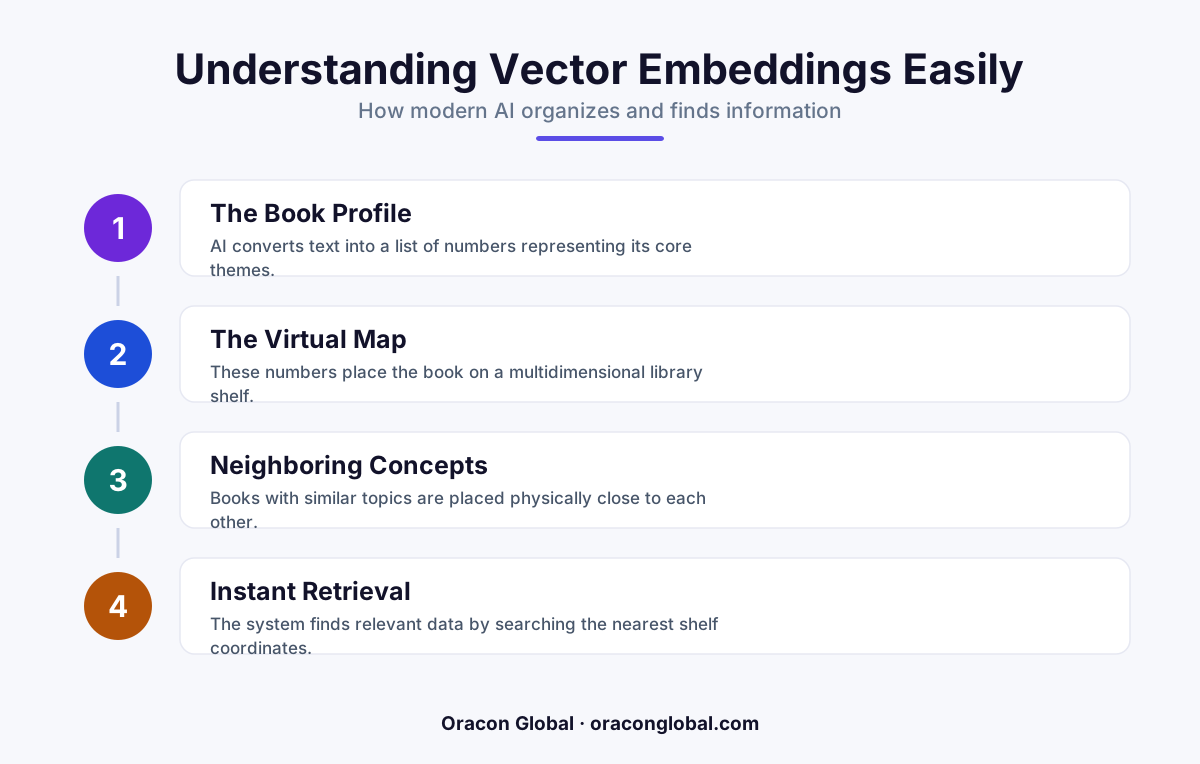
Vector embeddings are a way of turning complex business data into lists of numbers so computers can understand conceptual relationships. By using a virtual library catalog analogy, operations teams can easily visualize how AI groups similar ideas together to improve search and automation.
Introducing new AI tools to your operations team often runs into a common roadblock: the technical jargon. When developers start talking about vector embeddings explained in terms of multi-dimensional math, non-technical operators tend to tune out. Yet, understanding how these systems think is crucial for teams to trust and get the most out of modern company software.
You do not need a degree in data science to understand how AI organizes information. In fact, the easiest way to explain vector embeddings to your operations team is to step out of the server room and walk into a virtual library.
The Problem with Traditional Keyword Search
Before explaining the new way, it helps to look at the limitations of the old way. Traditional database search works like a basic keyword index. If you type the word "raincoat" into an old system, it looks for that exact combination of letters.
If an important operational document uses the phrase "waterproof jacket" instead, the traditional system will completely miss it. The old search index does not understand what the words actually mean; it only knows how they are spelled. This forces your operations team to memorize specific magic keywords just to find the files they need to do their jobs.
The Virtual Library: Introducing Vector Embeddings
To bridge the gap, ask your team to picture a massive virtual library. In a traditional library, books are organized by simple rules, like alphabetical order by author. If you want to find every book that mentions "outdoor survival," you have to walk to ten different sections and check every index.
Now, imagine a magical, infinite library where books are organized by their actual meaning and content. In this library, books with similar concepts are physically parked right next to each other on the shelves.
- The Book: This is your raw business data—an invoice, a customer support ticket, or a standard operating procedure (SOP).
- The Location Tag: Instead of a classic Dewey Decimal number, the virtual librarian assigns each book a unique set of GPS coordinates. This list of numbers is what developers call a vector embedding.
- The Shelves: The physical distance between books represents how closely related they are in real life. A book about "raincoats" sits right next to a book about "waterproof jackets" because their coordinates are almost identical.
By translating words into these coordinate lists, the computer can calculate the exact distance between two concepts. This is the foundation of AI search for operations.
How the Librarian Assigns Coordinates
How does the virtual librarian decide where to place a book? It uses multiple "shelving rules" or dimensions. In a simple three-dimensional space, the librarian might evaluate a document based on three questions:
- How much does this talk about weather? (East-West axis)
- How much does this talk about clothing? (North-South axis)
- Is this a formal policy or an informal chat? (Up-Down axis)
A document about emergency hurricane safety gear would get high scores for weather and clothing, placing it on a high shelf in the northeast corner. A casual chat log about sunny vacation packing would end up in a completely different part of the library. When your team asks the AI a question, the system instantly flies to the coordinate space of that question and grabs the nearest books on the shelf.
A Real-World Operations Use Case
Let us look at a practical example of how this math benefits daily business workflows. Imagine a global logistics company managing thousands of shipping dispute emails.
One customer emails: "My package was left in the wet snow and the box is ruined."
Another emails: "The delivery driver dropped my cargo in a puddle during a storm."
A keyword search for "puddle" would miss the first email. But because an AI system converts both messages into vector embeddings, it recognizes that both complaints share the same core concept of water damage during delivery. The system automatically groups these tickets together, routes them to the same operations specialist, and pulls up the exact company policy for weather-related damage claims.
Why This Matters for Your Studio Build
When we build custom AI agents and search tools at Oracon Global, we design these vector pipelines behind the scenes so your team does not have to worry about the math. Your operators simply type queries in plain natural language, and the system retrieves the correct, contextual answers from your internal databases instantly.
Teaching your team this analogy removes the mystery of AI. They will understand that the system is not guessing or acting on magic; it is simply navigating a highly organized, multi-dimensional library of your company's knowledge to find the closest match.
Are you looking to upgrade your company's internal tools with intelligent, context-aware search and workflow automation? Contact Oracon Global today to discuss how our senior in-house team can build custom AI systems tailored to your operations.
Frequently asked questions
What is a vector embedding in simple terms?
A vector embedding is a list of numbers that represents the meaning and context of a piece of data, allowing computers to compare concepts instead of just matching exact words.
Why do business operations teams need to understand embeddings?
Understanding how embeddings work helps operations teams design better search workflows, organize company data effectively, and trust the AI tools they use daily.
How does the library catalog analogy help explain AI search?
It compares complex mathematical coordinates to simple aisle numbers and shelf locations, showing how books with similar topics are placed close to each other.
What is the difference between keyword search and vector search?
Keyword search looks for exact spelling matches, while vector search finds matching ideas and context even if different words are used to describe them.
Read next
Beyond Chatbots: How to Build AI Agents That Actually Do Work for Your Business
Most businesses use AI to answer questions. Here is how to build custom AI agents that actually take action, connect to your internal tools, and handle complex workflows.
Beyond the Wrapper: How to Build Custom AI Agents for Business That Actually Work
Many businesses invest in basic AI wrappers only to find they lack the security and context needed for real work. Here is how to build custom AI agents that integrate deeply with your workflows and databases.
Enterprise AI Maintenance Costs: Budgeting for Year Two and Beyond
Building an AI system is only half the battle. Discover the practical, ongoing operational costs of enterprise AI, including token management, model drift, and continuous security audits.
Oracon Global builds production-grade AI agents, automation and apps — and you own the code and IP. Tell us what you want to automate.
Book a call →See our work