

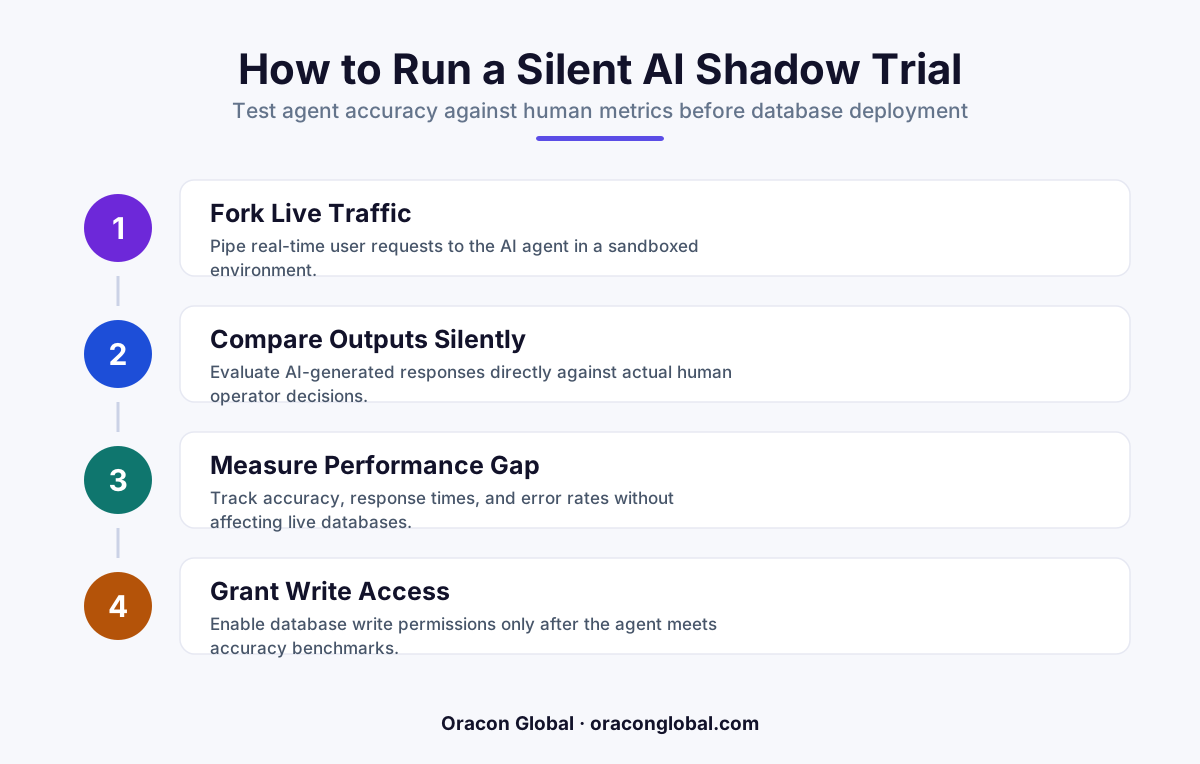
An AI shadow trial pipes real-time production data to a sandboxed AI agent, letting it generate decisions silently alongside your human team. By comparing the agent's simulated database writes against actual human actions, you can prove performance and safety before granting write access to your production systems.
Deploying a custom AI agent to automate business workflows is an exciting milestone. However, the moment of greatest anxiety for any founder or operations leader is granting that agent write access to the production database. One bad loop, an unhandled API error, or a subtle hallucination can corrupt customer records, mess up inventory levels, or trigger accidental financial transactions.
You cannot verify an agent's readiness simply by running basic tests in a quiet staging environment. Real-world business data is messy, unpredictable, and fast. To truly trust an agent, you must run an AI shadow trial. This approach lets you test AI agent performance against your live team's actual output in real time, without risking a single row of production data.
What is a Silent AI Shadow Trial?
A silent shadow trial is a passive testing architecture. Instead of letting the AI agent interact directly with your users or write to your primary databases, you pipe a duplicate stream of live production events to a sandboxed version of the agent.
The agent processes these events, fetches context, and formulates its decisions, API calls, or database writes. However, instead of executing those writes, the agent saves its intended actions to a secure, isolated evaluation log. This allows you to evaluate your agent under true production conditions before granting database write access.
The Step-by-Step Shadow Trial Architecture
Setting up a shadow trial requires a clean separation between your active business operations and your evaluation environment. A typical setup follows a simple, robust pipeline:
- Step 1: Event Duplication. When a human team member performs an action, your application triggers an event. This event payload is duplicated and sent to a secure queue.
- Step 2: Sandboxed Execution. The AI agent picks up the event from the queue. It queries read-only data sources to build its context and decides on an action.
- Step 3: Shadow Logging. Instead of calling a write API, the agent writes its final payload to a dedicated shadow table. This entry contains the exact database state change the agent wanted to make.
- Step 4: Automated Reconciliation. A background script compares the human team's actual write against the agent's proposed write, logging mismatches for review.
Defining Metrics to Test AI Agent Performance
To move an agent from shadow mode to active production, you need objective data. You should evaluate the agent across three core pillars during the trial:
1. Semantic Accuracy
Did the agent make the same business decision as your experienced team? For instance, if an incoming customer support ticket required a refund, did the agent correctly identify the eligibility criteria, or did it propose an unauthorized payout?
2. Formatting and Payload Schema Safety
Even if the decision is correct, a malformed JSON payload can crash downstream systems. The shadow trial logs let your engineering team verify that the agent’s proposed database writes strictly adhere to your system's schemas and validation rules.
3. Latency and Resource Costs
Running autonomous agents at scale incurs API costs and system overhead. A shadow trial gives you an exact look at your average token usage per run and how long the agent takes to formulate a response compared to your team's average turnaround time.
Transitioning Safely to Active Database Write Access
Once your shadow trial proves that the agent consistently matches or outperforms human accuracy metrics, you can begin a phased rollout. This gradual transition minimizes risk:
- Human-in-the-Loop Gate: The agent generates the database write, but presents it to a human team member as a single-click approval in their dashboard.
- Conditional Autonomy: Grant the agent direct write access only for low-risk, high-confidence scenarios, keeping human review for edge cases.
- Full Autonomy with Guardrails: Allow full write access, backed by real-time validation layers that block any anomalous behavior or sudden spikes in database write volume.
Build Safe Agentic Workflows with Oracon Global
Deploying AI to automate business operations does not mean risking your database integrity. At Oracon Global, our senior in-house engineering team designs and builds custom AI agents, workflow automation, and custom software systems with enterprise-grade safety frameworks built in from day one.
We work with founders and operators worldwide to build reliable, high-performance systems where you own 100% of the code and intellectual property. If you are ready to explore how custom AI agents can safely optimize your business operations, contact Oracon Global today for an honest, practical discussion about your project.
Frequently asked questions
What is a silent AI shadow trial?
It is a testing methodology where an AI agent receives real-time business data and generates mock decisions or database updates in a isolated sandbox, without executing them in production.
Why shouldn't I test AI agents in a standard staging environment?
Standard staging environments lack the messy, unpredictable flow of live business operations, meaning you cannot accurately measure how an agent performs against real-time human decision-making.
How do you compare AI agent performance against human teams?
By logging the silent decisions of the AI agent alongside the actual actions taken by your staff for the same work items, and running automated diff audits to check for alignment.
When is an AI agent ready for live database write access?
An agent is ready when its silent trial logs consistently match or exceed human accuracy thresholds and pass all programmatic compliance guardrails over a pre-defined evaluation period.
Read next
Beyond Chatbots: How to Build AI Agents That Actually Do Work for Your Business
Most businesses use AI to answer questions. Here is how to build custom AI agents that actually take action, connect to your internal tools, and handle complex workflows.
Beyond the Wrapper: How to Build Custom AI Agents for Business That Actually Work
Many businesses invest in basic AI wrappers only to find they lack the security and context needed for real work. Here is how to build custom AI agents that integrate deeply with your workflows and databases.
Enterprise AI Maintenance Costs: Budgeting for Year Two and Beyond
Building an AI system is only half the battle. Discover the practical, ongoing operational costs of enterprise AI, including token management, model drift, and continuous security audits.
Oracon Global builds production-grade AI agents, automation and apps — and you own the code and IP. Tell us what you want to automate.
Book a call →See our work