

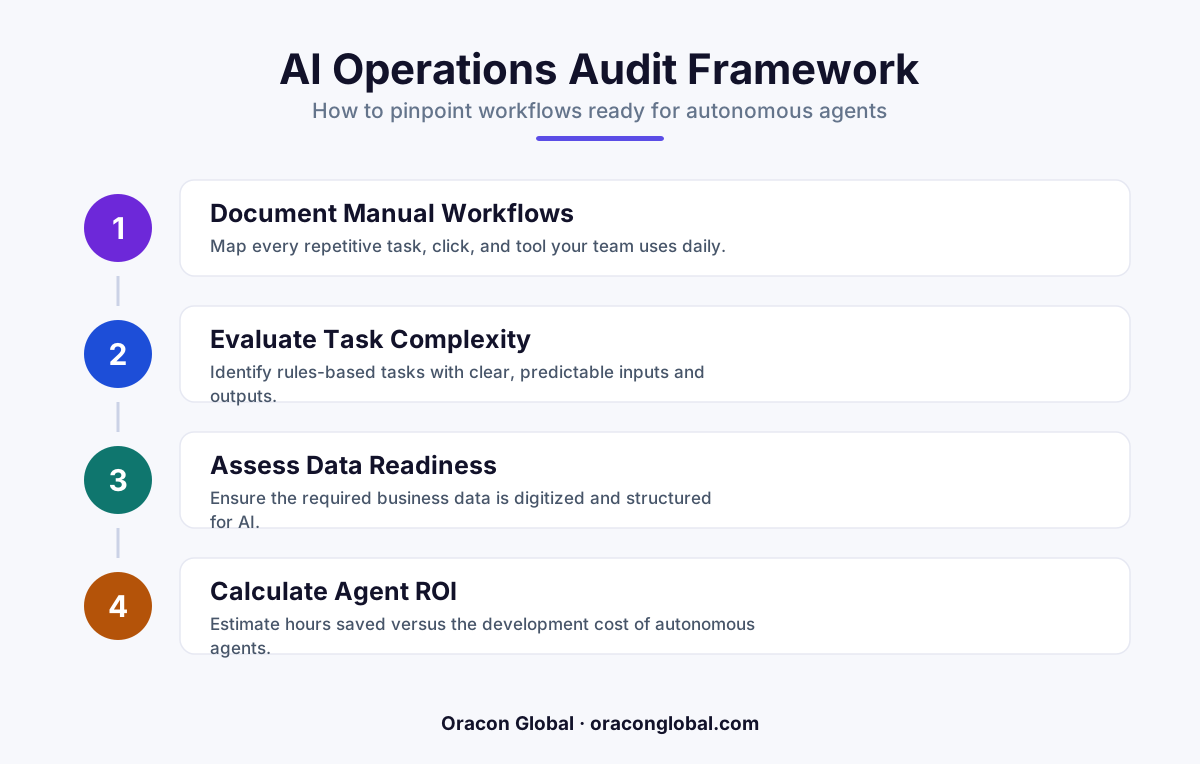
An AI operations audit helps business leaders identify which manual tasks are ready for automation by scoring them on decision complexity, data structure, and system access. By evaluating workflows against these structured criteria, you avoid costly development mistakes and target high-yield processes first.
Many business leaders are eager to deploy autonomous agents to free up their teams from repetitive tasks. However, jumping straight into development without a clear plan often leads to wasted resources, broken integrations, and tools that nobody actually uses. To build software that delivers real value, you must first understand where your team spends their time and which tasks are actually ready for automation.
The solution is a structured AI operations audit. By systematically mapping your business processes, analyzing your data maturity, and scoring tasks based on technical readiness, you can identify exactly which manual team workflows are prime candidates for autonomous agents. Here is a practical, step-by-step framework to audit your operations and build an automation roadmap that works.
Step 1: Inventory Your High-Volume Manual Team Workflows
The first step of an AI operations audit is to document what your team actually does every day. Instead of guessing, look at the tasks that consume the most hours or cause the most operational bottlenecks. Focus on departments that handle high-volume data entry, document processing, scheduling, or customer communications.
Gather your team leaders and build a simple registry of daily tasks. At this stage, do not worry about whether a task can be automated. Simply focus on capturing the reality of your daily operations. For each workflow, document the following details:
- The trigger (what starts the process, such as an incoming email or a new row in a spreadsheet).
- The inputs (PDFs, legacy database records, manual forms, or slack messages).
- The tools used (ERP systems, CRM platforms, legacy web portals, or spreadsheets).
- The estimated hours spent on the task per week across the entire team.
Step 2: Score Workflows for AI Automation Readiness
Not every manual task is a good fit for business process automation. Some tasks require human empathy, deep creative strategy, or physical intervention. To find the best opportunities for autonomous agents, evaluate each documented workflow using three core criteria for AI automation readiness:
1. Data Structure and Consistency
AI agents thrive on information they can easily parse. Ask yourself: Is the input data structured (like a SQL database or a standardized CSV) or semi-structured (like PDFs, invoices, and emails)? If the process relies on unstructured, unpredictable data like hand-written notes or vague phone calls, it will require more complex processing before an agent can handle it safely.
2. Decision Complexity and Rules
Look for workflows governed by clear, logical rules. If a human operator can write down the decision-making process as a series of "if-this-then-that" statements, an AI agent can likely execute it. If the task requires subjective, highly creative, or emotional decisions, it should remain in human hands.
3. System Access and Integration Depth
Consider where the data lives. Does the workflow require logging into five different legacy portals that lack modern APIs? Or does it use modern, cloud-based software with well-documented API endpoints? While custom middleware can bridge the gap to legacy software, tasks that utilize modern APIs are much faster and more cost-effective to automate.
Step 3: Map the Complexity vs. Impact Matrix
Once you have scored your manual team workflows, plot them on a simple matrix: Technical Complexity on the horizontal axis and Business Impact on the vertical axis. This visual mapping helps you prioritize your development queue.
Your goal is to identify "quick wins"—workflows that are low in technical complexity but high in business impact. These are processes that use structured data, follow clear rules, and save your team dozens of hours every week when automated. Examples include automated invoice matching, client intake document routing, or basic scheduling coordination.
"The biggest mistake we see companies make is attempting to automate their most complex, high-risk workflow first. Start with highly predictable, high-volume tasks to prove the architecture, build team trust, and secure an immediate return on investment."
Step 4: Analyze Integration Points and Data Security
Before writing code, your AI operations audit must address security and system integration. Autonomous agents need to read and write data across your business systems. You must define the boundaries of their workspace.
Identify the specific databases, file directories, and third-party tools the agent will need to access. Determine what level of user permissions the agent should have. It is best practice to treat an AI agent like a new digital employee, provisioning it with its own secure, restricted API credentials rather than sharing administrator accounts. This ensures you can audit every action the agent takes within your systems.
Step 5: Define the Human-in-the-Loop Safeguards
An effective workflow analysis always plans for exceptions. No autonomous system should run entirely unsupervised in its early stages. For every workflow you select for automation, you must design a clear path for human escalation.
Determine the threshold at which the AI agent should pause and hand the task to a human team member. For example, if an invoice reconciliation agent encounters a pricing discrepancy greater than 10%, it should flag the item and alert an administrator rather than guessing. Building these guardrails into your database state machines ensures operational safety and helps your team transition comfortably to working alongside AI.
Ready to Audit Your Operations?
A successful transition to AI automation starts with a clear, honest look at your current business processes. By running a structured operations audit, you protect your budget, focus your development team on high-value projects, and ensure your autonomous agents deliver measurable business value from day one.
At Oracon Global, our senior in-house engineering team helps business leaders design and build custom AI agents, workflow automations, and AI-native applications tailored to their unique processes. We build robust, production-ready software, and you retain 100% ownership of your code and intellectual property.
Are you ready to find out which of your manual workflows are ready for automation? Contact Oracon Global today to schedule a consultation with our senior team.
Frequently asked questions
What is an AI operations audit?
It is a structured evaluation of your team's daily manual tasks to determine which processes are technically viable and financially practical for automation using autonomous AI agents.
How long does a typical workflow audit take?
For a mid-sized organization or specific department, a thorough AI operations audit can usually be completed in two to four weeks of focused discovery and mapping.
Do we need to replace our existing software systems to adopt AI agents?
No. Well-designed autonomous agents are built to connect with your existing software stack, legacy databases, and modern APIs without requiring a complete system overhaul.
What makes a workflow a poor candidate for an AI agent?
Workflows that require deep emotional intelligence, physical manipulation, or highly subjective, non-rule-based creative decisions are poor candidates for autonomous agents.
Read next
Beyond Chatbots: How to Build AI Agents That Actually Do Work for Your Business
Most businesses use AI to answer questions. Here is how to build custom AI agents that actually take action, connect to your internal tools, and handle complex workflows.
Beyond the Wrapper: How to Build Custom AI Agents for Business That Actually Work
Many businesses invest in basic AI wrappers only to find they lack the security and context needed for real work. Here is how to build custom AI agents that integrate deeply with your workflows and databases.
Enterprise AI Maintenance Costs: Budgeting for Year Two and Beyond
Building an AI system is only half the battle. Discover the practical, ongoing operational costs of enterprise AI, including token management, model drift, and continuous security audits.
Oracon Global builds production-grade AI agents, automation and apps — and you own the code and IP. Tell us what you want to automate.
Book a call →See our work