

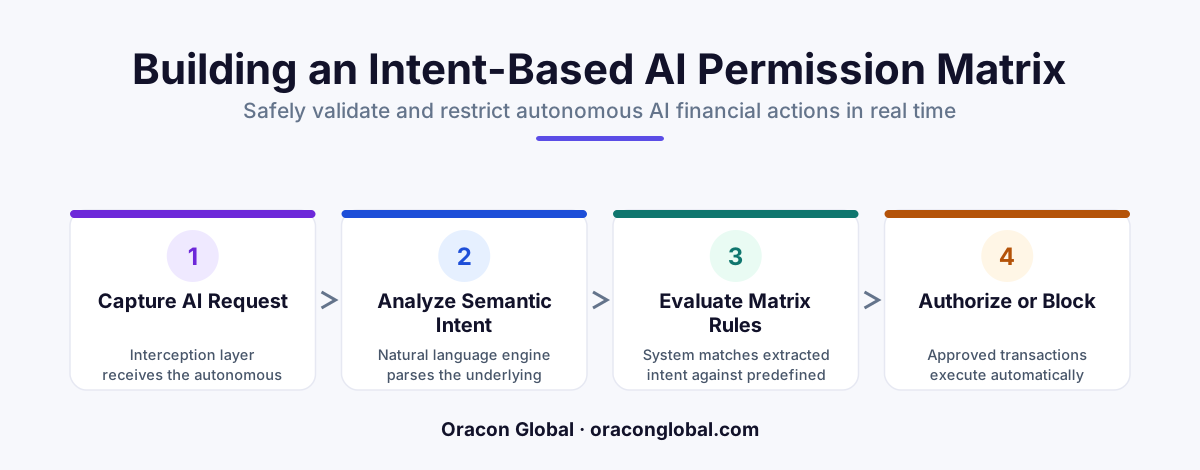
An intent-based permission matrix sits between your AI digital employee and your financial APIs to block unauthorized transactions. Instead of trusting raw LLM function calls, this security layer evaluates parameters, threshold rules, and organizational context deterministically before any money moves. This prevents hallucinated payouts, logic bypasses, and unauthorized invoice approvals.
Deploying AI digital employees across your finance and procurement workflows promises massive efficiency gains. Autonomous agents can reconcile vendor invoices, match purchase orders, and prep accounts payable queues in seconds. However, connecting an agent directly to your bank APIs or enterprise resource planning (ERP) ledger introduces a terrifying risk: unauthorized financial transactions triggered by model hallucinations, bad context parsing, or prompt injection attacks.
Traditional Role-Based Access Control (RBAC) is insufficient for autonomous software. If an AI agent holds the API credential to execute payout webhooks, an RBAC system sees every request from that agent as valid. To prevent costly errors, enterprise engineering teams build an intent-based permission matrix—a deterministic security gate that inspects what the AI is trying to do before any money moves.
The Problem with Native LLM Tool Calling
Most modern AI architectures rely on native tool calling (or function calling). When an agent determines it needs to pay a vendor, it outputs a structured JSON payload containing details like the vendor ID, amount, and ledger account. It then calls an internal software function to dispatch the payment.
The core danger is that Large Language Models (LLMs) are probabilistic engines. They do not "understand" financial limits in a mathematical sense; they simply predict the next most likely token. A minor context misunderstanding can lead to severe operational issues:
- Parameter Drift: The agent mistakes a total invoice balance for a single line item discount, overpaying a supplier by thousands of dollars.
- Context Confusion: The agent reads an expired vendor agreement and issues payments using obsolete bank routing numbers.
- Cascading Tool Errors: A loop error causes the agent to re-trigger a valid payment request multiple times in a single minute.
To establish safe AI financial automation, you cannot rely on system prompts telling the AI to "be careful with money." You must enforce a hard mathematical boundary around every output.
What Is an Intent-Based Permission Matrix?
An intent-based permission matrix is a hardcoded, deterministic middleware layer that sits between your AI digital employee and your backend payment services or database write engines. It evaluates the agent's proposed action against multi-dimensional policy rules before converting the request into an actual database transaction.
Rather than asking "Is this agent allowed to call the PayVendor endpoint?", the permission matrix asks three distinct questions:
- Intent Validation: Does the semantic intent match the supporting documents in the current context thread?
- Parameter Bounds: Do the extracted amounts, vendor IDs, and currency codes fall strictly within pre-approved, deterministic risk thresholds?
- State Consistency: Has this specific invoice or transaction hash already been processed or locked by another state machine?
If any check fails, the transaction is immediately blocked, and the action is routed to a human exception queue.
Key Components of the Architecture
To implement an effective permission layer, your custom application needs to decouple reasoning from execution. The system processes requests through three clear stages.
1. Semantic Intent Decoupling
When the AI agent generates an action, it must submit an "Intent Payload" to the matrix rather than invoking the raw database API directly. This payload contains the raw tool call, the source document ID (such as the PDF invoice ID), and the specific reasoning context generated by the LLM.
2. Deterministic Rule Matching
The permission matrix runs the payload through strict, non-AI code modules. These rules evaluate hard policies such as:
- Maximum Single Transaction Limits: For example, any payout generated by an autonomous agent above $2,500 requires mandatory two-factor human authorization.
- Vendor Match Enforcement: Payout destination accounts must match pre-verified IBAN or ACH routing records stored in a secure, read-only database.
- Velocity Caps: A hard ceiling on total dollar volume or total transaction count an agent can execute within a 60-minute window.
3. Real-Time State Locking and Auditing
If the transaction passes all deterministic rules, the matrix issues a short-lived cryptographic token that allows the payment gateway wrapper to process the transaction. Simultaneously, it writes an immutable log entry documenting the exact prompt context, payload, and rule verification hash.
Building Safety Into Your Engineering Strategy
When teams rely on off-the-shelf wrappers or basic prompt engineering, they usually hit a wall as soon as real business capital is on the line. Moving custom software into production requires strict architectural isolation. Never grant an LLM direct SQL write access or unbuffered payment gateway keys.
By enforcing an intent-based permission matrix, software teams give business executives the confidence to scale autonomous workflows. The AI handles the high-volume heavy lifting of parsing, matching, and preparing transactions, while deterministic code guarantees that unauthorized or erroneous payments never reach your bank account.
Building reliable, enterprise-grade AI software requires senior technical execution that blends modern model architectures with bulletproof backend engineering. If you are ready to deploy autonomous agents without exposing your core operations to financial or technical risk, reach out to the senior team at Oracon Global today.
Frequently asked questions
What is an intent-based permission matrix for AI?
It is an intermediary security layer that evaluates the semantic intent and parameters of an AI agent's action against hardcoded business policies before allowing an API call to execute.
How does this differ from traditional Role-Based Access Control (RBAC)?
Traditional RBAC checks if an API key has permission to call an endpoint. An intent-based matrix inspects the payload contents, transaction value, recipient history, and intent context in real time.
Can prompt engineering replace a permission matrix?
No. System prompts and LLM guardrails are non-deterministic and can be bypassed by edge cases or prompt injection. Financial execution requires hardcoded, deterministic validation code.
Does adding a permission matrix create execution latency?
No. Evaluating a JSON payload against pre-compiled policy matrices in code takes under five milliseconds, adding zero noticeable delay to financial workflows.
Read next
Beyond Chatbots: How to Build AI Agents That Actually Do Work for Your Business
Most businesses use AI to answer questions. Here is how to build custom AI agents that actually take action, connect to your internal tools, and handle complex workflows.
Beyond the Wrapper: How to Build Custom AI Agents for Business That Actually Work
Many businesses invest in basic AI wrappers only to find they lack the security and context needed for real work. Here is how to build custom AI agents that integrate deeply with your workflows and databases.
Enterprise AI Maintenance Costs: Budgeting for Year Two and Beyond
Building an AI system is only half the battle. Discover the practical, ongoing operational costs of enterprise AI, including token management, model drift, and continuous security audits.
Oracon Global builds production-grade AI agents, automation and apps — and you own the code and IP. Tell us what you want to automate.
Book a call →See our work