

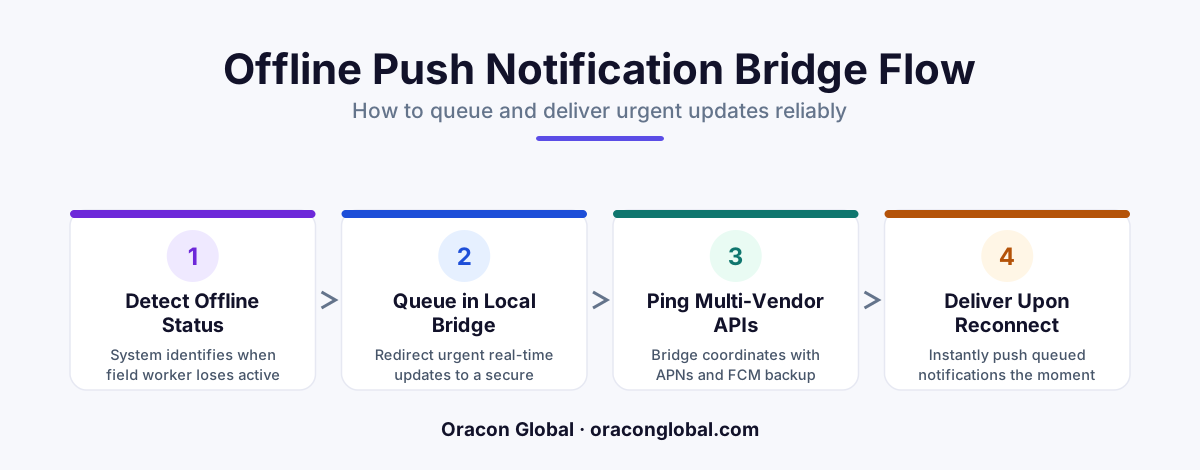
Standard push notification services drop messages when mobile devices go offline for extended periods. By building a custom multi-vendor push notification bridge with an active state queue, you can guarantee that urgent field updates are buffered and delivered immediately upon reconnection.
Field operations rely entirely on real-time information. Whether it is an emergency utility repair, a sudden change in a delivery route, or an urgent safety alert, operators need to know their field teams are looking at the most current data. Yet, the physical reality of field work means operating in dead zones, concrete structures, and remote areas where cellular signals vanish.
When a mobile device goes offline, standard push notification systems like Apple Push Notification service (APNs) and Firebase Cloud Messaging (FCM) begin to fail silently. These platforms are designed for immediate delivery; if a device is unreachable for too long, the message is permanently dropped. To prevent critical updates from disappearing into the ether, businesses must implement a dedicated mobile push notification bridge designed for offline mobile synchronization and guaranteed real-time field updates.
The Hidden Failure Point of Standard Push Notifications
Most product teams assume that because they have FCM or APNs integrated, their notifications are reliable. In reality, these services use a basic store-and-forward mechanism with a very short shelf life. If a field technician is working in a hospital basement or a rural utility site for three hours, any push notifications sent during that window will likely expire and be deleted by Apple or Google's servers.
When the technician finally steps back into coverage, their app has no record of the missed alerts. The local app database remains stale, the UI shows outdated instructions, and the operator is left wondering why the team hasn't responded to the schedule change. A custom custom push gateway solves this by moving the delivery guarantee from third-party networks to your own infrastructure.
Architecting a Resilient Multi-Vendor Push Bridge
A resilient push bridge sits between your core business backend and the external notification networks. It acts as an intelligent traffic controller that understands the connection state of every device in the field. Instead of blindly blasting out messages, the bridge manages delivery status with a dedicated transactional database.
1. The Persistent Notification Queue
When an update is generated, the bridge does not immediately send it to the mobile OS gateway. Instead, it writes the message to a persistent local database queue. Each notification is assigned a unique tracking ID, a priority tier, and a Time-To-Live (TTL) value. This ensures that even if your entire system restarts, the undelivered notifications remain safely stored in your database.
2. Active State Monitoring
To deliver messages efficiently, the bridge needs to know which devices are online. While maintaining a continuous WebSocket connection is one way to monitor state, a more battery-friendly approach for mobile devices involves tracking the app's network state during periodic API sync calls. When the app successfully pings the server, the bridge marks that device as active and immediately flushes any queued notifications waiting for it.
3. Multi-Channel Routing Engine
A true multi-vendor bridge does not rely on a single delivery path. If a high-priority work order needs to reach a technician immediately and the app does not acknowledge a standard push notification within five minutes, the bridge can automatically route the update through an alternative channel, such as a secure SMS API or an automated voice call. This multi-channel approach ensures maximum mobile data reliability under harsh network conditions.
Step-by-Step Delivery and Acknowledgment Flow
To ensure no message is ever dropped or duplicated, the push bridge must implement a strict handshake protocol with the mobile app. Here is how the lifecycle of a high-priority update should look:
- Generation: The dispatcher updates a job in the web ERP, which triggers a notification payload in the push bridge.
- Queuing: The bridge saves the payload to the queue with a status of "Pending" and attempts immediate delivery via FCM/APNs.
- Offline Hold: If the device is unreachable, the bridge keeps the message in the queue instead of discarding it.
- Reconnection Detection: The mobile app regains network access and sends a lightweight heartbeat signal to the bridge.
- Flush and Handshake: The bridge sends all pending notifications for that user in a single, ordered batch.
- Client Acknowledgment: The mobile app receives the batch, updates its local database, and returns an "Ack" receipt to the bridge.
- Archival: The bridge marks the notifications as "Delivered" and archives them for auditing.
Handling Out-of-Order Updates and Conflicts
When a device has been offline for several hours, it may have missed multiple updates to the exact same job file. Simply dumping all queued messages onto the device in chronological order can cause race conditions, UI flashing, and database corruption. The app might process an older update after a newer one, reverting the local database to an incorrect state.
To prevent this, your bridge should implement semantic payload merging. If three updates are queued for the same job ID while a technician is offline, the bridge should evaluate the queue and consolidate them. When the device reconnects, the bridge delivers only the latest, most accurate state representation, drastically reducing cellular data consumption and preventing local database conflicts.
Protecting Battery Life and Cellular Bandwidth
Continuous background polling is a common pitfall that drains device batteries and inflates cellular data bills. A well-designed custom push gateway uses silent push notifications to wake up the app in the background only when there is data to process. This allows the app to pull the required updates, run background database migrations, and update the UI before the user even unlocks their phone, providing a seamless experience without killing the battery.
Own Your Notification Infrastructure
Relying on generic third-party notification services for critical business operations is a risk that often leads to missed appointments, safety hazards, and frustrated field crews. By building a custom push bridge, you regain complete control over how your data travels, how long it is stored, and how it is recovered when your team is working off the grid.
At Oracon Global, our senior in-house development team specializes in building robust offline-first mobile systems, secure API middleware, and custom workflow automations. We build tailored software solutions that keep your business running smoothly under any conditions, and we transfer 100% of the code and intellectual property ownership directly to you.
Want to secure your mobile communications? Contact Oracon Global today to discuss how we can build a highly reliable push notification architecture for your field operations.
Frequently asked questions
Why do standard push notifications fail when field users go offline?
Apple (APNs) and Google (FCM) use a store-and-forward model with strict, short-lived expiration windows. If a device remains offline past this window, the notification is discarded forever.
What is a custom multi-vendor push notification bridge?
It is an intermediary backend layer that tracks device connectivity states, holds notifications in a persistent queue, and dynamically routes them across APNs, FCM, or SMS channels.
How does this architecture prevent duplicate notifications?
The bridge uses a deduplication engine driven by unique message IDs and client-side acknowledgment handshakes to ensure a notification is marked as delivered only when the app confirms receipt.
Can this bridge handle fallback channels like SMS?
Yes, the routing engine can be configured to automatically escalate undelivered high-priority notifications to SMS or email if the mobile app does not acknowledge receipt within a set timeframe.
Read next
Beyond Chatbots: How to Build AI Agents That Actually Do Work for Your Business
Most businesses use AI to answer questions. Here is how to build custom AI agents that actually take action, connect to your internal tools, and handle complex workflows.
Beyond the Wrapper: How to Build Custom AI Agents for Business That Actually Work
Many businesses invest in basic AI wrappers only to find they lack the security and context needed for real work. Here is how to build custom AI agents that integrate deeply with your workflows and databases.
Enterprise AI Maintenance Costs: Budgeting for Year Two and Beyond
Building an AI system is only half the battle. Discover the practical, ongoing operational costs of enterprise AI, including token management, model drift, and continuous security audits.
Oracon Global builds production-grade AI agents, automation and apps — and you own the code and IP. Tell us what you want to automate.
Book a call →See our work