

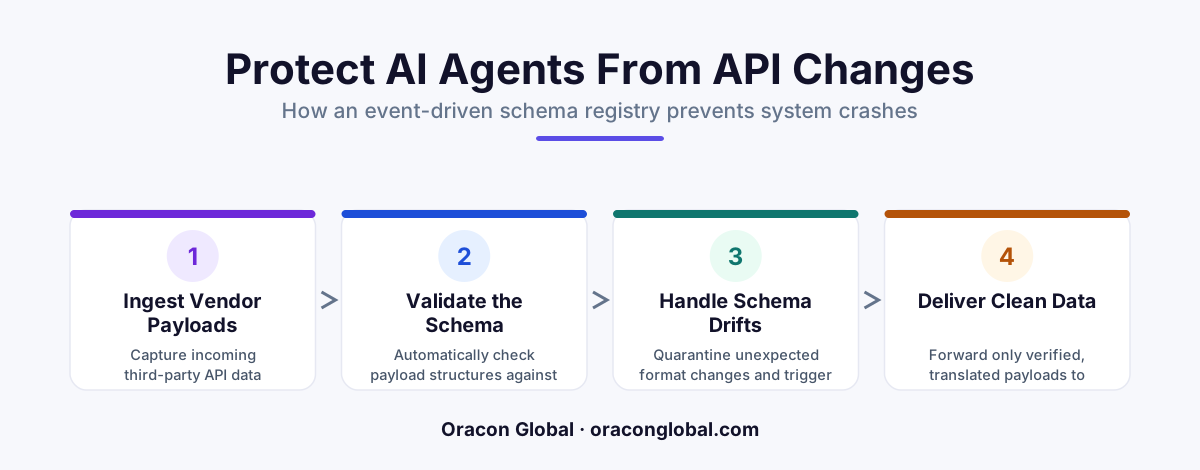
When external vendor APIs change their output structure, AI tools designed for fixed formats often fail silently or throw severe errors. An event-driven schema registry sits between your agents and external webhooks, validating payloads against strict schemas, isolating anomalies, and alerting your team before corrupted data reaches your core system.
If your business operations rely on custom AI agents to process logistics updates, reconcile invoices, or update customer accounts, you are likely integrated with several external vendor APIs. These third-party systems are highly dynamic. Vendors frequently update their software, rename database columns, or alter their webhook response structures without giving your team any advance warning.
For standard web applications, a minor change in an external API payload might result in a temporary UI glitch or a quiet error log. For an autonomous AI agent, however, a shifted data field is a catastrophic failure. Because AI tools depend on strict data contracts to run automated decisions, an unexpected payload change can cause your system to halt entirely, execute incorrect database writes, or waste expensive API tokens on repeating loop cycles. Building an event-driven schema registry is the most practical way to protect your systems from these unpredictable external changes.
Why API Payload Changes Are Fatal to Autonomous AI
Traditional software development uses rigid, hardcoded integration rules. If an API payload changes, the code throws a standard error, a developer is notified, and a patch is applied. The system is paused, but it remains safe from corrupting your database.
AI agents, on the other hand, often operate with a degree of autonomy, pulling context from live data streams to make real-time decisions. When a payload changes unexpectedly, the agent might not throw a standard error. Instead, it may try to interpret the missing or altered data using semantic reasoning. This leads to several common operational failures:
- Hallucinated Parameters: If a vendor renames a critical field, the agent might attempt to guess which other field contains that information, leading to incorrect data entry in your internal ERP.
- Token Waste and Infinite Loops: When an agent receives an unstructured payload it does not recognize, it may repeatedly query the source or retry the processing step, driving up your cloud compute costs.
- Silent Data Deletion: If the agent processes a null value because a field name changed, it might overwrite valid historical data inside your database with empty records.
To prevent these failures, you need an architecture that validates, sanitizes, and translates every single external payload before your AI agents ever see the data.
How an Event-Driven Schema Registry Works
An event-driven schema registry is an architectural gatekeeper. It acts as a central repository for all the data shapes (schemas) your business expects to receive from external vendors. Instead of allowing external APIs to write directly to your AI processing queues, all incoming webhooks and payloads are routed through the registry first.
The registry operates in three distinct phases whenever an external event occurs:
1. Structural Interception
When a vendor system triggers a webhook, the payload is captured by your registry. At this stage, the AI agent is not even aware that an event has occurred. The data is entirely isolated in a temporary, secure buffer.
2. Schema Validation
The registry compares the incoming JSON or XML structure against the active schema version stored for that specific vendor. It checks for the presence of mandatory fields, verifies data types (such as ensuring a price field remains a float and has not changed to a string), and confirms that nested object pathways match expected configurations.
3. Real-Time Routing and Quarantine
If the payload passes validation, the event-driven system instantly routes the data to the AI agent's queue. If the validation fails, the registry intercepts the payload, holds it in a quarantine queue, and triggers an automated alert for your technical team, all while keeping the AI agent safely offline to prevent erratic behavior.
Key Components of a Resilient Schema Registry Architecture
Building a registry that keeps your systems safe does not require overcomplicating your existing software. A clean, production-ready setup focuses on three core functional layers:
An effective schema registry must be fast, deterministic, and isolated. It should never use an LLM to validate the incoming schema structure; instead, use lightweight, hardcoded parsing rules to ensure absolute reliability.
To implement this successfully, your engineering team should build out the following components:
- The Schema Database: A lightweight, highly indexed storage layer containing version-controlled JSON schemas for every external endpoint you integrate with.
- The Validation Engine: A simple, high-speed microservice that runs schema checks (using standard libraries like JSON Schema or Zod) in milliseconds.
- The Dead-Letter Queue (DLQ): A dedicated buffer database where invalid payloads are stored. This allows your team to inspect what changed, update the mapping schema, and replay the event manually without losing historical data.
- The Translation Mapping Layer: A system that maps older API formats to newer formats. If a vendor changes a field, you can write a quick translation rule in the registry, allowing your AI agent to keep using the old data format while your team plans a permanent update.
Practical Benefits for Operations and Growth
Implementing an event-driven registry provides immediate stability to your technical operations, especially if you are scaling your use of digital employees and automated workflows. First, it ensures business continuity. A vendor updating their platform on a Friday night will no longer result in a broken AI system over the weekend; the registry simply flags and holds the new payloads safely.
Second, it drastically reduces your maintenance overhead. Instead of editing the prompt engineering, vector search logic, or underlying code of five different AI agents when a single partner changes their system, your developers only have to update a single schema template in the central registry.
Building vs. Buying Your Integration Guardrails
While basic schema verification can sometimes be handled by generic API gateway tools, those systems are rarely designed to handle the dynamic needs of agentic AI workflows. Custom-built schema registries give you the flexibility to define specific fallback actions, such as routing quarantined payloads to a human operator dashboard or automatically executing a legacy API call when a modern one fails.
At Oracon Global, our senior in-house development team builds robust, custom AI architectures, integrations, and enterprise web systems that keep your workflows stable. We deliver clean, reliable software where you retain 100% ownership of the code and intellectual property.
If you want to secure your AI operations against fragile external integrations and unpredictable vendor updates, reach out to Oracon Global to discuss how we can build a resilient architecture for your business.
Frequently asked questions
Why do minor API payload changes break AI agents so easily?
AI tools rely on strict, predictable data inputs to map variables, run prompts, and execute database writes. If a vendor changes a field name from "billing_zip" to "postal_code" or nests an array deeper into a JSON object, the agent's logic fails because the expected keys are missing.
What does an event-driven schema registry actually do?
It acts as an active validation gatekeeper. Every time an external API sends data, the registry instantly checks the payload structure against saved schema templates. If the incoming data does not match, it quarantines the event, routes it to a queue for adjustment, and keeps the AI from processing broken information.
Does this add noticeable latency to AI agent workflows?
No. Because the registry is event-driven and runs on lightweight, compiled matching logic before the heavy LLM processing begins, the validation step takes only a few milliseconds, ensuring your operational speed remains unaffected.
Can we build this without rewriting our entire software stack?
Yes. A schema registry is designed to sit as a middleware layer. It intercepts incoming webhooks and API responses before they hit your core application database or your AI agent's context window, requiring zero modifications to your legacy infrastructure.
Read next
Beyond Chatbots: How to Build AI Agents That Actually Do Work for Your Business
Most businesses use AI to answer questions. Here is how to build custom AI agents that actually take action, connect to your internal tools, and handle complex workflows.
Beyond the Wrapper: How to Build Custom AI Agents for Business That Actually Work
Many businesses invest in basic AI wrappers only to find they lack the security and context needed for real work. Here is how to build custom AI agents that integrate deeply with your workflows and databases.
Enterprise AI Maintenance Costs: Budgeting for Year Two and Beyond
Building an AI system is only half the battle. Discover the practical, ongoing operational costs of enterprise AI, including token management, model drift, and continuous security audits.
Oracon Global builds production-grade AI agents, automation and apps — and you own the code and IP. Tell us what you want to automate.
Book a call →See our work