

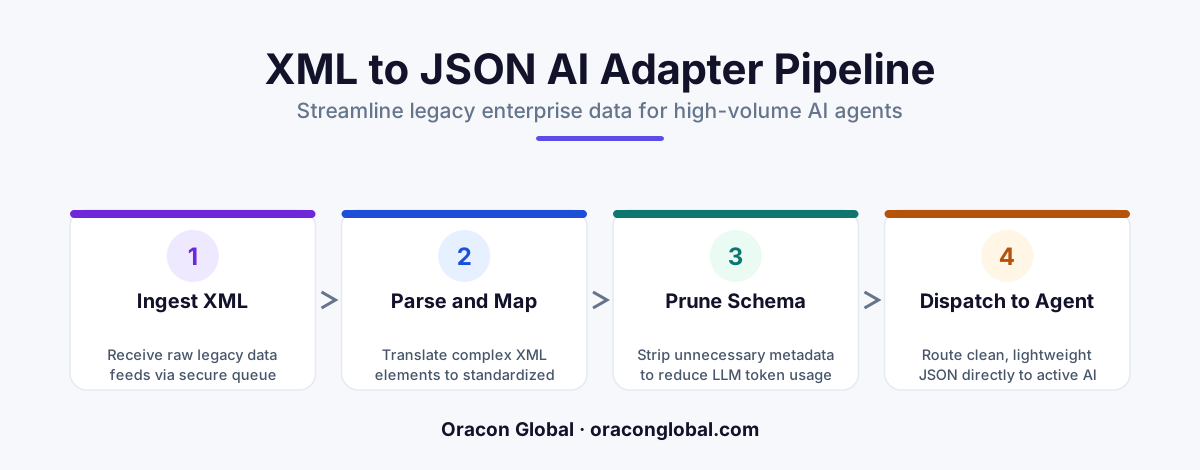
AI agents struggle to parse verbose, deep-nested legacy XML schemas without wasting expensive tokens and triggering validation errors. By implementing an intermediate, memory-cached XML-to-JSON schema adapter layer, businesses can deliver structured, agent-friendly JSON payloads to LLM runtimes at scale.
Many of the most valuable data pipelines in enterprise businesses are trapped inside legacy architectures. For decades, industries like logistics, healthcare, financial services, and manufacturing have relied on complex XML schemas, SOAP APIs, and physical file exports to move mission-critical information between systems. While these pipelines are highly reliable, they present a massive hurdle for modern artificial intelligence.
When you attempt to connect these legacy data streams directly to autonomous AI agents, operations quickly break down. Large Language Models (LLMs) are optimized for JSON. Raw, deeply nested XML packed with verbose namespaces and transport-level metadata drains your LLM token budget, inflates API latency, and leads to frequent structural parsing errors. To run high-volume AI workflows successfully, you need a way to translate legacy data on the fly. Here is how to build a custom schema adapter layer that maps legacy XML to JSON seamlessly.
Why Legacy XML Stalls Modern AI Agents
AI agents rely on structured tool calling to interact with the physical world. For an agent to update a shipping status, check an inventory level, or generate a billing reconciliation report, it needs to receive clean, predictable data payloads. Feeding raw XML files directly into an LLM context window causes three distinct operational bottlenecks:
- Token Inflation: XML tags, attributes, and namespace declarations require significantly more characters than equivalent JSON properties. At scale, this extra text costs thousands of dollars in wasted token fees and unnecessarily crowds the agent's context window.
- Parsing Errors: While advanced LLMs can read XML, they frequently struggle to generate syntactically correct XML responses when calling tools. JSON, supported natively by modern application runtimes and LLM structured output modes, is far more reliable.
- Schema Complexity: Enterprise XML schemas are often deeply nested, containing hundreds of fields that a specific AI agent does not need to see. This excess noise increases the risk of hallucination and decision-making delays.
A custom XML schema adapter acts as an intelligent translation bridge. It intercepts your legacy data pipelines, strips away the unnecessary system noise, flattens complex structures, and exposes a clean, optimized JSON payload to your AI agent data pipelines.
Designing the Schema Adapter Architecture
To support enterprise AI workflows without introducing latency or system instability, the adapter layer must be lightweight, stateless, and incredibly fast. It sits directly between your legacy enterprise service bus (ESB) or file storage and your AI agent orchestration layer.
Rather than relying on heavy, slow XML-to-JSON conversion libraries that blindly translate everything, a custom adapter layer uses a declarative mapping manifest. This manifest defines exactly how specific XML elements map to target JSON properties, allowing you to filter out junk data before it ever reaches your LLM.
Step 1: Stream-Based XML Parsing
Never load massive XML files entirely into system memory. For high-volume pipelines, utilize stream-based SAX or StAX parsers. These parsers read the incoming XML file sequentially, triggering events when specific elements are encountered. This approach ensures your adapter layer can process multi-megabyte files instantly with a microscopic memory footprint, avoiding server crashes during peak operational hours.
Step 2: Declarative Mapping Rules
Instead of hardcoding the conversion logic for every single legacy XML feed, implement a simple schema dictionary. This dictionary maps the source XPath to a destination JSON key. For example, a legacy shipping XML path like /v1:ShipmentConfirmation/v1:LogisticsData/v1:TrackingID can be mapped directly to a flat JSON field called tracking_number.
Step 3: Data Type Coercion and Validation
XML stores everything as text. Your adapter layer must enforce strict data types during the translation process. If a legacy field represents a currency value or a quantity, the adapter should cast it to a JSON float or integer. This ensures that the downstream AI agent receives mathematically valid types, eliminating structural surprises that could halt an automated billing or routing workflow.
Implementing Caching for High-Volume Performance
In high-volume operational environments, the same schema translation rules are applied millions of times a day. To prevent translation from becoming a performance bottleneck, your schema adapter layer must leverage caching.
By caching the compiled mapping schemas and validation rules in an in-memory database like Redis, you reduce the CPU cycle overhead of every translation request. The stateless adapter node simply fetches the pre-compiled mapping instructions from the cache, runs the stream conversion in milliseconds, and delivers the clean JSON schema mapping payload to the AI queue.
"Building an AI agent is only half the battle. The real work is engineering the invisible middleware that feeds clean data to the models without breaking legacy business operations."
Handling Real-Time Bi-Directional Updates
An AI agent does not just consume data; it also acts on it. When an agent decides to update an inventory record or approve a logistics order, it will produce a JSON response. Your custom adapter layer must therefore be bi-directional, converting the agent's structured JSON decisions back into the exact XML schema your legacy mainframe or ERP demands.
To do this safely, the adapter utilizes the same declarative mapping dictionary in reverse. It validates the agent's JSON output against a strict JSON Schema, maps the keys back to the corresponding XPath elements, and constructs a perfectly formed XML payload. This allows your legacy systems to receive updates exactly as they always have, requiring zero expensive modifications to your core, decade-old software infrastructure.
Building with an In-House Engineering Partner
Integrating legacy enterprise data with cutting-edge AI requires a deep understanding of both systems engineering and modern LLM orchestration. Standard, off-the-shelf integration tools often lack the flexibility required to map highly customized legacy schemas without introducing massive latency or high operational costs.
At Oracon Global, our senior in-house development team builds robust, custom integration layers, stateful workflow automations, and AI-native systems tailored to your unique business architecture. We construct performant middleware that respects your existing infrastructure while unlocking the full power of modern AI agents. Crucially, we deliver clean, production-ready code with 100% intellectual property ownership retained by your business.
If you are ready to bridge the gap between your legacy data pipelines and high-volume AI automation, contact Oracon Global today to discuss your architecture with an expert engineer.
Frequently asked questions
Why can't I just feed raw legacy XML directly into an AI agent?
Raw XML is highly verbose and contains unnecessary metadata, namespaces, and deep nesting that consumes excessive LLM tokens, drives up API latency, and frequently causes structural parsing failures in the agentic runtime.
What is a custom schema adapter layer?
It is a lightweight, stateless middleware component that intercepts legacy XML data pipelines, strips away transport-level overhead, flattens the hierarchy, and maps the attributes into a clean, predictable JSON schema optimized for AI tool calling.
How does this adapter layer handle high-volume data traffic?
The architecture utilizes stateless validation, in-memory caching for schema definitions, and stream-based parsing libraries to process high-throughput XML payloads without introducing performance bottlenecks or database locks.
Will we need to modify our legacy enterprise applications to use this?
No. The schema adapter layer sits quietly as an intermediate middleware bridge, meaning your legacy ERPs, CRMs, or mainframes continue exporting their standard XML feeds without requiring any risky code modifications.
Read next
Beyond Chatbots: How to Build AI Agents That Actually Do Work for Your Business
Most businesses use AI to answer questions. Here is how to build custom AI agents that actually take action, connect to your internal tools, and handle complex workflows.
Beyond the Wrapper: How to Build Custom AI Agents for Business That Actually Work
Many businesses invest in basic AI wrappers only to find they lack the security and context needed for real work. Here is how to build custom AI agents that integrate deeply with your workflows and databases.
Enterprise AI Maintenance Costs: Budgeting for Year Two and Beyond
Building an AI system is only half the battle. Discover the practical, ongoing operational costs of enterprise AI, including token management, model drift, and continuous security audits.
Oracon Global builds production-grade AI agents, automation and apps — and you own the code and IP. Tell us what you want to automate.
Book a call →See our work