

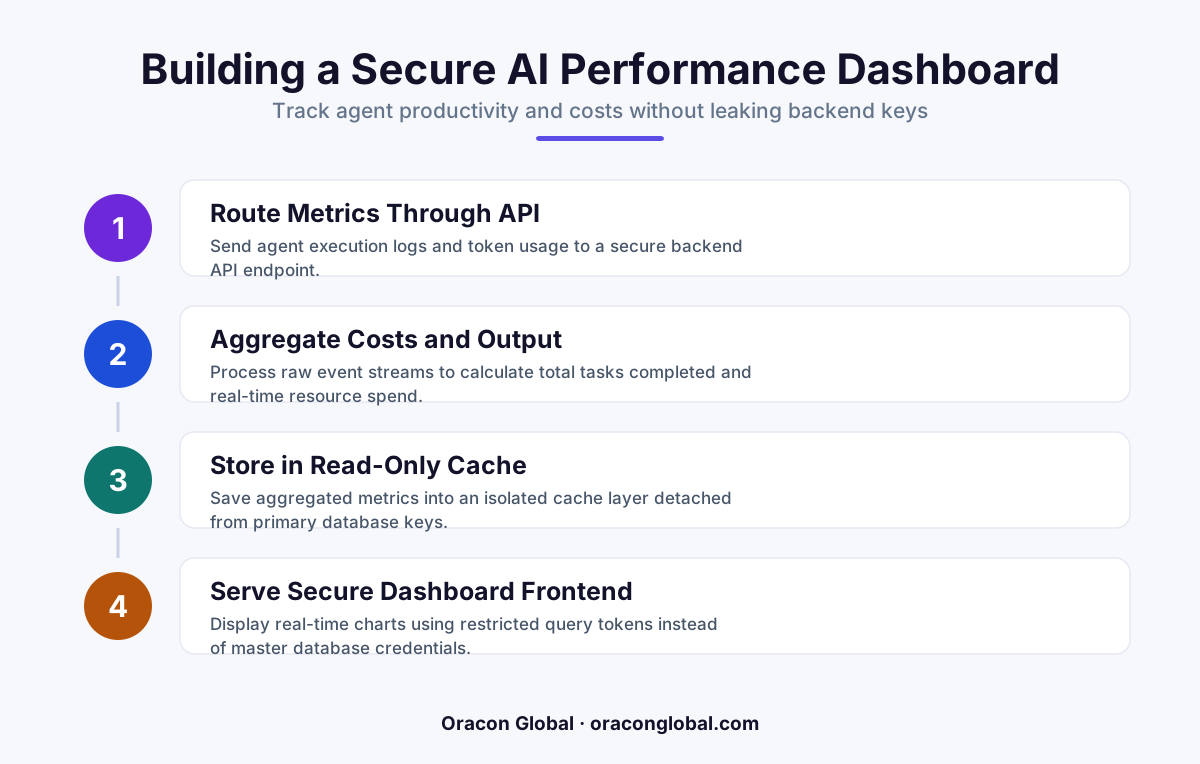
To safely track AI digital employee output and token costs, route operational telemetry through a dedicated ingestion gateway rather than letting your dashboard query primary production databases directly. This decoupled approach preserves real-time visibility while keeping database credentials, sensitive client records, and API secrets completely isolated.
When organizations deploy an AI digital employee dashboard to oversee autonomous operations, management gains instant visibility into daily execution. However, tracking operational velocity and token expenditure creates a major security challenge: how do you give operations managers live performance graphs without granting their analytics tools direct read access to core production stores? Exposing internal database keys or allowing frontend tools to query production environments directly opens up severe security vulnerabilities.
To monitor AI resource costs and operational speed safely, engineering teams must build an isolated telemetry pipeline. By decoupling the live user interface from backend data stores, you can track AI performance metrics cleanly, protect customer privacy, and ensure high-throughput execution across every department.
The Security Risks of Direct Analytics Connections
When engineering teams rush an agentic workflow into production, they often build operational reporting by querying primary databases directly. A WebSockets connection or embedded dashboard fetches data directly from the table where the AI worker logs its task completions. While this approach is simple to prototype, it introduces significant technical risk in production environments.
First, giving a reporting interface direct credentials to primary data tables exposes internal database keys to the client application. If a browser session or frontend dashboard is compromised, an attacker could gain direct access to sensitive customer records, proprietary operational logs, or internal API keys stored alongside the task outputs.
Second, running heavy analytical queries—such as aggregating total token expenditures, computing average completion latencies, or counting task volume by hour—on live production databases leads to resource contention. High-frequency dashboard refreshes can lock critical tables, slowing down the very AI agents you are trying to measure.
Architecting an Isolated Telemetry Ingestion Layer
The solution to tracking agentic throughput securely is establishing a decoupled telemetry pipeline. Instead of exposing your primary backend, your AI digital employees push execution metadata to a dedicated, stateless ingestion bridge that processes metrics out-of-band.
This architecture relies on three distinct layers that insulate your infrastructure while delivering live updates to operations teams:
- The Execution Context: As an AI worker executes a task, it logs anonymous operational facts—such as run duration, model tier used, token volume, and completion status—directly to an asynchronous background event stream.
- The Telemetry Proxy: A lightweight ingestion gateway receives these payload events, strips away raw prompt text, customer identifiers, or proprietary data, and converts the event into a simple metric payload.
- The Read-Only Data Store: The sanitized metrics land in a dedicated time-series store or read-optimized analytical database. The reporting interface queries this isolated store exclusively.
By enforcing this pattern, the frontend dashboard never holds connection strings or service keys for your core production databases. Even if an unauthorized user intercepts the dashboard credentials, they only see aggregated, non-sensitive numerical throughput stats.
Key Metrics to Track for Autonomous Workflows
Building effective secure AI agent observability requires selecting metrics that reflect genuine business outcomes rather than simple server health. Traditional software monitoring focuses on CPU usage and memory consumption. In contrast, evaluating an autonomous AI team member requires tracking productivity alongside resource expense.
1. Token and Compute Costs per Workflow
Because generative models charge per token, tracking aggregate spend alone is insufficient. Your monitoring architecture should calculate unit economics by recording exact input and output token counts per completed task. This allows operations managers to identify inefficient prompts, spot looping routines, and evaluate whether switching to a smaller, specialized model maintains quality while lowering cost.
2. Task Completion and Throughput Rates
Measure the exact volume of successfully executed tasks over designated timeframes. Tracking hourly or daily throughput helps managers align digital workforce capacity with business demand, ensuring operations run smoothly during unexpected volume spikes.
3. Human Handoff and Exception Percentages
An effective AI worker should resolve routine requests independently while routing complex edge cases to human operators. Tracking the exact percentage of tasks flagged for manual review reveals whether system instructions are too strict, too lax, or failing to handle changing business rules.
Enforcing Safe AI API Telemetry in Practice
To implement safe AI API telemetry without degrading system response times, the reporting pipeline must operate asynchronously. Never force an autonomous agent to wait for a metric write to complete before moving to its next action step.
When the agent completes an execution step, it dispatches an event to a high-speed background queue. The queue worker processes the metric payload independently, applying data sanitization rules before writing the result to the reporting layer. The public-facing dashboard subscribes to a secure WebSockets channel fed by this reporting store, ensuring live UI updates without exposing internal network endpoints or database credentials.
Furthermore, prompt contents and variable outputs should never pass directly into the operational reporting store. By separating operational telemetry from full payload logging, your team can maintain strict regulatory compliance, prevent accidental PII leaks, and retain total visibility over system performance.
Scaling Your AI Workforce Safely
Gaining real-time visibility into autonomous operations should never require compromising underlying data security. By isolating reporting architectures from primary data stores, using dedicated telemetry proxies, and focusing on practical unit economics, founders and operators can manage their digital staff with total confidence.
At Oracon Global, we build robust AI agents, AI digital employees, custom SaaS platforms, and enterprise software designed for production-grade reliability and security. If you are ready to deploy autonomous tools with secure, enterprise-grade architecture, speak with our senior development team today.
Frequently asked questions
Why shouldn't a dashboard query the production AI database directly?
Direct database queries force the frontend dashboard layer to hold sensitive read keys or run heavy analytical aggregations on production tables, which risks data leaks and degrades system performance.
How do you measure AI digital employee productivity accurately?
Track objective execution metrics such as completed workflow cycles, human exception handoff rates, token consumption per task, and end-to-end task turnaround time.
What is the safest way to pass telemetry data to a real-time dashboard?
Use a stateless ingestion API or edge proxy that receives redacted execution events from the AI pipeline, writes them to a read-only reporting store, and streams updates via WebSockets.
Does monitoring AI token usage require logging prompt text?
No, you can record metadata such as token counts, model names, task IDs, and latency without saving or transmitting the underlying raw prompt or customer PII.
Read next
Beyond Chatbots: How to Build AI Agents That Actually Do Work for Your Business
Most businesses use AI to answer questions. Here is how to build custom AI agents that actually take action, connect to your internal tools, and handle complex workflows.
Beyond the Wrapper: How to Build Custom AI Agents for Business That Actually Work
Many businesses invest in basic AI wrappers only to find they lack the security and context needed for real work. Here is how to build custom AI agents that integrate deeply with your workflows and databases.
Enterprise AI Maintenance Costs: Budgeting for Year Two and Beyond
Building an AI system is only half the battle. Discover the practical, ongoing operational costs of enterprise AI, including token management, model drift, and continuous security audits.
Oracon Global builds production-grade AI agents, automation and apps — and you own the code and IP. Tell us what you want to automate.
Book a call →See our work