

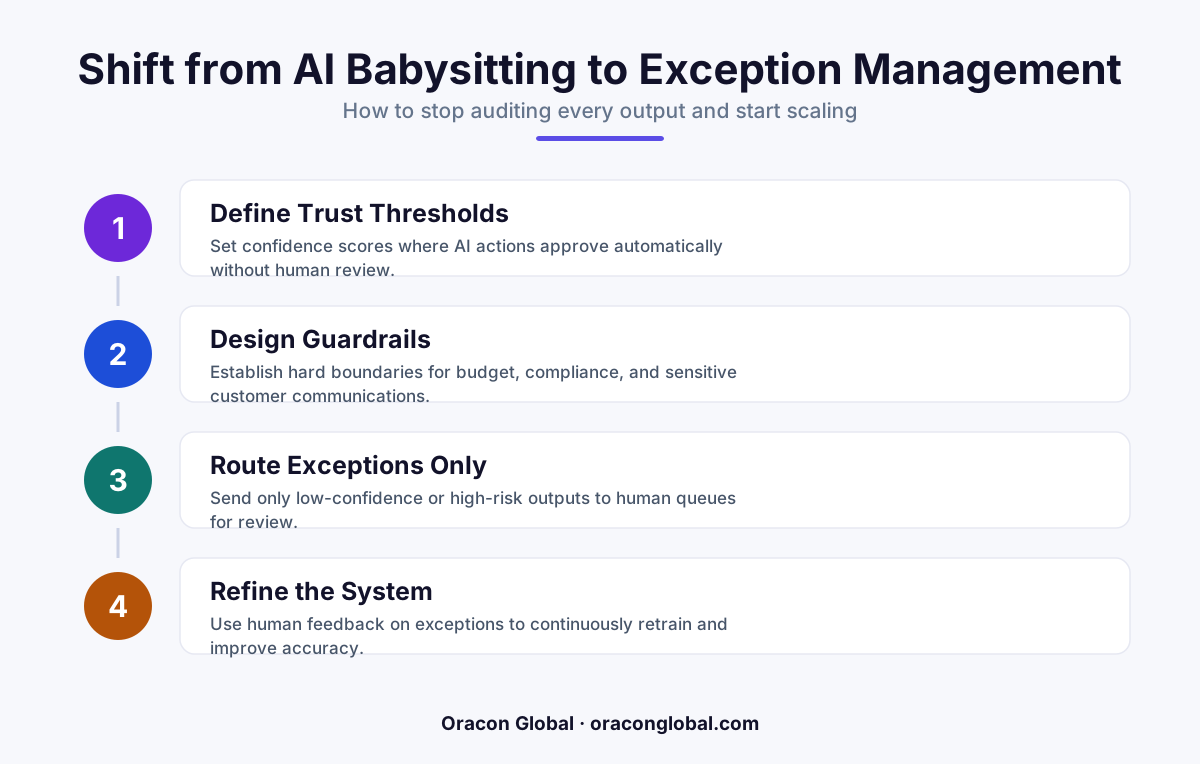
Continuous manual review of AI outputs drains operational efficiency and fatigues your team. By building deterministic guardrails, structured confidence scoring, and dedicated exception queues, you can shift your team to a high-leverage "management by exception" model where humans only intervene when the system flag explicitly requests help.
Many businesses introduce AI digital employees with the promise of freeing up human time, only to discover a frustrating new reality: their team is now spending hours reading, verifying, and double-checking every single line of text or data the AI produces. This is not automation. It is simply trading a data entry job for a highly tedious auditing job.
To scale your business with AI agents, your team must stop babysitting outputs and start managing true exceptions. Transitioning to a high-leverage operational model requires moving away from continuous monitoring and toward structured AI exception handling. When designed correctly, your software handles the bulk of the work autonomously, bringing in your team only when a human decision is truly necessary.
The Hidden Cost of Continuous AI Supervision
When an operations team is forced to approve every action an AI agent takes, several problems arise. First, context-switching fatigue sets in rapidly. Reading hundreds of semi-automated drafts to spot occasional errors is more mentally draining than writing those drafts from scratch.
Second, this approach destroys the unit economics of your software investment. If a human must spend two minutes validating a task that took the AI three seconds to generate, your throughput is still strictly limited by human headcount. To break this bottleneck, you need to shift your operational mindset. Your team should act as supervisors who manage deviations, while the software runs the standard path autonomously.
Building the Infrastructure for Exception Management
Transitioning away from continuous oversight requires building specific architectural layers into your business software. You cannot simply tell your team to trust the AI more; you must give them system-level reasons to trust it. Here are the core components required to safely manage AI exceptions.
1. Implement Structured Confidence Scoring
Every time an AI agent processes a document, maps a database field, or drafts a response, it should generate a structured confidence score. This score is not a guess; it is a calculated metric based on data completeness, semantic similarity to known good templates, and model probability outputs.
With these scores in place, you can establish clear operational rules:
- High Confidence (90-100%): The agent executes the action autonomously (e.g., updates the ERP, sends the email, or books the logistics route).
- Medium Confidence (70-89%): The agent pauses and routes the task to a human review queue with the flagged areas highlighted.
- Low Confidence (Below 70%): The agent immediately hands the task over to a human operator, saving the AI API costs entirely.
2. Establish Hardcoded Business Guardrails
AI models are probabilistic, but your business logic must be deterministic. You should never rely on an LLM to remember your operational boundaries. Instead, build hardcoded code-level gates around your AI agents.
For example, if an AI agent is drafting a billing adjustment, a hardcoded rule in your database layer should prevent it from approving any refund over $500 without manual admin approval. If the agent attempts to exceed this limit, the system blocks the write and generates a formal system exception for your team to review.
3. Design an Action-Oriented Exception Queue
Instead of forcing your team to work inside a generic chat interface or scroll through endless logs, build a dedicated exception dashboard. This interface should behave like a specialized ticketing system.
When an exception is triggered, the dashboard should present the human operator with three things: the raw input data, the AI's proposed action, and the specific reason the exception was flagged (e.g., "Confidence score fell to 74%" or "Failed to match supplier SKU"). The human can then approve, reject, or edit the action with a single click, keeping your workflows moving without friction.
How Your Team's Role Evolves
When you transition to managing exceptions, your day-to-day operations change dramatically. Instead of performing repetitive tasks, your experienced team members focus their energy where human judgment adds the most value.
Rather than reviewing 1,000 standard customer invoices, an operator might only look at the 15 invoices that triggered a price-matching discrepancy flag. The rest are processed instantly by your AI digital employees. This shift allows your business to handle ten times the transaction volume without burning out your staff or rushing to hire more coordinators.
Continuous Improvement Through Feedback Loops
A true exception-based architecture is not static. Every time a human resolves an exception on your custom dashboard, that action provides highly valuable operational data. By logging how your team corrects the AI's work, your development team can continually refine your data validation pipelines and update business rules.
Over time, the system becomes smarter, the volume of manual exceptions drops, and your team's operational leverage continues to grow. You move from a state of constant firefighting and babysitting to a streamlined, predictable system of digital delegation.
Build Your Exception-First AI Architecture
Setting up reliable autonomous workflows is not about finding a more creative prompt; it is about building robust software engineering around your AI models. At Oracon Global, our senior in-house team builds custom web applications, AI-native ERPs, and workflow automation systems that protect your business with deterministic guardrails and clean human-in-the-loop interfaces. Best of all, you own 100% of the code and intellectual property we build for you.
Ready to stop babysitting your software and start scaling your operations? Get in touch with Oracon Global today to discuss how we can build resilient, production-ready AI tools for your team.
Frequently asked questions
Why is my team still reviewing every single action taken by our AI agents?
This usually happens because the system lacks a reliable, automated way to measure confidence or enforce strict operational guardrails, leaving human oversight as the only defense against bad data.
What is an AI exception handling workflow?
It is an architectural pattern where the AI agent processes standard data autonomously and only routes cases to a human queue when confidence scores fall below a threshold or a hardcoded business rule is triggered.
How do we set safe confidence thresholds for autonomous processing?
You analyze historical operational data to find the sweet spot where the AI consistently makes accurate decisions, then route any transaction falling below that metric to a human-in-the-loop review queue.
What happens to the exceptions that humans resolve?
Resolved exceptions should be logged as structured training data or used to update deterministic business rules, allowing the system to handle similar edge cases autonomously in the future.
Read next
Beyond Chatbots: How to Build AI Agents That Actually Do Work for Your Business
Most businesses use AI to answer questions. Here is how to build custom AI agents that actually take action, connect to your internal tools, and handle complex workflows.
Beyond the Wrapper: How to Build Custom AI Agents for Business That Actually Work
Many businesses invest in basic AI wrappers only to find they lack the security and context needed for real work. Here is how to build custom AI agents that integrate deeply with your workflows and databases.
Enterprise AI Maintenance Costs: Budgeting for Year Two and Beyond
Building an AI system is only half the battle. Discover the practical, ongoing operational costs of enterprise AI, including token management, model drift, and continuous security audits.
Oracon Global builds production-grade AI agents, automation and apps — and you own the code and IP. Tell us what you want to automate.
Book a call →See our work