

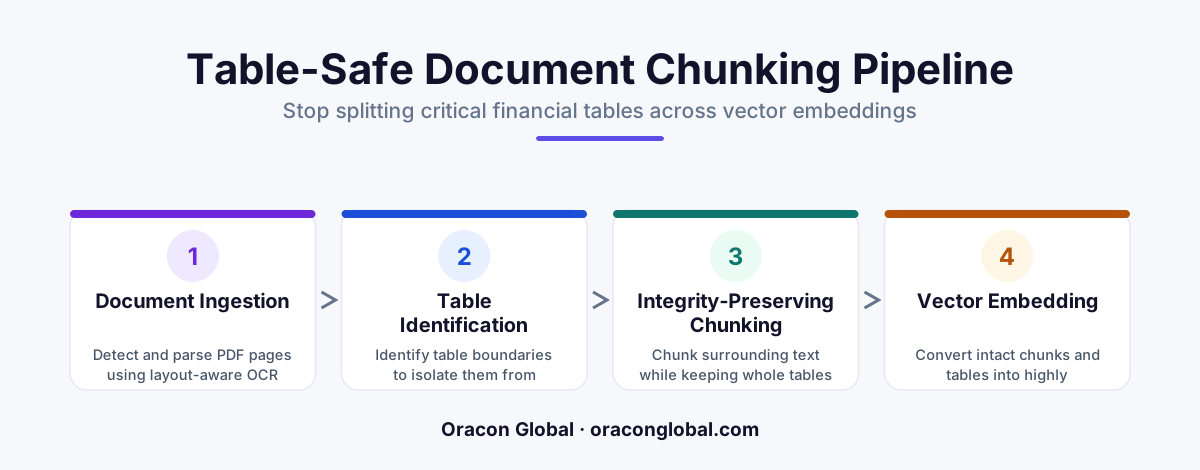
Standard character-limit chunking destroys the tabular structure of financial documents during vector ingestion. By implementing a layout-aware parsing pipeline using heuristic boundary detection, businesses can keep entire tables within single vector embeddings to ensure flawless RAG lookup.
When businesses deploy Retrieval-Augmented Generation (RAG) systems to query internal financial documents, they often expect immediate, flawless answers. Instead, they frequently encounter a frustrating problem: the AI hallucinates numbers, swaps quarterly revenue figures, or completely misses line items. This happens because standard data ingestion tools are designed for plain narrative text, not complex structured data.
The root cause of these errors lies in how documents are broken down before being saved to a database. If your system uses naive, character-based chunking, it will inevitably slice your balance sheets, income statements, and cash flow tables in half. Once a table is split across different vector embeddings, your AI search loses the structural context required to read the data correctly. To solve this, you need to build a real-time document chunking pipeline that respects document layout and preserves table integrity.
The Structural Failure of Naive Chunking in Financial RAG
Most basic RAG setups rely on simple recursive text splitters. These tools look for natural pauses in text, like double newlines or periods, and slice the document into fixed-size segments (for example, blocks of 1,000 characters with a 200-character overlap). While this works reasonably well for standard policy documents or training manuals, it fails catastrophically when applied to financial PDFs.
Consider a standard multi-column financial table showing quarterly performance over several years. A naive chunker might cut the table horizontally right after the second quarter. The top half of the table, containing the column headers, goes into one vector chunk, while the bottom half, containing the actual numbers, goes into another.
When an operator asks your AI digital employee, "What was our operating income in Q3 of last year?", the system searches your vector database. Because the vector representation of the bottom half lacks the column headers, the search engine might prioritize irrelevant text blocks or retrieve a fragmented chunk. Denied the complete grid context, the LLM is forced to guess, leading to inaccurate answers that can compromise business decisions.
Building a Layout-Aware Ingestion Pipeline
To prevent tables from being split, you must replace naive text splitting with a layout-aware document chunking pipeline. This approach processes files not as a single long string of characters, but as a structured collection of visual and semantic elements. The pipeline must perform three primary tasks in real time:
- Document Structure Analysis: Identify structural boundaries, separating paragraphs, headers, footers, images, and tables.
- Table Boundary Isolation: Detect where a table begins and ends, ensuring the entire structure is treated as a single, indivisible entity.
- Semantic Serialization: Convert the visual table into a text format that preserves relationships between columns and rows, such as Markdown or JSON, before generating vector embeddings.
Step 1: Structural Extraction and Identification
The pipeline starts by converting incoming PDFs into a format where structural elements can be identified. Instead of extracting raw text directly, the system uses object detection models or rule-based layout parsers to find coordinate boxes for different document zones. This step separates standard body text from tabular structures, ensuring that narrative text is chunked normally while tables are routed to a specialized processing path.
Step 2: Dynamic Boundary Grouping
Once a table zone is detected, the pipeline marks its coordinate boundaries. Any text falling within these coordinates is locked together. Even if a table spans multiple pages, the pipeline uses heuristic analysis to match column headers across page breaks, stitching the fragmented table back into a single unified data structure before it is passed to the next stage.
Converting Tables for Vector Search and LLM Readability
Simply keeping the table text together is not enough; you must also format it so that both the mathematical vector database and the LLM can understand the data relationships. Raw, space-separated text extracted from a PDF often loses its vertical alignment, turning a clean grid into a confusing jumble of numbers.
Your real-time pipeline should serialize the isolated table into structured Markdown or a clean HTML grid. LLMs are highly proficient at reading Markdown tables because the pipe symbols clearly define the boundaries of each cell.
Example of Markdown Serialization:
| Quarter | Revenue (M) | Operating Expense (M) | Net Margin |
|---|---|---|---|
| Q1 2025 | $12.4 | $8.1 | 34.6% |
| Q2 2025 | $14.2 | $8.5 | 40.1% |
This structured representation is then paired with parent document metadata, such as the document name, year, and section header, before being sent to the vector database. When the vector embedding is created, the mathematical representation captures the unified context of the entire financial table.
Architecting the Real-Time Processing Flow
A production-ready pipeline must handle files as they are uploaded, without introducing noticeable latency for the user. To achieve this, the ingestion architecture should decouple the document upload from the heavy processing steps using a secure queue system.
- Upload and Event Trigger: A user uploads a financial PDF through your app. The upload event writes the raw file to secure cloud storage and publishes a message to a lightweight processing queue.
- Worker Processing: An isolated worker process picks up the document, runs the layout analysis, and extracts tables as complete, serialized markdown blocks.
- Embedding Generation: The narrative text blocks and the preserved table blocks are sent to your embedding model in parallel batches.
- Vector Database Upsert: The resulting embeddings, enriched with structural metadata (such as "element_type: table"), are saved to your vector database, ready for immediate, highly accurate retrieval.
By keeping tables intact and formatting them correctly, your RAG system can retrieve complete datasets rather than fragmented scraps of data. This ensures that your business automation tools, custom AI search engines, and AI digital employees operate with absolute precision.
Take Control of Your Business Data
Off-the-shelf AI wrappers and basic chunking tools inevitably fall short when faced with the complex layouts of real-world business documents. Securing the integrity of your financial tables requires a custom data pipeline tailored to your operational needs.
At Oracon Global, our senior in-house team designs and builds robust AI pipelines, custom web and mobile applications, and enterprise-grade workflow automations. We construct systems where you retain 100% ownership of your code and intellectual property. If you want to build an accurate, high-performance RAG system that your team can rely on, contact Oracon Global today to discuss your project.
Frequently asked questions
Why do standard RAG systems hallucinate when reading financial tables?
Standard RAG systems use naive chunking based on character or token counts, which often slices a table in half. When the LLM retrieves only a fragment of the table, it lacks the context of column headers or adjacent metrics, causing it to hallucinate or miscalculate figures.
What is layout-aware document chunking?
Layout-aware chunking is a method of parsing documents by analyzing their visual and structural elements, such as tables, headers, and paragraphs, rather than relying solely on arbitrary text lengths. This ensures that unified structural components remain intact.
Can OCR tools alone solve the split-table problem in vector embeddings?
No. While OCR tools can extract text from images, they do not inherently understand table boundaries or format them into a search-friendly structure. You need a dedicated parsing layer to identify table boundaries and convert them into clean markdown or JSON before vectorization.
How does preserving table boundaries impact LLM token usage?
Keeping tables intact within single chunks actually optimizes token usage. It prevents the LLM from processing duplicate or fragmented data across multiple retrieved chunks and ensures the model gets the exact, complete context it needs in a single query.
Read next
Beyond Chatbots: How to Build AI Agents That Actually Do Work for Your Business
Most businesses use AI to answer questions. Here is how to build custom AI agents that actually take action, connect to your internal tools, and handle complex workflows.
Beyond the Wrapper: How to Build Custom AI Agents for Business That Actually Work
Many businesses invest in basic AI wrappers only to find they lack the security and context needed for real work. Here is how to build custom AI agents that integrate deeply with your workflows and databases.
Enterprise AI Maintenance Costs: Budgeting for Year Two and Beyond
Building an AI system is only half the battle. Discover the practical, ongoing operational costs of enterprise AI, including token management, model drift, and continuous security audits.
Oracon Global builds production-grade AI agents, automation and apps — and you own the code and IP. Tell us what you want to automate.
Book a call →See our work