

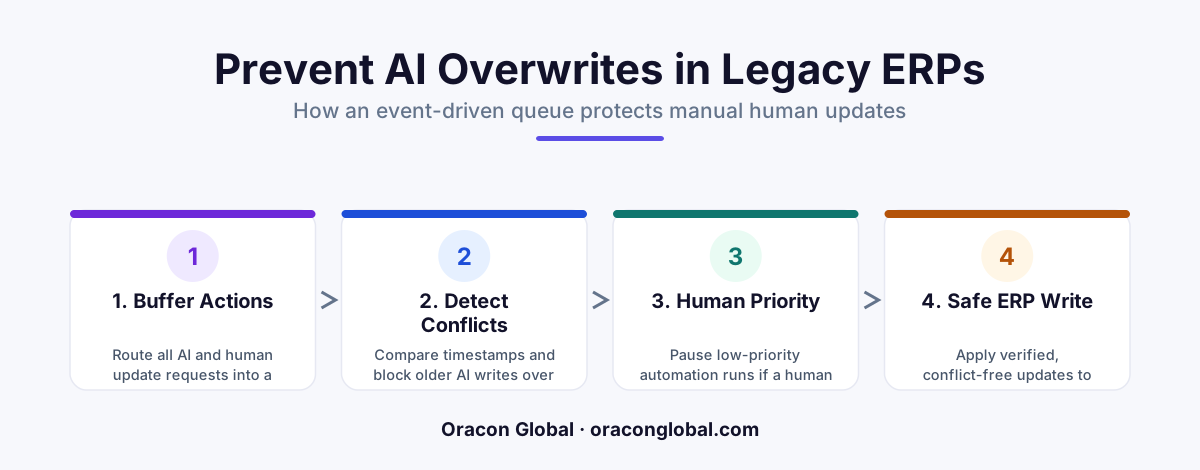
To stop fast-moving AI agents from clobbering slower human updates in legacy ERPs, you need an intermediary event-driven queue. This system intercepts agent database writes, evaluates them against pending human operations, and uses semantic versioning to resolve data conflicts before they hit the database.
Deploying autonomous AI agents to work alongside your operational team is one of the fastest ways to scale business automation. However, a major technical roadblock occurs when fast-moving AI digital employees read and write data to the same legacy ERP system your human staff uses every day.
A human operator might open an ERP record, make a phone call to verify shipping details, and save the update three minutes later. Meanwhile, an AI agent running at high volume can read the initial record, process an automated vendor update, and execute five database writes in a fraction of a second. Without the right architecture, the AI agent will overwrite the human operator's pending changes, leading to corrupted inventory data, missed orders, and operational confusion.
Maintaining enterprise data integrity requires a buffer. Here is how to build an event-driven database queue to manage preventing AI agent database writes from clobbering human operations in legacy ERP integrations.
The Concurrency Problem in Legacy ERP Integration
Modern cloud databases use optimistic concurrency control (OCC) or row-level locking to manage simultaneous edits. Legacy ERP systems, however, are rarely built to handle hundreds of automated API calls acting on the same records that human staff are actively editing.
When a human operator opens a client profile or a purchase order in a legacy system, the database often lacks a way to signal to external APIs that the record is "checked out." The system operates on a "last write wins" basis. Because an AI agent can execute database writes at a rate that humans cannot match, the agent almost always wins the race, silently erasing manual entries made just moments before.
To secure your legacy ERP integration, you must decouple your AI agent's write operations from the physical database. Instead of allowing agents to write directly to database tables, all automated actions must flow through an intermediary event-driven database queue.
Architecting the Event-Driven Queue
An event-driven queue acts as an intelligent traffic controller. It intercepts all proposed write operations from your AI agents, validates them against human activity, and sequences them safely. The architecture relies on three core components:
- The Event Ingestion Layer: A lightweight buffer (built with tools like Redis or PostgreSQL-backed transactional queues) that captures every data-write payload generated by the AI agent.
- The Active Session Monitor: A state tracker that monitors active human sessions in the ERP. This can be achieved by tracking user interface events, open tabs, or temporary lock state tables.
- The Reconciliation Engine: The brain of the queue. It compares the AI's proposed write against the human's active workspace and determines if there is a resource conflict.
Step 1: Implementing a State-Tracking Ledger
To prevent conflicts, the queue must know what your human team is working on. Because legacy ERPs rarely expose active user locks via APIs, you can build a lightweight shadow ledger. When a human staff member opens a record in your custom web or mobile front-end, a temporary "lease" is registered in the state ledger. While this lease is active, the database queue flags that record as temporarily restricted for automated writes.
Step 2: Semantic Conflict Comparison
Not every AI write needs to be blocked. If a human operator is updating a customer's billing address, and an AI agent is updating that same customer's real-time shipment delivery status, both writes can safely co-exist. The reconciliation engine parses the incoming payload from the AI agent. If the fields do not overlap with the fields the human is editing, the queue allows the AI write to proceed.
Handling Conflicts Gracefully: Three Resolution Strategies
When the queue detects that an AI agent is attempting to modify the exact same field a human is actively changing, it must resolve the conflict without dropping data or crashing the automation pipeline. We recommend building three distinct resolution paths into your database queue:
- Human Priority (Veto): The simplest and safest default rule. If a human has modified a field within a specific time window, the queue discards or archives the AI's proposed write. The human update always wins.
- Delta Merging: If the AI agent is updating a numerical value (such as inventory count) and the human operator is doing the same, the queue calculates the mathematical difference (the delta) of both updates and applies them sequentially, rather than allowing one value to overwrite the other.
- The Exception Hold Queue: When the system cannot determine which update is more accurate, it holds the AI's write operation in a visual queue on your operational dashboard. A human manager can then review the discrepancy side-by-side and click to approve or reject the automated change.
Ensuring Zero Downtime and Failover
An event-driven database queue must be highly resilient. If the queue crashes, your business automation halts. At Oracon Global, we build these systems with strict transactional boundaries. Write operations are kept in a durable queue state until the legacy ERP explicitly acknowledges a successful write.
By keeping a local, isolated state of all pending writes, the queue can retry failed database transactions during periods of high ERP latency without forcing the AI agent to re-run expensive LLM operations. This approach protects your cloud computing budget while ensuring your legacy database remains consistent and corruption-free.
Keep Your Data Safe with Resilient Architecture
Deploying AI agents should not mean sacrificing the integrity of your core business data. By placing a custom event-driven database queue between your autonomous agents and your legacy ERP, you get the speed of modern automation alongside the safety of human-controlled operations.
At Oracon Global, our senior in-house team specializes in building custom web and mobile apps, AI-native ERP systems, and robust database architectures that connect seamlessly with legacy business infrastructure. We deliver custom code worldwide, and our clients retain 100% ownership of their software and intellectual property.
Want to protect your business databases while scaling your automation? Contact Oracon Global today to discuss your systems architecture needs.
Frequently asked questions
Why do AI agents overwrite human operations in legacy ERP systems?
AI agents process transactions and API calls in milliseconds, while human operators take minutes to update fields. Legacy ERPs lack modern row-locking and optimistic concurrency controls, allowing fast-moving AI writes to overwrite pending manual changes.
What is an event-driven database queue?
It is an intermediary software layer that captures all incoming data writes from AI agents, buffers them, and evaluates them against active human sessions and pending manual transactions before updating the primary database.
Do we need to rewrite our entire legacy ERP to implement this?
No. A custom event-driven queue acts as a non-invasive middleware layer that sits between your AI agent infrastructure and your legacy ERP database, preserving your existing core systems.
How does the system decide which edit wins during a conflict?
The queue uses pre-defined business logic and semantic comparison. Generally, human inputs are prioritized, or the queue flags the conflict for manual approval instead of blindly executing the automated write.
Read next
Beyond Chatbots: How to Build AI Agents That Actually Do Work for Your Business
Most businesses use AI to answer questions. Here is how to build custom AI agents that actually take action, connect to your internal tools, and handle complex workflows.
Beyond the Wrapper: How to Build Custom AI Agents for Business That Actually Work
Many businesses invest in basic AI wrappers only to find they lack the security and context needed for real work. Here is how to build custom AI agents that integrate deeply with your workflows and databases.
Enterprise AI Maintenance Costs: Budgeting for Year Two and Beyond
Building an AI system is only half the battle. Discover the practical, ongoing operational costs of enterprise AI, including token management, model drift, and continuous security audits.
Oracon Global builds production-grade AI agents, automation and apps — and you own the code and IP. Tell us what you want to automate.
Book a call →See our work