

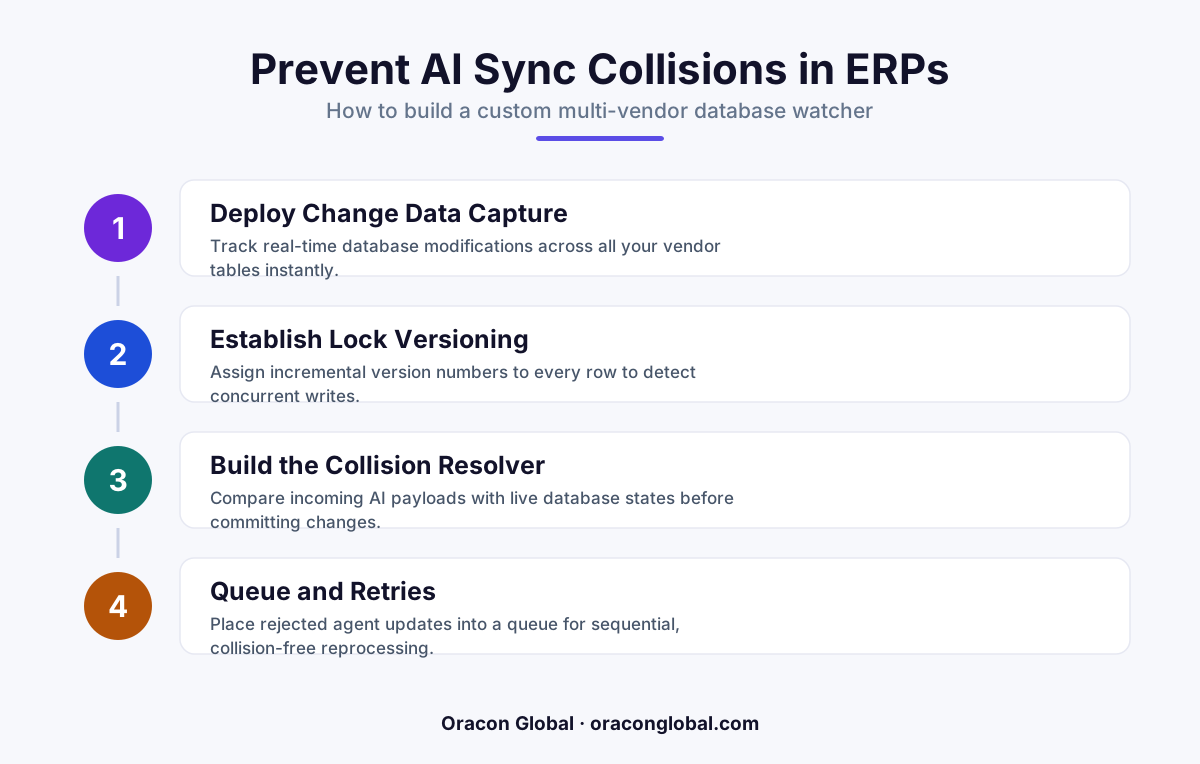
Distributed ERP systems face severe sync collisions when autonomous AI agents execute rapid, concurrent database writes. By building an event-driven database watcher with optimistic locking and a centralized state validator, you can prevent data overwrites and keep your business records perfectly synchronized.
Distributed ERP architectures are designed to keep complex global businesses running smoothly. However, when you introduce autonomous AI agents into this ecosystem to automate purchasing, inventory updates, or customer invoicing, a quiet structural vulnerability emerges: the AI agent sync collision.
Unlike human operators who input data at a predictable, manageable pace, AI digital employees execute writes at machine speed across multiple databases. If one agent is updating a supplier record in a legacy database while another is processing an invoice for that same supplier in a cloud-based CRM, they can easily overwrite each other's work. Without a dedicated safeguarding mechanism, this leads to corrupt records, double-booked inventory, and system-wide synchronization failures.
To keep your distributed ERP systems running reliably, you need an active traffic cop. Here is how to build a custom ERP database watcher designed to prevent concurrent database writes from corrupting your business records.
The Hidden Threat of Agentic Sync Collisions
In a traditional distributed ERP setup, database replication and API polling schedules are designed with the assumption of human latency. A human team member opens a record, edits it, and saves it. Databases have plenty of time to resolve conflicts using standard timestamping or simple last-write-wins rules.
AI agents break this assumption entirely. An agentic workflow might query a database, make a call to an LLM, evaluate a business rule, and execute a write back to the ERP. Because these operations occur in parallel across dozens of running threads, two or more agents can easily read the exact same state of a database, compute different actions, and attempt to write back to the same row at nearly the same instant. This results in an AI agent sync collision where critical business data is silently lost.
Step 1: Implementing the Change Data Capture Layer
To prevent collisions, your custom watcher must know about database changes the millisecond they occur. Relying on scheduled API polling is too slow and will inevitably miss concurrent operations.
The solution is to build a Change Data Capture (CDC) engine that hooks directly into the replication logs of your various database vendors. Whether you are using PostgreSQL, MySQL, or a proprietary legacy database, the watcher streams transaction logs in real time. This ensures that every insert, update, or delete is captured as an event before it is fully committed to the wider distributed network.
Step 2: Designing the Centralized State Validator
Once your watcher is streaming events, it needs a logical brain to evaluate incoming writes. This is where you implement a centralized state validator. Instead of allowing AI agents to write directly to your database tables, all agentic writes must route through an API gateway monitored by the watcher.
The validator uses a combination of two critical design patterns to maintain agentic data integrity:
- Optimistic Concurrency Control (OCC): Every record in your ERP is assigned a version number or a cryptographic hash. When an AI agent reads a record to perform a task, it must record that version number. When it attempts to write the update back, the watcher checks if the version number in the database has changed. If it has, the write is rejected and sent back to the agent for recalculation.
- Logical Lock Tables: For multi-step agentic workflows that require several minutes to complete, the watcher can place a temporary logical lock on specific rows. This prevents other agents from modifying the target record until the primary agent completes its task or the lock times out.
Step 3: Building the Event-Driven Resolution Queue
When a sync collision is detected, you cannot simply throw an error and let the AI agent crash. The system must handle exceptions gracefully to keep your business operations running.
Your custom watcher should route collided or rejected writes into an event-driven queue. This queue serves as a holding bay where conflict-resolution rules are applied automatically:
If the conflict is minor, such as two agents trying to append different tags to a customer profile, the queue merges the data. If the conflict is critical, such as two agents attempting to allocate the same physical warehouse inventory to different orders, the watcher flags the transaction and routes it to a human-in-the-loop dashboard for manual approval.
Maintaining Absolute Data Integrity
Deploying autonomous AI agents without a protective middleware layer is one of the fastest ways to introduce technical debt into an enterprise. A custom database watcher acts as a permanent shield, ensuring that your transition to an AI-augmented workflow does not come at the expense of your database consistency.
At Oracon Global, our senior in-house engineering team builds production-ready AI agents, custom ERP systems, and robust database integrations that deliver seamless performance on a global scale. We ensure you retain 100% ownership of your code and intellectual property from day one.
Want to secure your enterprise database architecture for the age of AI? Contact the team at Oracon Global today to discuss your development needs.
Frequently asked questions
What causes an AI agent sync collision in an ERP?
Sync collisions occur when multiple AI agents, or an agent and a human user, attempt to update the same database record simultaneously without a central coordination layer to determine which write is valid.
Why can't standard database transactions prevent these collisions?
Standard database locks work well for short, isolated transactions, but AI workflows often involve multi-step API calls and reasoning loops that hold connections open too long, leading to timeouts or deadlocks.
How does a custom database watcher solve this issue?
It acts as an active, event-driven traffic cop that monitors changes across all vendor databases, validates incoming writes against real-time schemas, and queues updates sequentially.
Will building a watcher require rewriting our legacy ERP code?
No. A custom database watcher sits as a lightweight middleware layer that hooks into database binlogs or webhook streams without requiring modifications to your core ERP software.
Read next
Beyond Chatbots: How to Build AI Agents That Actually Do Work for Your Business
Most businesses use AI to answer questions. Here is how to build custom AI agents that actually take action, connect to your internal tools, and handle complex workflows.
Beyond the Wrapper: How to Build Custom AI Agents for Business That Actually Work
Many businesses invest in basic AI wrappers only to find they lack the security and context needed for real work. Here is how to build custom AI agents that integrate deeply with your workflows and databases.
Enterprise AI Maintenance Costs: Budgeting for Year Two and Beyond
Building an AI system is only half the battle. Discover the practical, ongoing operational costs of enterprise AI, including token management, model drift, and continuous security audits.
Oracon Global builds production-grade AI agents, automation and apps — and you own the code and IP. Tell us what you want to automate.
Book a call →See our work