

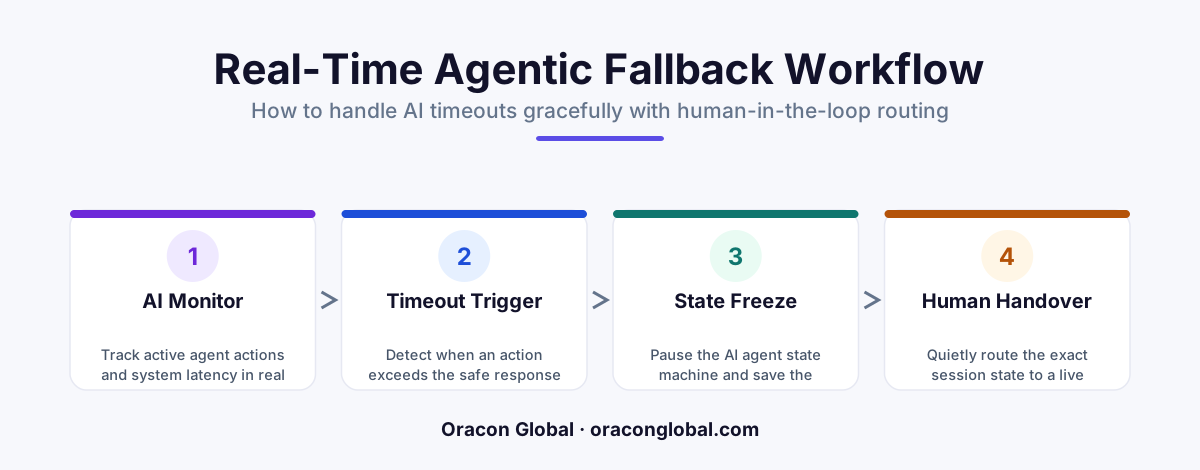
An agentic fallback state machine acts as a real-time circuit breaker for your AI tools. By tracking execution states and API latencies, it detects stalled AI actions early and routes the entire conversation context to a live human operator before the customer notices a system timeout.
Imagine a customer interacting with your AI support assistant to process a high-value subscription change. The agent initiates the billing tool, calls your database, and attempts to update the user record. But a third-party payment gateway suffers a momentary network lag. The API call stalls, the LLM hangs waiting for a tool response, and the customer is left staring at a blank screen.
In a standard setup, this scenario ends in a system timeout, an unhelpful error message, and a frustrated customer who has to start the process all over again. To build production-grade AI applications, you need a deterministic safety net. By implementing a real-time agentic fallback state machine, you can detect these micro-failures instantly and hand the conversation over to a human operator before the customer experience breaks.
Why Standard API Timeouts Fail the Customer Experience
Traditional software handles timeouts with simple retries or crash logs. If an API call fails after 30 seconds, the system logs an error and returns a generic warning to the client interface. While this approach works fine for background batch processing, it is a disaster for real-time customer experience AI.
AI agents introduce a new layer of complexity because they are non-deterministic. A stalled interaction could be caused by:
- An LLM generation taking too long to parse.
- A slow semantic search query in your vector database.
- A cold start on a third-party API tool used by the agent.
- An infinite loop where the agent repeatedly calls different tools without resolving the task.
Staring at a loading indicator for more than ten seconds destroys user trust. A human-in-the-loop fallback mechanism ensures that if the AI stalls, a live team member steps in with full context, completing the task before the user realizes anything went wrong.
How an Agentic Fallback State Machine Works
An agentic fallback state machine is an asynchronous orchestration layer that sits between your frontend application, your AI agent, and your human operations dashboard. Instead of letting the AI run autonomously until it crashes, the state machine tracks every step of the agent's workflow as a explicit, state-driven sequence.
1. State Tracking and Heartbeats
Every time an AI agent initiates an action—such as querying a database or executing an API write—it must transition to a specific state (e.g., Awaiting_Tool_Response). The state machine assigns a precise time-to-live (TTL) to this state. If the agent does not post a heartbeat update or transition to the next state within the allowed window, the state machine flags the process as stalled.
2. The Graceful Fallback Trigger
Once a timeout threshold is crossed, the state machine revokes the AI's write permissions for that specific transaction. This prevents a slow API call from executing late and creating double entries in your database. The state machine then instantly bundles the conversation history, the active system state, and the failed tool execution data into a standardized payload.
3. Human Agent Routing
The payload is routed to a human operator queue. On the human-facing dashboard, the support agent doesn't just see a fresh ticket. They see a complete transcript of what the AI was attempting to do, which API stalled, and a single-click prompt to complete the action manually. To the customer, the transition is seamless, appearing as a slightly longer pause before a highly competent agent solves their issue.
Key Architectural Components of a Fallback System
Building a resilient fallback engine requires separating your workflow orchestration from the raw LLM calls. Here is the foundational architecture needed for real-time workflow automation with built-in fallbacks:
A Centralized State Store
Do not store the agent's active memory solely inside the LLM's context window. Use a fast, key-value store like Redis to maintain the active state of the conversation and any pending system actions. If the AI service fails entirely, the human agent's dashboard pulls the clean, structured data directly from Redis.
Asynchronous Task Queues
All tool executions should run as asynchronous tasks rather than blocking, synchronous API calls. By using a task queue, your state machine can easily monitor how long an action has been running in the background and terminate it if it exceeds the latency budget.
An Action Escrow Layer
Before an AI agent executes a state-changing database write or external API call, it should register the intent with an escrow layer. If the human operator has to take over, they can review, edit, or manually approve the pending action that stalled in the queue.
Designing the Transition: Keeping It Seamless for Users
How you handle the transition on the client-facing app is just as important as the backend code. When the state machine detects a timeout and begins routing to a human, the frontend interface should update dynamically.
Instead of displaying a generic connection error, the app can display context-aware micro-copy such as: "Let me loop in a specialist to finalize this update for you." Because the human operator receives the structured payload of the conversation, they do not need to ask the customer to repeat their name, order number, or request. They can step in, say, "I've got the details of your subscription change right here, let me approve that for you now," and complete the transaction.
Build Safe AI Workflows with Oracon Global
AI digital employees can handle high volumes of repetitive operations, but they perform best when backed by robust, deterministic engineering. A fallback state machine ensures your business gets the efficiency of autonomous AI without risking your customer satisfaction scores when systems lag.
At Oracon Global, we build production-grade AI agents, custom web and mobile apps, and robust workflow automations with safety, speed, and reliability in mind. Our senior in-house team designs tailored architectures that keep your operations running smoothly, ensuring you own 100% of the code and intellectual property.
If you are ready to build resilient, enterprise-ready AI applications for your business, contact Oracon Global today to discuss your project.
Frequently asked questions
What is an agentic fallback state machine?
It is a structured software architecture that monitors the execution states and latency of AI agents, automatically routing stalled or failing operations to human team members in real time.
How long should an AI agent wait before routing to a human?
For customer-facing channels, a hard timeout of 8 to 12 seconds is standard. The state machine should initiate a human handover around the 8-second mark if the LLM or external APIs fail to respond.
Do I need to rebuild my entire AI system to add a fallback state machine?
No. A fallback state machine can be built as an asynchronous middleware or state management layer that wraps around your existing AI toolkits and API integrations.
Does the customer know they are being handed off to a human?
The transition can be designed to be completely seamless. The human operator receives the entire conversation history and execution state, allowing them to type a reply or complete the action without making the customer repeat themselves.
Read next
Beyond Chatbots: How to Build AI Agents That Actually Do Work for Your Business
Most businesses use AI to answer questions. Here is how to build custom AI agents that actually take action, connect to your internal tools, and handle complex workflows.
Beyond the Wrapper: How to Build Custom AI Agents for Business That Actually Work
Many businesses invest in basic AI wrappers only to find they lack the security and context needed for real work. Here is how to build custom AI agents that integrate deeply with your workflows and databases.
Enterprise AI Maintenance Costs: Budgeting for Year Two and Beyond
Building an AI system is only half the battle. Discover the practical, ongoing operational costs of enterprise AI, including token management, model drift, and continuous security audits.
Oracon Global builds production-grade AI agents, automation and apps — and you own the code and IP. Tell us what you want to automate.
Book a call →See our work