

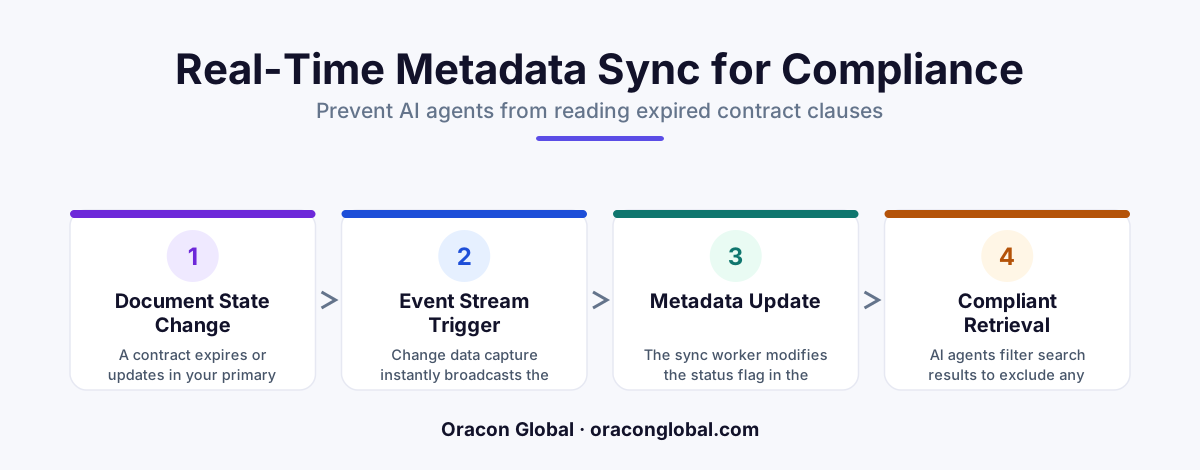
When legal contracts expire or change, standard vector stores often continue serving stale chunks to your AI agents because embedding updates are slow. By decoupling the vector embeddings from a real-time relational metadata sync layer, you can instantly filter out invalid clauses at query time without waiting for expensive vector re-indexing.
Automating contract reviews, procurement audits, and legal queries with AI agents is one of the fastest ways to eliminate operational bottlenecks. When an AI digital employee can scan thousands of pages of vendor agreements in seconds, your operations team can move at triple speed. But in production, a silent danger emerges: AI agents reading and acting on expired contract clauses.
Most corporate knowledge bases rely on Retrieval-Augmented Generation (RAG) and vector databases. While vector stores are excellent at matching concepts, they are notoriously bad at tracking real-time status changes. If a vendor contract expired at midnight, but the raw text chunks still live in your vector database, your AI agent will happily retrieve those stale clauses and draft a purchase order based on outdated pricing. To solve this, you need a real-time metadata sync layer that acts as an instant compliance gate.
The Structural Flaw of Standard Vector Stores
To understand why this happens, look at how data gets into your AI systems. When you upload a business contract, a parser breaks the document down into small paragraphs, converts them into mathematical vectors (embeddings), and saves them in a vector store.
The vector store is designed for semantic search—finding text with similar meanings. It does not natively understand transactional logic, such as:
- Whether the document status changed from "Active" to "Archived" in your ERP.
- Whether a specific clause was superseded by a newer addendum signed ten minutes ago.
- Whether a contract has passed its hard expiration date.
If you rely solely on semantic similarity, the AI agent will retrieve the most "relevant-sounding" text, even if that text is legally dead. Relying on your AI model to self-police by reading dates inside the text is a recipe for hallucinations and compliance breaches.
Why Re-Indexing is Not the Answer
The instinctive reaction to stale data is to delete the old vectors and re-index the document. While this works for static wikis, it fails in fast-moving business environments for three reasons:
1. High Computational Latency
Re-parsing documents, generating new embeddings through an LLM API, and updating index trees takes time. If a sales rep marks a contract as inactive, there is a dangerous window of minutes or hours where the AI agent still reads the old terms.
2. API Cost and Rate Limits
Re-embedding entire folders of documents every time a minor status change occurs is incredibly inefficient. It wastes API budget and risks hitting rate limits on your embedding providers.
3. No Support for Temporary Holds
If a contract is temporarily paused due to a dispute, you do not want to delete its vector embeddings only to re-generate them next week. You need a way to instantly toggle access off and on.
Building a Real-Time Metadata Sync Layer
To prevent AI agent legal risk, you must decouple the semantic text search from the document's operational status. This is achieved by building a real-time metadata sync layer. This architecture pairs your vector database with a fast, relational cache or transactional database (like PostgreSQL or Redis) that tracks the live state of every document.
Here is how the workflow operates in a production system:
- The Event Trigger: A contract expires or is modified in your ERP, CRM, or document management system.
- The Metadata Update: Instead of touching the vector store, your system fires an instant webhook that updates the document's status to "Inactive" or "Expired" in your relational sync database. This write takes milliseconds.
- The Hybrid Query: When the AI agent searches for information, it does not query the vector database blindly. The query pipeline forces a metadata filter.
- The Dynamic Gate: The vector store runs a pre-filter, matching the query only against vectors that carry an active document ID according to the sync layer. Expired chunks are completely ignored.
"By shifting the responsibility of compliance from the LLM prompt to the database query level, you guarantee absolute determinism. If a contract is inactive in your database, it is physically impossible for the AI to read it."
Designing the Database Schema for Compliance
To make your metadata sync layer robust, your relational database needs to map every vector chunk to its parent document and its live operational constraints. A simple and effective schema includes:
- Chunk ID: The unique identifier of the vector text block.
- Document ID: The foreign key linking back to your master contract database.
- Live Status: A boolean or state flag (e.g., Draft, Active, Under Review, Expired).
- Expiration Timestamp: A hard datetime field that automatically invalidates the record without human intervention.
- Access Rules: Role-based permissions to ensure sensitive contract clauses are only retrieved by authorized agents.
When the AI agent initiates a search, the system appends a strict SQL-style filter to the vector database query: WHERE document_status = 'Active' AND expiration_date > NOW(). The vector store instantly drops all non-compliant candidates before the LLM ever sees them.
The Benefits of a Decoupled Architecture
Implementing a dedicated metadata sync layer transforms your AI applications from fragile demos into resilient enterprise tools. It provides immediate, tangible business benefits:
First, you achieve instant compliance. The second a contract is marked void in your primary database, your AI agents stop using its terms. There is zero propagation delay, protecting your business from accidental commitments or outdated pricing agreements.
Second, it drastically reduces cloud and API costs. Because you do not need to constantly re-embed and rewrite vector records, your database operations remain lightweight and highly performant. You only write data when text actually changes, not when a status flag toggles.
Finally, this architecture allows for complex logic handling. You can implement nuanced access controls, such as restricting specific AI agents from reading sensitive executive compensation clauses while allowing them to parse general vendor terms within the very same document.
Taking Control of Your Agentic Data Pipelines
Building reliable AI systems requires moving beyond simple wrappers. It requires smart, custom data engineering that respects the realities of business workflows. A real-time metadata sync layer ensures your AI digital employees remain grounded, compliant, and perfectly aligned with your live operational data.
If you are looking to build secure, production-grade AI agents, custom workflow automations, or enterprise-ready knowledge bases, our senior in-house team is here to help. We build robust systems where you retain 100% ownership of the code and intellectual property.
Would you like to discuss how to secure your business's data pipelines for custom AI agents? Get in touch with the team at Oracon Global today.
Frequently asked questions
Why do AI agents read expired contract clauses if the document was updated?
Vector databases do not automatically know when a document's real-world status changes. If an PDF or contract is marked as inactive in your CRM or ERP, the vector database will still return its text chunks during semantic searches unless you actively filter them out or re-index the data.
What is a metadata sync layer in vector databases?
It is a fast relational reference database or caching system that sits alongside your vector store. Before any query is processed by the AI agent, the sync layer checks the current, live operational status of the source document and blocks chunks that belong to expired, deleted, or drafted agreements.
Why not just re-index the vector database every time a contract changes?
Vector embedding and re-indexing are computationally expensive, slow, and can cause API latency spikes. If your business manages thousands of dynamic contracts, real-time re-indexing is too slow to prevent immediate compliance errors, whereas relational metadata filtering happens in milliseconds.
Do we need to modify our existing LLM prompt to fix this issue?
No. Prompt engineering is not reliable enough to prevent compliance errors. The solution must be handled at the data architecture level by completely removing expired chunks from the LLM's context window before the prompt is ever sent.
Read next
Beyond Chatbots: How to Build AI Agents That Actually Do Work for Your Business
Most businesses use AI to answer questions. Here is how to build custom AI agents that actually take action, connect to your internal tools, and handle complex workflows.
Beyond the Wrapper: How to Build Custom AI Agents for Business That Actually Work
Many businesses invest in basic AI wrappers only to find they lack the security and context needed for real work. Here is how to build custom AI agents that integrate deeply with your workflows and databases.
Enterprise AI Maintenance Costs: Budgeting for Year Two and Beyond
Building an AI system is only half the battle. Discover the practical, ongoing operational costs of enterprise AI, including token management, model drift, and continuous security audits.
Oracon Global builds production-grade AI agents, automation and apps — and you own the code and IP. Tell us what you want to automate.
Book a call →See our work