

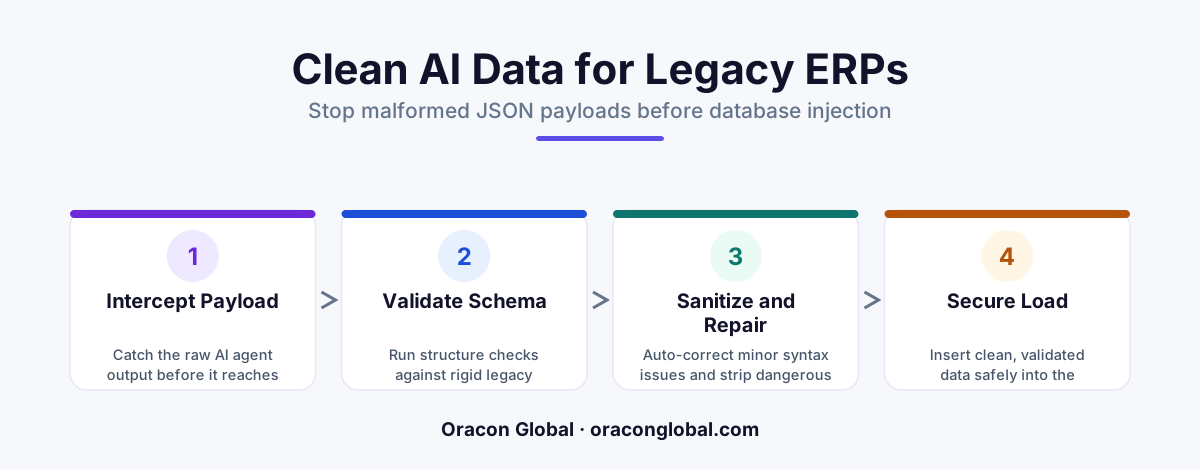
When AI agents interact with legacy ERP systems, they often generate subtle formatting errors in JSON payloads that cause system crashes. A custom middleware API sanitizer intercepts these payloads, validates them against strict schemas, and heals minor structural errors before they touch your core database.
Deploying an AI agent to handle automated data entry, purchase orders, or logistics updates can immediately free up your operations team. However, a major technical roadblock often appears when that agent attempts to write data directly back to your legacy ERP. While modern Large Language Models (LLMs) are excellent at processing complex information, they occasionally generate invalid formatting. When these malformed JSON payloads hit older database environments, the results are rarely pretty. Legacy systems expect perfect, rigid schemas, and a single misplaced comma or unescaped quote can halt production pipelines.
To keep your business running smoothly, you need a deterministic bridge between the creative output of generative AI and the unforgiving rules of your core database. Building a custom API sanitizer for AI is the most reliable way to intercept, validate, and clean data before it ever reaches your legacy ERP integrations.
The Danger of Malformed JSON Payloads in Legacy Systems
Most enterprise resource planning (ERP) databases built a decade or more ago were never designed to handle unstructured or semi-structured data. They require precise data types, exact character lengths, and strict relational integrity. When you integrate an AI agent to read supplier emails or invoices and update inventory, the agent must translate that text into a structured format, usually JSON.
Even when using advanced prompt engineering or native tool-calling features, AI models occasionally fail to deliver valid JSON. Common issues include:
- Unescaped Quotes: Text containing internal quotation marks (e.g., "The 12\" metal bracket") can break the JSON parser.
- Truncated Payloads: If the model hits its token limit mid-response, it might leave bracket pairs open.
- Conversational Bleed: The AI might prefix its output with conversational phrases like "Here is the requested JSON data:" instead of returning a clean object.
- Data Type Inconsistencies: Writing a string like "1,200" instead of an integer like 1200, which database fields fail to process.
Without an intermediary verification step, these malformed JSON payloads will either trigger database connection errors, lock tables, or corrupt records. This requires manual engineering intervention to clean up the logs and restart the automated queues.
Architecting a Multi-Vendor API Sanitizer
Instead of letting your AI agent talk directly to your ERP, you should route all agentic outputs through a lightweight, custom middleware layer. This is where your multi-vendor API sanitizer lives. Think of it as an intelligent firewall designed specifically for data formatting.
This middle layer handles three distinct phases: interception, healing, and validation.
1. Interception and Extraction
The sanitizer first receives the raw text output from the AI. Using strict regex and parsing algorithms, it isolates the JSON structure from any conversational fluff. If the agent appended conversational text before or after the JSON block, the sanitizer strips it away instantly.
2. Deterministic JSON Healing
If the JSON is broken, the sanitizer does not simply reject it. It runs the payload through a series of deterministic healing rules. For instance, if there is a missing closing brace or bracket due to a truncated response, the sanitizer automatically appends the matching character. It also escapes rogue double quotes inside text fields and normalizes inconsistent number formats.
3. Strict Schema Validation
Once the syntax is physically clean, the sanitizer validates the payload against a hardcoded schema mapped directly to your legacy ERP integrations. It checks that all required fields are present, date formats match (e.g., converting "MM/DD/YYYY" to ISO 8601), and string lengths fit within the database's column limits.
Managing Multi-Vendor Complexity Safely
Enterprise operations rarely rely on a single vendor or software platform. Your AI agent might need to parse data from a logistics provider's API, match it with a supplier's catalog, and write the final record to your accounting database. Each of these vendors has slightly different API formats and data rules.
A robust API sanitizer handles this by using vendor-specific schema modules. When the AI agent initiates a task, the sanitizer identifies the destination system and loads the corresponding validation profile. This decoupling of AI logic from database logic ensures that you can update individual vendor schemas without having to retrain or adjust your AI agent prompts.
By implementing this AI agent database validation step, you protect your core systems from unpredictable model updates. If a foundation model provider updates their LLM backend and changes the default formatting style, your sanitizer absorbs the shock, keeping your core business operations uninterrupted.
Building vs. Buying Your AI Integration Layer
While some cloud providers offer generic JSON parsing utilities, they rarely understand the nuanced business rules of your custom workflows or the rigid requirements of older ERP setups. Off-the-shelf tools often fail silently when faced with complex, nested objects or legacy database schemas.
A custom-built API sanitizer gives your team absolute control over the data flow. Because you own the middleware, you can write specific recovery routines that fit your business. For instance, if an automated purchase order payload fails validation because a vendor SKU is missing, the sanitizer can route that specific item to a human review queue while letting the rest of the valid order process immediately.
At Oracon Global, we build robust AI agents, workflow automation systems, and secure integration middleware. Our senior in-house team specializes in bridging the gap between modern generative models and legacy systems, ensuring that your enterprise automation operates reliably without risking database stability. Best of all, we build with a focus on complete IP ownership, meaning you own 100% of your custom integration code and sanitizer logic.
If you are ready to stabilize your automated workflows and secure your business databases from unpredictable AI outputs, reach out to the engineering team at Oracon Global today. Let’s discuss how we can build a secure, resilient integration layer for your business.
Frequently asked questions
Why do AI agents generate broken JSON if they are configured to output structured data?
Even with system prompts and JSON schema enforcement, LLMs can occasionally truncate outputs, escape characters incorrectly, or insert conversational text into the payload when processing complex, multi-vendor data.
Can we use standard API gateways to solve this formatting issue?
Standard gateways usually block invalid requests entirely, which halts the automation. A custom API sanitizer actively heals minor JSON syntax errors and formats the data to match legacy ERP expectations without human intervention.
Does implementing a sanitizer layer increase system latency?
Minimal. By building a lightweight parser in languages like Node.js or Python on the edge, the validation and correction take only milliseconds, which is negligible compared to the execution time of the LLM itself.
Who owns the intellectual property of the custom sanitizer we build with Oracon?
You do. Oracon Global operates on a strict custom development model where our clients retain 100% ownership of the code, integration scripts, and IP.
Read next
Beyond Chatbots: How to Build AI Agents That Actually Do Work for Your Business
Most businesses use AI to answer questions. Here is how to build custom AI agents that actually take action, connect to your internal tools, and handle complex workflows.
Beyond the Wrapper: How to Build Custom AI Agents for Business That Actually Work
Many businesses invest in basic AI wrappers only to find they lack the security and context needed for real work. Here is how to build custom AI agents that integrate deeply with your workflows and databases.
Enterprise AI Maintenance Costs: Budgeting for Year Two and Beyond
Building an AI system is only half the battle. Discover the practical, ongoing operational costs of enterprise AI, including token management, model drift, and continuous security audits.
Oracon Global builds production-grade AI agents, automation and apps — and you own the code and IP. Tell us what you want to automate.
Book a call →See our work