

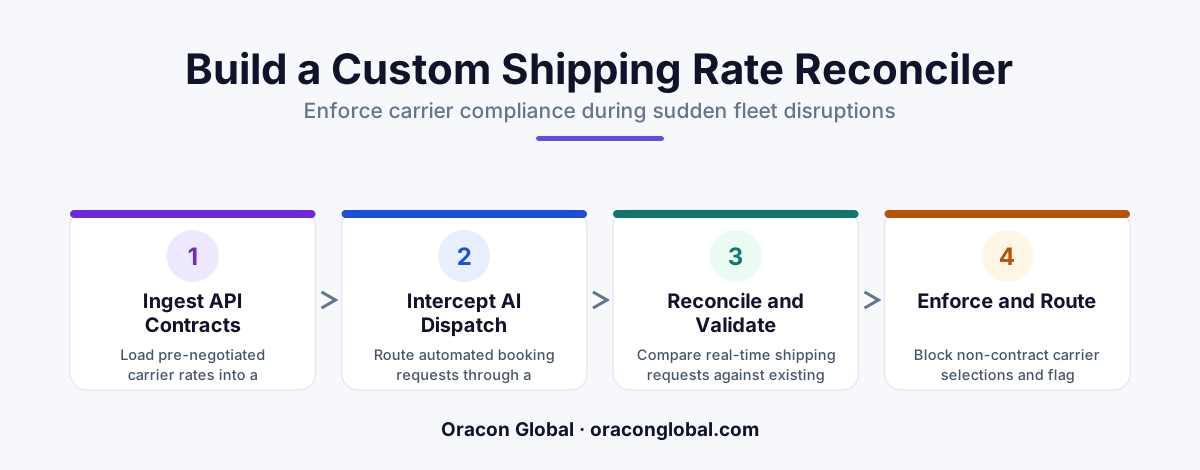
Fleet disruptions shouldn't force your autonomous shipping systems into expensive, non-compliant booking decisions. By wrapping your AI dispatch agents in a custom multi-vendor shipping rate reconciler, you can programmatically enforce carrier contracts, preserve spot-rate boundaries, and keep your logistics margins intact automatically.
When a major storm blocks a shipping lane or a regional fleet operator experiences a sudden capacity crunch, logistics teams go into survival mode. Historically, human dispatchers would spend hours on the phone scrambling to find alternative trucks. Today, autonomous AI dispatch agents can handle these disruptions in seconds, rerouting freight and booking alternative capacity without breaking a sweat.
But this speed comes with a hidden financial risk. If your AI dispatch agents are optimized solely for delivery speed or fulfillment rates, they will solve disruptions by booking any carrier that has an open bed. Without strict guardrails, an autonomous agent can easily bypass your hard-won corporate carrier agreements, booking expensive spot-market rates with non-contract carriers. These compliance slips can quietly erode your shipping margins by thousands of dollars per day.
To prevent these costly booking errors, modern logistics platforms require a dedicated compliance layer. Here is how to build a custom shipping rate reconciler that keeps your AI dispatch agents honest, compliant, and cost-effective, even when your primary fleet is disrupted.
The Structural Flaw in Purely Agentic Logistics
Many companies integrate AI agents directly with their Transportation Management Systems (TMS) and carrier APIs, expecting the model to make smart financial decisions on the fly. However, Large Language Models (LLMs) are not native calculators. When faced with a complex grid of shipping lanes, fuel surcharges, and accessorial fees, an agent cannot reliably calculate the true cost of a shipment against a static contract PDF or a legacy database table.
When a primary carrier rejects a tender during a fleet disruption, the AI agent's primary goal is to resolve the exception. If it has direct access to public freight exchanges, it will select the first available vehicle that matches the route requirements, regardless of whether that carrier is on your approved vendor list. To prevent this, you must separate the decision-making intelligence of the AI from the mathematical and regulatory enforcement of your business rules.
How a Multi-Vendor Shipping Rate Reconciler Works
A custom shipping rate reconciler acts as an API-driven gatekeeper. Instead of allowing your AI dispatch agents to book carriers directly, all booking payloads must pass through a programmatic reconciliation layer. This layer compares the agent's proposed booking against your real-time contract database before any digital signature or financial commitment is made.
This architecture relies on three core operational pillars:
- The Contract Ledger: A structured, highly performant database containing your negotiated rates, approved carriers, active shipping lanes, and allowed margin tolerances for spot bookings.
- The Real-Time Rate Aggregator: An API middleware layer that pulls live spot rates, fuel surcharges, and transit times from your contracted carriers.
- The Compliance Gatekeeper: A deterministic rules engine that evaluates the AI agent's proposed route and issues a hard "Go" or "No-Go" response based on contract alignment.
Step 1: Standardizing Multi-Vendor Carrier Schemas
The first hurdle in building a robust shipping rate reconciler is data fragmentation. Every carrier—whether a global logistics giant or a regional short-haul provider—exposes different API payload formats, legacy EDI standards, or XML spreadsheets. Your AI dispatch agent cannot reliably parse these conflicting formats on its own without making formatting errors.
Your reconciler must feature a translation layer that normalizes all incoming carrier data into a single, standardized JSON schema. This schema should clearly define flat rates, mileage charges, fuel adjustments, and accessory fees. Once standardized, your rules engine can compare apples to apples instantly.
Step 2: Defining Dynamic Spot-Rate Tolerances
During a severe disruption, sticking 100% to your contract carrier list might be physically impossible. If your contracted partners have zero capacity, you need a safe way to access the spot market. A custom reconciler allows you to define dynamic tolerances.
For example, you can program your system to allow the AI agent to book a non-contract carrier only if the spot rate is within 8% of the typical contract rate for that specific lane, and only after three contracted carriers have officially rejected the tender. If the rate exceeds that threshold, the reconciler pauses the transaction and routes the ticket to a human logistics manager for approval.
Step 3: Creating a State Machine for Dispatch Workflows
An AI agent should never be allowed to execute a booking in a single, unverified step. Instead, the process must be governed by a strict, state-based workflow. The AI agent proposes a booking, transitioning the transaction state to Pending_Reconciliation. The reconciler evaluates the proposal and either promotes it to Approved_Ready_To_Book or demotes it to Rejected_Compliance_Violation. This ensures that even if the AI model experiences a hallucination, your financial systems remain completely protected.
Why Off-the-Shelf Software Often Falls Short
Many enterprise TMS platforms claim to have built-in rate calculators, but they are rarely designed to play nice with autonomous AI workflows. They often lack real-time API feedback loops, meaning your AI agent won't know why a transaction was blocked, causing it to stall or repeat the same incorrect booking attempt indefinitely.
A custom-built solution, designed specifically for your company's unique vendor relationships and tech stack, allows you to:
- Retain 100% IP Ownership: You own the code, the integration pipelines, and the compliance logic, freeing you from restrictive vendor licensing fees.
- Integrate Proprietary Contract Formats: No matter how messy your carrier contracts are, a custom pipeline can parse, clean, and store them securely.
- Maintain Zero-Latency Validations: Custom lightweight microservices can validate shipping bids in milliseconds, keeping your automated logistics pipeline moving at speed.
Keep Your Operations Moving Safely
Automating your logistics with AI dispatch agents is a highly effective way to cut down response times and keep your supply chain moving during unpredictable fleet disruptions. However, autonomous speed must never come at the expense of fiscal discipline. By implementing a custom shipping rate reconciler, you can confidently delegate high-volume dispatch tasks to digital employees, knowing your carrier agreements and operating margins are fully protected by hardcoded, deterministic guardrails.
Are you ready to secure your automated logistics pipelines and build custom AI-driven workflows that protect your bottom line? Contact the senior in-house development team at Oracon Global today to discuss how we can build your custom dispatch engines and compliance systems.
Frequently asked questions
Why do AI dispatch agents select non-contract carriers during disruptions?
AI agents are often optimized for speed or fulfillment rates, meaning they will book any available truck to resolve a delay if they lack a hardcoded compliance and rate reconciliation boundary.
How does a custom shipping rate reconciler prevent these booking errors?
It acts as an API-level gatekeeper that intercepts the agent's booking request, compares the selected rate and carrier against contract databases, and rejects the action if it violates compliance rules.
Can this system handle real-time spot market rate fluctuations?
Yes, by integrating live carrier APIs and private contract rate tables, the reconciler can dynamically evaluate whether a spot rate is acceptable or if it requires human intervention.
Do we need to rebuild our existing transportation management system (TMS) to use this?
No, a custom reconciler runs as a lightweight middleware layer that sits between your AI dispatch agents, your legacy TMS, and external carrier APIs.
Read next
Beyond Chatbots: How to Build AI Agents That Actually Do Work for Your Business
Most businesses use AI to answer questions. Here is how to build custom AI agents that actually take action, connect to your internal tools, and handle complex workflows.
Beyond the Wrapper: How to Build Custom AI Agents for Business That Actually Work
Many businesses invest in basic AI wrappers only to find they lack the security and context needed for real work. Here is how to build custom AI agents that integrate deeply with your workflows and databases.
Enterprise AI Maintenance Costs: Budgeting for Year Two and Beyond
Building an AI system is only half the battle. Discover the practical, ongoing operational costs of enterprise AI, including token management, model drift, and continuous security audits.
Oracon Global builds production-grade AI agents, automation and apps — and you own the code and IP. Tell us what you want to automate.
Book a call →See our work