

When logistics AI agents book cargo autonomously, they often rely on stale cached data, leading to customs clearance failures. By building an intermediary tariff auditor that cross-references live World Customs Organization databases and multi-vendor API registries before any booking completes, you can prevent compliance errors and border delays.
Autonomous AI digital employees are transforming logistics by handling freight bookings, generating bills of lading, and dispatching cargo in seconds. However, these systems have a critical vulnerability: they are only as accurate as the data they access. When an AI agent relies on cached database records or historical shipping templates, it risks booking cargo using expired Harmonized System (HS) codes.
Every year, international customs authorities update HS codes to reflect new trade classifications, environmental regulations, and safety standards. If an AI shipping agent submits an outdated code, your cargo risks border delays, expensive warehousing fees, and regulatory penalties. To prevent these costly bottlenecks, you need a dedicated safety layer: a custom multi-vendor customs tariff auditor.
The Risk of Unchecked AI Bookings in Logistics
When human logistics operators book international cargo, they rely on experience, updated compliance checklists, and manual verification tools. AI agents, on the other hand, operate at speed. They scan historical commercial invoices, match description keywords to tariff schedules, and execute API calls to carrier systems almost instantly.
While this speed is a massive advantage for operational efficiency, it removes the natural human pause that catches errors. If your core ERP database contains an outdated HS code mapping from three years ago, the AI agent will confidently use it. This creates a hidden operational hazard where compliance errors are propagated at scale across thousands of shipments before your team even notices.
How a Custom Customs Tariff Auditor Protects Your Workflows
A custom customs tariff auditor is a lightweight software middleware layer that sits directly between your AI digital employees and your shipping booking engines. Instead of allowing the AI agent to write directly to carrier APIs or legacy ERP ledgers, all outgoing booking payloads must pass through this auditing gate first.
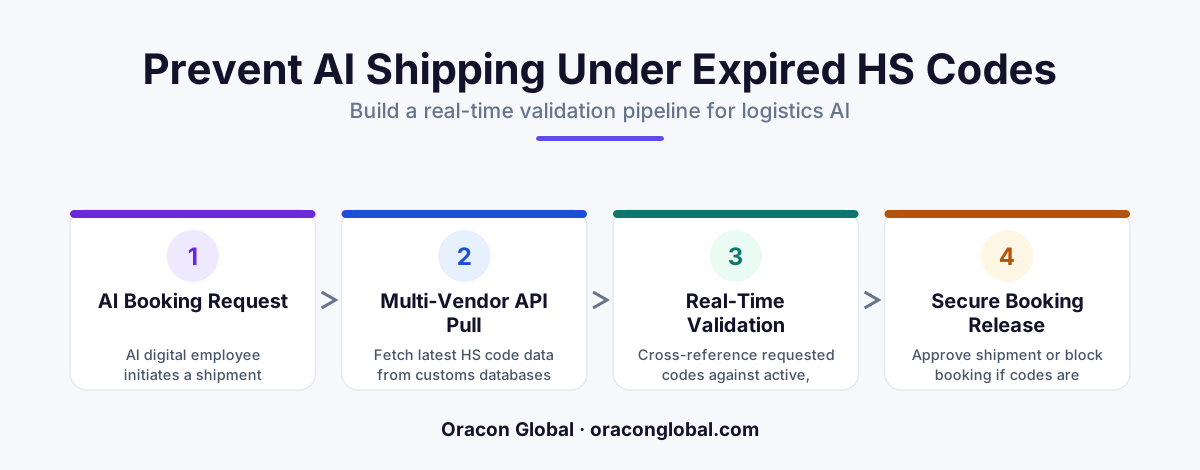
Here is how the system intercepts and validates data in real time:
- Interception: The AI shipping agent generates a booking payload containing cargo details, origin, destination, and the proposed HS code.
- Validation Request: Before the booking is finalized, the auditor extracts the HS code and queries live global tariff databases and multi-vendor customs APIs.
- Compliance Check: The system verifies if the code is currently active, checks for upcoming expiration dates, and confirms if any localized tariff adjustments apply to the shipping route.
- Resolution or Routing: If the code is valid, the booking proceeds. If the code is expired or invalid, the auditor halts the transaction and routes the ticket to a human compliance officer for correction.
The Multi-Vendor API Integration Layer
A major challenge in global shipping is that no single database holds every localized tariff rule. While the World Customs Organization (WCO) maintains the core six-digit HS codes, individual nations append their own digits for duty classification, such as the HTS codes in the United States or TARIC codes in Europe.
To build a robust system, your tariff auditor must aggregate data from multiple third-party customs APIs, national trade portals, and internal compliance wikis. The auditor normalizes these varied data sources into a single, clean JSON structure that your AI agent can read and understand dynamically. This multi-vendor approach ensures your compliance check is accurate, regardless of where the cargo is loading or discharging.
Designing the Exception Queue for Human Intervention
An automated auditor should not try to fix complex compliance issues autonomously. If a tariff code is expired, the system must trigger a deterministic escape hatch. Rather than allowing the AI to guess a replacement code—which can lead to compounding hallucination errors—the system places the booking into an operational exception queue.
Your team is presented with a simple dashboard showing the flagged shipment, the expired HS code, and recommended, valid alternatives pulled by the auditor. With a single click, a human operator can approve the correction. This hybrid approach keeps your logistics operations highly automated while ensuring that absolute regulatory decisions remain under human control.
The Benefits of Custom Code Over Off-the-Shelf SaaS
Many logistics companies rely on off-the-shelf software subscriptions to manage compliance. However, these generic platforms often lack the flexible API endpoints required to integrate seamlessly with custom-built AI agents. They can also introduce unpredictable licensing costs as your shipment volume scales.
Building a custom customs tariff auditor gives you complete control over your technical infrastructure. There are no monthly seat fees, and you can customize the validation rules to match your specific product categories, trade routes, and supplier networks. Best of all, you retain 100% ownership of the code and intellectual property, protecting your company's proprietary operational workflows.
Safeguard Your Agentic Operations with Oracon Global
Automating your supply chain with AI digital employees offers an incredible competitive edge, but only if you build the safety nets necessary to protect your business from costly compliance errors. At Oracon Global, our senior in-house engineering team designs and builds custom AI agents, workflow automations, and robust middleware layers that keep your operations running smoothly and securely.
We work with logistics providers, distributors, and global enterprises to build scalable software solutions tailored to their exact business logic. Want to see how we can help secure your shipping and fulfillment pipelines? Get in touch with our team today to discuss your next custom project.
Frequently asked questions
Why do AI shipping agents use expired HS codes?
AI agents often rely on historical shipping data, static local databases, or cached files that do not reflect the frequent, real-time updates made to the global Harmonized System.
How does a custom tariff auditor solve this issue?
It acts as an automated compliance gate between the AI agent and your shipping booking system, validating every proposed HS code against live international tariff registries before the booking is executed.
Can we build this without replacing our existing logistics ERP?
Yes. A custom auditor can sit as a lightweight middleware layer that intercepts API requests from your AI agent, verifies the payload, and then forwards the approved data to your legacy ERP.
Do we need to pay recurring software licenses for this tool?
Not if you build it custom. By choosing custom development with a studio like Oracon, you own 100% of the code and intellectual property, avoiding ongoing seat-licensing fees.
Read next
Beyond Chatbots: How to Build AI Agents That Actually Do Work for Your Business
Most businesses use AI to answer questions. Here is how to build custom AI agents that actually take action, connect to your internal tools, and handle complex workflows.
Beyond the Wrapper: How to Build Custom AI Agents for Business That Actually Work
Many businesses invest in basic AI wrappers only to find they lack the security and context needed for real work. Here is how to build custom AI agents that integrate deeply with your workflows and databases.
Enterprise AI Maintenance Costs: Budgeting for Year Two and Beyond
Building an AI system is only half the battle. Discover the practical, ongoing operational costs of enterprise AI, including token management, model drift, and continuous security audits.
Oracon Global builds production-grade AI agents, automation and apps — and you own the code and IP. Tell us what you want to automate.
Book a call →See our work