

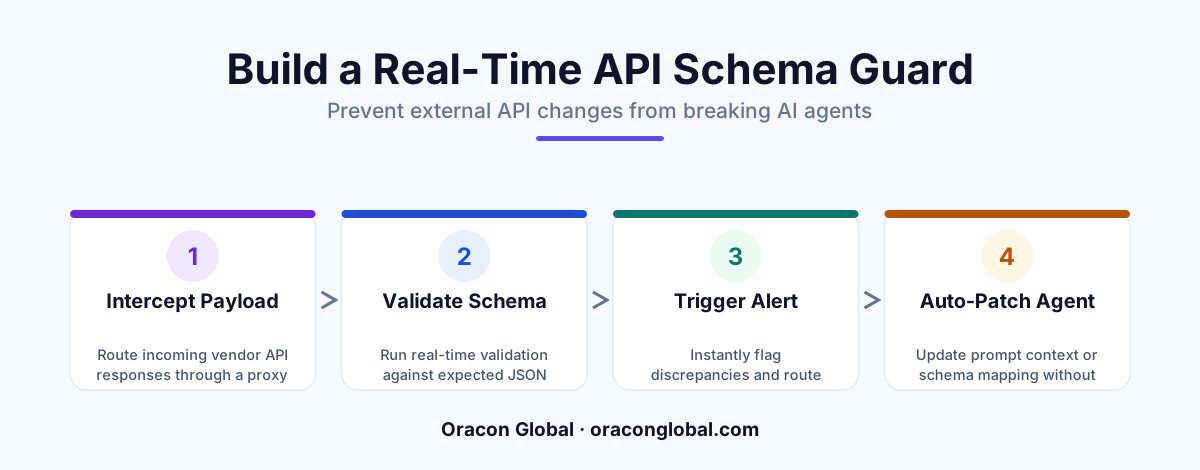
An AI agent relies on predictable API data structures to execute its tools. A real-time schema guard acts as an active validation layer between your agent and external systems, parsing payloads against strict specifications and translating discrepancies to prevent agentic crashes.
When a human operator encounters a slightly modified data export, they use context to adapt. If a vendor changes a column header from "delivery_date" to "expected_delivery," a human reads the screen, makes the mental leap, and continues working. AI agents do not have this luxury.
Production AI agents rely on rigid, deterministic tools to interact with the physical and digital world. When an external vendor quietly deprecates a payload field or modifies an API response schema, the agent’s underlying tool integration fails. Because the agent receives unexpected data, it either halts mid-workflow, attempts to hallucinate a path forward, or passes corrupted values down the line. To maintain AI agent reliability, engineering teams must deploy defensive infrastructure.
A real-time schema guard acts as an active, automated firewall between your autonomous agents and the volatile external APIs they depend on. Here is how to construct a resilient validation layer that prevents silent system failures when third-party software changes without warning.
The Hidden Threat of Silent API Deprecations
Most modern enterprises integrate their custom workflows with dozens of external software platforms, from shipping portals to legacy accounting engines. While major API version updates are usually announced months in advance, minor structural modifications often slip through unnoticed. A field might shift from mandatory to optional, a date format might lose its timezone offset, or a nested object might be flattened into a simple string.
Standard software applications throw explicit trace errors when faced with these changes, allowing developers to debug the API integration. However, an AI agent interacting with a broken tool response may try to self-correct by inventing data to fit its system prompt. This results in silent data corruption, where the system records incorrect values without raising a traditional error flag.
Anatomy of a Real-Time Schema Guard
To defend your operational workflows against external API volatility, you need an intermediary layer that sits between the external API client and your AI agent's tool execution environment. The schema guard performs three vital tasks: validation, translation, and containment.
1. Structural Validation at the Edge
Every payload returned from an external vendor must be intercepted before it reaches the agent's context window. Using lightweight serialization libraries, the schema guard validates the incoming JSON or XML against a strict local schema definition. If the payload meets the structural contract, it passes through instantly with negligible latency.
2. Automated Fallback and Translation
If the validation check fails due to missing, renamed, or restructured fields, the guard initiates a translation sequence. It references a local mapping table to check if the missing data has simply been relocated or renamed. If the change is minor, the guard dynamically rewrites the payload to match the schema expected by the AI agent, allowing the automated workflow to continue uninterrupted.
3. Isolated Isolation Queues
When an external payload suffers a major structural break that cannot be programmatically resolved, the schema guard halts that specific agent thread. Instead of letting the agent fail silently or crash the entire system, the payload is routed to an isolation queue. The system alerts an operator while preserving the state of the workflow, preventing broken data from corrupting downstream databases.
Step-by-Step: Implementing the Guard Layer
Building an effective guard layer does not require rewriting your entire codebase. You can implement this pattern using a structured, three-tiered approach:
- Define Local Contracts: Maintain strict, declarative schema definitions for every external API endpoint your agent accesses. These local schemas serve as the absolute source of truth.
- Deploy Validation Middleware: Position a fast, event-driven validation gateway in front of your agent's API tools. This gateway checks every incoming payload against your local contracts in real-time.
- Build a Semantic Translation Path: When validation fails on a non-critical field, route the malformed payload to a fast-execution schema translator. This translator can use a deterministic mapping script to realign the payload structure.
By decoupling the raw external API response from the agent's input parameters, you build an isolated environment where changes in external software are handled gracefully at the infrastructure level rather than breaking your production business processes.
Owning Your Agent Infrastructure
Relying on brittle, direct integrations with third-party APIs leaves your automated workflows vulnerable to external development cycles. Building defensive infrastructure like schema guards ensures your digital employees remain online, accurate, and predictable.
At Oracon Global, our senior in-house team designs and delivers resilient, custom AI agents, workflow automations, and enterprise software solutions. We build production systems with built-in redundancies, and our clients retain 100% ownership of their code and intellectual property. If you want to build durable, production-grade systems that withstand the realities of changing digital ecosystems, contact Oracon Global today.
Frequently asked questions
Why can't LLMs handle changed API payloads automatically?
While LLMs are flexible, they expect structured tool outputs to match their system instructions. A missing or renamed field causes the agent to pass invalid parameters to subsequent steps, triggering a silent logic failure.
How does a schema guard differ from standard API monitoring?
Standard monitoring alerts you after a failure occurs. A schema guard dynamically intercepts the malformed payload, maps it to the expected structure if possible, or routes it to an isolated queue before it pollutes your database.
Does adding a validation layer introduce noticeable latency?
No. When built with lightweight serialization frameworks, validation takes only a few milliseconds, which is negligible compared to the latency of an LLM call.
Can we build this without rewriting our existing integrations?
Yes. A schema guard functions as a lightweight middleware layer that sits in front of your external API gateways, meaning your core application code remains untouched.
Read next
Beyond Chatbots: How to Build AI Agents That Actually Do Work for Your Business
Most businesses use AI to answer questions. Here is how to build custom AI agents that actually take action, connect to your internal tools, and handle complex workflows.
Beyond the Wrapper: How to Build Custom AI Agents for Business That Actually Work
Many businesses invest in basic AI wrappers only to find they lack the security and context needed for real work. Here is how to build custom AI agents that integrate deeply with your workflows and databases.
Enterprise AI Maintenance Costs: Budgeting for Year Two and Beyond
Building an AI system is only half the battle. Discover the practical, ongoing operational costs of enterprise AI, including token management, model drift, and continuous security audits.
Oracon Global builds production-grade AI agents, automation and apps — and you own the code and IP. Tell us what you want to automate.
Book a call →See our work