

AI agents struggle with the rigid, unforgiving schemas of legacy invoicing APIs, often sending slightly malformed data that triggers system-wide crashes. By building an intermediary real-time API payload sandbox, businesses can catch, validate, and auto-repair AI-generated payloads in a safe environment before they ever touch production accounting software.
When you deploy AI digital employees to handle automated invoice processing, the initial results usually look spectacular. The AI reads incoming emails, extracts billing line items, matches purchase orders, and drafts the necessary data. But the moment you connect that AI to a legacy invoicing API, friction begins.
Legacy billing systems, enterprise resource planning (ERP) software, and older accounting databases are notoriously fragile. They do not tolerate minor formatting shifts. While a modern system might ignore an extra whitespace or a slightly nested JSON object, a legacy invoicing API will simply crash, lock the database table, or throw a generic internal server error. Because Large Language Models (LLMs) are probabilistic, they occasionally generate output structures that deviate from rigid API schemas.
To prevent these failures without babysitting your automation, you need an intermediary buffer: a real-time API payload sandbox. This system intercepts AI-generated data, validates it in an isolated environment, repairs structural mutations on the fly, and guarantees that only pristine payloads reach your core financial systems.
The Structural Friction Between Probabilistic AI and Rigid APIs
Modern AI agents are exceptional at understanding unstructured data, but they struggle with absolute deterministic precision. A legacy invoicing API expects data to look exactly like its schema map, which might have been written fifteen years ago. If the API requires a date format of YYYY-DD-MM, but the AI outputs YYYY-MM-DD, the transaction fails.
Common issues that trigger API integration errors when AI interacts with legacy systems include:
- Array nesting mismatches: The AI wraps single invoice line items inside a nested list when the API expects a flat key-value structure.
- Type coercion failures: The AI outputs a tax rate as a string (e.g.,
"0.08") instead of a float (0.08) or an integer representing cents. - Missing required non-nullable fields: The AI skips an empty optional field like "Address Line 2", but the legacy database expects the key to exist with a null value rather than being omitted entirely.
- Character encoding issues: The AI injects special unicode characters or emojis from raw emails that the legacy SQL database cannot process, causing a database write failure.
How a Real-Time API Payload Sandbox Works
Instead of allowing your AI digital employee to talk directly to the production invoicing endpoint, you route the AI's outbound tools to a sandbox validation layer. This layer acts as a virtual runtime environment specifically designed to stress-test and clean the data before transmission.
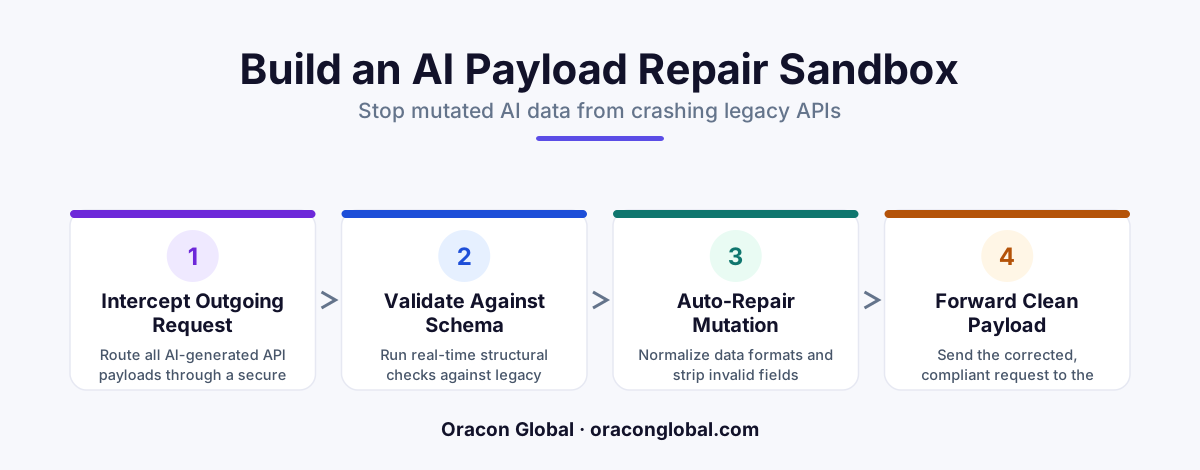
Step 1: The Interception and Parsing Stage
When the AI agent decides to create an invoice, it executes its database tool. Instead of sending the POST request directly to the ERP, the tool directs the payload to the sandbox. The sandbox immediately serializes the payload and duplicates it into an isolated state container.
Step 2: Strict Schema Validation
The sandbox runs the payload through a strict, code-defined schema validator (using tools like JSON Schema or Zod). Unlike the legacy API, which might fail silently or lock up, the sandbox validator returns extremely specific, structured errors. It pinpoints exactly which field is broken, what type was received, and what type was expected.
Step 3: The Automated Repair Loop
If the validator identifies a structural issue, the sandbox does not immediately give up. It applies deterministic, code-based transformation rules to patch common mistakes. For example, if a date is formatted incorrectly, a simple helper function reformats it. If a string is provided where an integer is required, the sandbox casts the variable safely. This step ensures that minor, easily correctable variations are resolved in milliseconds without human intervention.
Step 4: Safe Forwarding and State Syncing
Once the sandbox confirms the payload matches the target schema perfectly, it releases the data to the production legacy invoicing API. Because the data has been scrubbed and verified, the ERP processes the transaction successfully on the first attempt, maintaining a 100% database write success rate.
Architecting the Sandbox: Three Essential Components
Building an effective payload sandbox does not require rebuilding your legacy infrastructure. Instead, it relies on a clean, lightweight middle-tier architecture. A robust implementation requires three primary technical components:
1. Deterministic Type Castters and Fallbacks
Never rely on the LLM to self-correct its own payload structures via prompt engineering. Prompting an AI to "always return valid JSON matching this schema" works most of the time, but not all of the time. Your sandbox must use hardcoded, deterministic programming rules to sanitize, cast, and restructure the incoming data objects.
2. An Isolated Simulation Log
The sandbox should log every validation failure, original payload, repaired payload, and final API response. This creates an invaluable audit trail. By reviewing these logs, your engineering team can identify if the AI is consistently struggling with a specific type of invoice, allowing you to update the system prompts or schema mappings accordingly.
3. A Human-in-the-Loop Exception Queue
If the sandbox encounters an invalid payload that it cannot programmatically repair (for example, if a critical field like "Grand Total" is missing entirely), it must hold the transaction. Instead of letting the AI fail silently or crash the system, the sandbox flags the invoice and routes it to a simple admin dashboard where an operator can manually input the missing data and approve the release with a single click.
Securing Your Financial Automation with Oracon Global
Deploying AI digital employees to handle core back-office operations like automated invoice processing can save your business thousands of hours. However, without a dedicated validation layer, connecting autonomous systems to legacy infrastructure creates unnecessary operational risk.
At Oracon Global, our senior in-house development team specializes in building robust, production-grade AI integrations that respect your existing technology stack. We design and deliver custom software, AI agent networks, and resilient middleware platforms that keep your legacy systems safe while maximizing the efficiency of your digital workforce. Best of all, we build with clean architectures where our clients own 100% of the code and intellectual property.
Ready to build robust AI automations that integrate flawlessly with your legacy accounting databases? Contact the engineering team at Oracon Global today to schedule a consultation.
Frequently asked questions
Why do AI digital employees send broken payloads to legacy APIs?
Large Language Models are probabilistic and naturally creative, which means they can occasionally output minor variations in JSON or XML structures, missing required fields or nesting arrays incorrectly. While modern APIs might handle this gracefully, rigid legacy invoicing APIs usually fail or crash when receiving unexpected formats.
What is a real-time API payload sandbox?
It is an isolated intermediary service that intercepts data payloads generated by an AI agent, tests them against strict schema validation rules in real-time, and either repairs them automatically or routes them to a human queue if they cannot be fixed safely.
Does this sandbox replace the existing invoicing API?
No. The sandbox sits entirely between your AI digital employee and your legacy invoicing API, acting as a smart safety buffer that ensures only perfect, production-ready data is forwarded to your core accounting records.
How much development effort does a payload sandbox require?
It requires setting up a lightweight validation engine, schema maps, and an automated repair loop, which is a standard middle-tier development task that saves hundreds of hours of manual database troubleshooting and API maintenance down the line.
Read next
Beyond Chatbots: How to Build AI Agents That Actually Do Work for Your Business
Most businesses use AI to answer questions. Here is how to build custom AI agents that actually take action, connect to your internal tools, and handle complex workflows.
Beyond the Wrapper: How to Build Custom AI Agents for Business That Actually Work
Many businesses invest in basic AI wrappers only to find they lack the security and context needed for real work. Here is how to build custom AI agents that integrate deeply with your workflows and databases.
Enterprise AI Maintenance Costs: Budgeting for Year Two and Beyond
Building an AI system is only half the battle. Discover the practical, ongoing operational costs of enterprise AI, including token management, model drift, and continuous security audits.
Oracon Global builds production-grade AI agents, automation and apps — and you own the code and IP. Tell us what you want to automate.
Book a call →See our work