

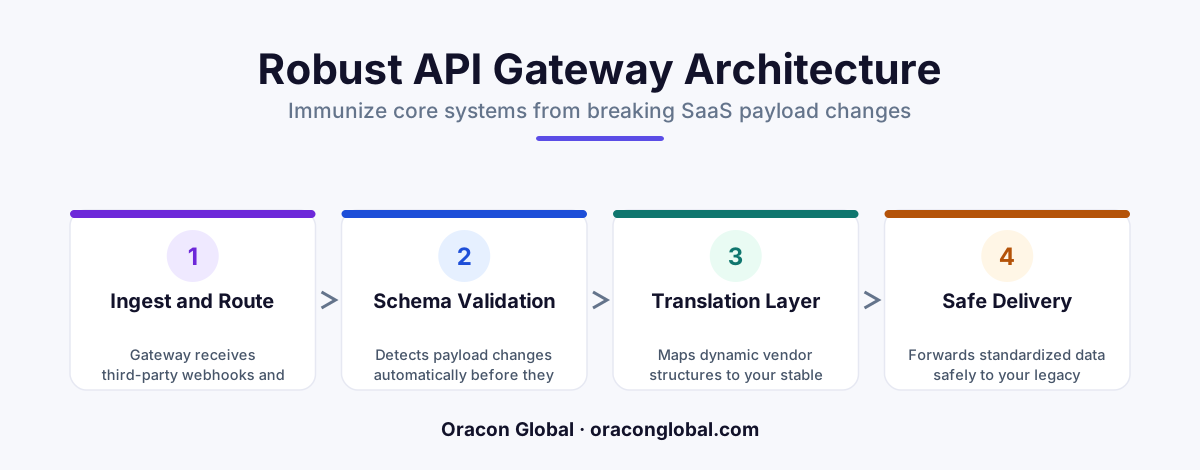
Downstream API updates frequently break brittle legacy integrations. By placing a custom API gateway with an inline schema translation layer between your systems and your vendors, you can intercept, normalize, and validate payloads to ensure uninterrupted business workflows.
In a perfectly designed digital ecosystem, every software partner would give months of advance notice before changing their API payloads. They would run immaculate versioning strategies, keep their documentation flawlessly updated, and never deprecate a nested field without warning.
In the real world, downstream vendors push updates on Friday afternoons that silently strip nested properties, rename key variables, or alter date formats. When these changes hit brittle legacy SaaS integrations, the result is immediate pipeline failure. Workflows halt, data syncs fail, and engineering teams are forced into fire-fighting mode to rewrite hardcoded integration logic.
To survive in a multi-vendor ecosystem, you cannot rely on external providers to keep their payloads static. Instead, you must build a protective buffer. A custom custom API gateway featuring an inline schema translation layer isolates your core software from downstream changes, ensuring that external modifications never break your internal business systems.
The Structural Weakness of Direct Integrations
Most legacy systems are built with tight coupling. This means the application code directly expects a specific JSON structure or XML payload from a partner's webhook or API endpoint. If a vendor changes a field from shipping_address to delivery_destination, the integration parser throws an unhandled exception.
When you rely on direct integrations, you face several compounding risks:
- Cascading Failures: A single broken endpoint in a non-critical third-party vendor can trigger database transaction rollbacks that halt unrelated core business processes.
- Lack of Visibility: When an external payload structure changes, finding the exact line of code that failed in a legacy system can take hours of log hunting.
- High Maintenance Overhead: Engineers spend valuable hours writing hotfixes for old integrations rather than building new product features.
Instead of hoping your vendors will behave, you can implement a resilient API architecture that intercepts, sanitizes, and normalizes all incoming and outgoing data before it touches your core database.
Building a Custom Gateway with Schema Translation Layers
A custom gateway acts as an intelligent intermediary. It does not simply forward packets; it reads, validates, and transforms data in flight. At the heart of this gateway is a schema translation layer.
Think of this layer as an automated bilingual interpreter. On one side, it speaks the volatile, unpredictable language of various external APIs. On the other side, it speaks the strict, immutable language of your legacy system. Even if a vendor changes how they format their data, the interpreter translates it into the precise format your legacy system expects.
Step 1: Implementing Schema Validation
The gateway must first inspect incoming payloads using declarative schemas (such as JSON Schema). When a payload arrives from a vendor, the gateway compares it against the expected model. If a field is missing, or if a data type has shifted from an integer to a string, the gateway flags the discrepancy immediately. This prevents malformed data from ever reaching your core application state.
Step 2: Dynamic Payload Mapping
Rather than hardcoding the translation logic into your application backend, the translation layer uses configuration maps. These maps define how fields in the vendor's payload correspond to your internal data structures. If a downstream vendor updates a payload, you do not need to rewrite your application code. You simply update a single configuration file on the gateway to map the new field names to your legacy schema.
Step 3: Safe Fallbacks and Default Values
If an update from a vendor omits a field that your legacy system strictly requires, the gateway can inject pre-configured default values or look up missing relational data from a local cache. This keeps the transaction alive and prevents database write errors while your team investigates the schema drift.
Decoupling Through API Versioning Middleware
An effective custom gateway also acts as your own internal API versioning middleware. It allows you to maintain stable internal endpoints for your legacy systems to consume, even if you are pulling data from four different versions of an external API simultaneously.
This design provides several distinct operational advantages:
- Graceful Degradation: If an external partner experiences a critical schema failure, the gateway can serve cached or simulated mock data to keep your user interface responsive.
- Centralized Logging and Alerting: The gateway records all schema mismatches in a central dashboard, alerting your product team to vendor changes long before users notice a system delay.
- Normalized Data Contracts: Your internal developers only have to understand one clean, well-documented data structure, rather than learning the quirky API designs of dozens of different vendors.
Ensuring Long-Term Resiliency
Building a custom gateway is not about creating a highly complex piece of infrastructure; it is about establishing a clear separation of concerns. By treating external data as inherently untrustworthy, you protect the integrity of your internal systems and shield your business from unexpected developer decisions made by your partners.
At Oracon Global, we design and build resilient backend architectures, custom integrations, and custom software systems designed to scale without breaking. If you are tired of dealing with brittle integrations and want to build a stable, future-proof API infrastructure for your business, contact Oracon Global today to discuss how we can help.
Frequently asked questions
Why do legacy SaaS integrations break so easily?
Legacy systems are typically built with strict, brittle data schemas that lack the flexibility to handle unexpected changes in downstream API keys, structures, or data formats.
What does a schema translation layer do?
It acts as an interpretive buffer between your system and third-party APIs, transforming incoming payloads into a standardized format before they reach your database.
Do we need to rewrite our legacy database to prevent these breaks?
No, a custom API gateway intercepts and reformats the data in flight, meaning your existing backend database does not need to be modified.
How does this design improve overall system resilience?
By decoupling your core application from external APIs, you isolate points of failure and can easily update translation mappings without redeploying your entire software stack.
Read next
Beyond Chatbots: How to Build AI Agents That Actually Do Work for Your Business
Most businesses use AI to answer questions. Here is how to build custom AI agents that actually take action, connect to your internal tools, and handle complex workflows.
Beyond the Wrapper: How to Build Custom AI Agents for Business That Actually Work
Many businesses invest in basic AI wrappers only to find they lack the security and context needed for real work. Here is how to build custom AI agents that integrate deeply with your workflows and databases.
Enterprise AI Maintenance Costs: Budgeting for Year Two and Beyond
Building an AI system is only half the battle. Discover the practical, ongoing operational costs of enterprise AI, including token management, model drift, and continuous security audits.
Oracon Global builds production-grade AI agents, automation and apps — and you own the code and IP. Tell us what you want to automate.
Book a call →See our work