

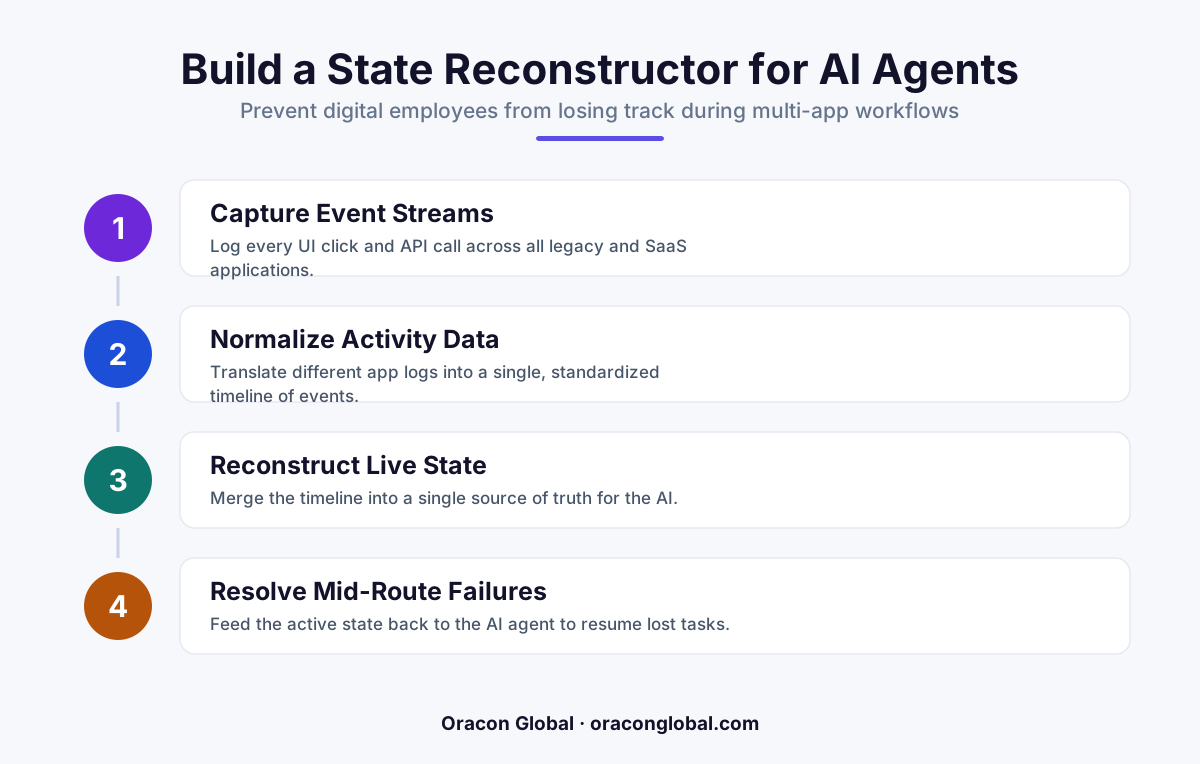
AI agents often break during multi-app transitions because traditional stateless APIs do not preserve context when a step fails or delays. By building a custom real-time state reconstructor, businesses can log, verify, and rebuild the exact operational state of an AI digital employee at any second. This structural safety net ensures automated workflows run to completion without duplicate executions or dropped data.
Imagine sending a human operations specialist to update a customer file. They open your CRM, copy an invoice number, log into a legacy billing portal, submit a credit request, and update your internal ERP. If the billing portal freezes mid-submission, the specialist knows exactly what they did, what failed, and where to pick up the pieces.
Now, assign the same task to an autonomous AI agent. When the billing portal stalls for ten seconds, the agent often loses its place. Lacking a human's intuitive memory, the agent might retry the transaction and cause a double charge, or assume the task succeeded and close the file prematurely. This is the challenge of running AI digital employees across multi-app workflows: without a shared, resilient memory of the journey, automations break at the seams between applications.
To solve this, modern enterprise architectures use a real-time state reconstructor. This specialized software layer tracks every step an AI agent takes across different applications, ensuring that if a system stalls, the agent can reconstruct exactly where it left off and complete the job safely.
The Structural Flaw in Stateless Multi-App Workflows
Most business applications communicate through stateless APIs. When an AI agent queries a database, sends a webhook, or posts data to a CRM, each transaction is treated as an isolated event. The system processing the request has no concept of what the agent did three seconds ago in a different application.
In a complex workflow, this statelessness creates dangerous blind spots. If your AI digital employee is managing an order reconciliation that touches three separate systems, a single delayed API response can derail the entire process. The agent is left in an indeterminate state, unable to answer basic operational questions:
- Did the target system receive the data before it timed out?
- Is the pending transaction a duplicate or a new request?
- Which database holds the current source of truth for this specific step?
Without a way to resolve these questions, the agent either halts, requiring human intervention, or worse, continues executing steps based on outdated or incorrect assumptions. This is where API transition errors turn simple automation runs into messy database cleanups.
What is a Real-Time State Reconstructor?
A real-time state reconstructor acts as an independent flight recorder for your automated processes. Instead of relying on individual applications to keep track of a multi-step journey, the reconstructor sits between your AI agents and your software suite. It captures, timestamps, and indexes every event, outbound payload, and incoming webhook response.
If an AI agent encounters an error or a network delay while transitioning between apps, it does not guess what to do next. Instead, it queries the state reconstructor. The reconstructor analyzes the event timeline and presents a verified, unified picture of the workflow state. This allows the agent to safely resume, retry, or gracefully escalate the task to a human supervisor.
The Core Architecture of a State Reconstructor
Building an effective state reconstructor does not require a complete rewrite of your core systems. Instead, it is built as a highly resilient middleware layer designed around three core components:
- The Event Ledger: A lightweight, append-only data store that logs every action token, payload signature, and system response associated with a specific workflow run.
- The Correlation Engine: A logic layer that maps disparate identifiers (such as a CRM ticket ID, a billing portal invoice number, and an ERP transaction hash) to a single, unified tracking ID.
- The State Interpreter: An API endpoint that translates the raw chronological event ledger into a structured status report that stateful AI agents can easily understand and act upon.
How to Build a Reconstructor Step-by-Step
To implement a resilient state reconstructor for your business, your development team should focus on establishing a clear sequence of operations that monitors every stage of an automated task.
Step 1: Implement Unique Correlation IDs
Before an AI digital employee initiates a workflow, the state reconstructor must generate a unique correlation ID. This ID must be injected into the header of every API call, metadata field, and database write across all target platforms. Even if your legacy ERP does not natively support custom tracking, you can often append this ID to text fields or internal notes columns to ensure traceability.
Step 2: Build an Intercepting Event Buffer
Avoid letting your AI agents write directly to third-party APIs without a safety net. Instead, route the agent's actions through your state reconstructor. The reconstructor logs the intended payload, marks the step as "In-Flight" in the Event Ledger, and then forwards the request to the target application. This guarantees that even if the target application crashes, a record of the agent's intent remains safely preserved.
Step 3: Resolve Out-of-Order Webhooks
Multi-app workflows often return status updates asynchronously, meaning a confirmation message from Step 3 might arrive before the success notification from Step 2. Your correlation engine must use deterministic rules to sort incoming events by physical timestamp rather than arrival time. This prevents your AI agent from reacting to stale or out-of-order data updates.
"The secret to reliable AI automation isn't building a smarter language model; it's building a more resilient software environment that keeps the model grounded in real-world facts."
The Business Impact of Self-Healing Automations
When you protect your AI operations with a real-time state reconstructor, the day-to-day experience of your operations team changes dramatically. Instead of spending hours auditing databases to find out why a billing run stalled or why an order was duplicated, your systems manage their own recovery.
For founders and operators, this structural reliability translates directly into predictable scaling. You can deploy AI digital employees to handle sensitive, high-volume administrative tasks—such as inventory reconciliation, client onboarding, or multi-vendor invoicing—with the confidence that network hiccups and slow legacy portals won't corrupt your production databases.
Build Resilient AI Systems with Oracon Global
At Oracon Global, we build custom, enterprise-grade AI agents, workflow automations, and web applications designed for the messy reality of everyday business operations. Our senior in-house development team ensures that your systems are robust, scalable, and fully secure. Most importantly, when you work with us, you own 100% of your code and intellectual property from day one.
If you are ready to move beyond simple AI demonstrations and deploy resilient, production-ready automations that actually save your team time, we can help. Reach out to the Oracon Global team today to discuss your project.
Frequently asked questions
Why do AI digital employees get lost during multi-app transitions?
Standard APIs are stateless, meaning they process individual requests without knowing what happened before or after. When an AI agent moves a task across different platforms, a slight delay or silent error in one app breaks the logical chain, leaving the agent with no way to verify the current state of the workflow.
What is a real-time state reconstructor?
It is a lightweight architectural layer that records every action, payload, and webhook response across your business applications. If an AI agent encounters a disruption, the reconstructor rebuilds the exact timeline of events so the agent can resume its work safely without duplicating actions.
How does this differ from traditional database logging?
Traditional logging tells you that an error occurred, but it does not preserve the context or the intent of the AI agent. A state reconstructor actively maps out-of-order webhooks and pending states, translating raw technical logs into a structured timeline the agent can read and act upon in real time.
Do we need to rewrite our entire legacy database to install this?
No. A state reconstructor operates as a middleware layer. It intercepts events and API payloads between your existing applications and the AI agent, meaning you can secure your workflows without costly database migrations or system overhauls.
Read next
Beyond Chatbots: How to Build AI Agents That Actually Do Work for Your Business
Most businesses use AI to answer questions. Here is how to build custom AI agents that actually take action, connect to your internal tools, and handle complex workflows.
Beyond the Wrapper: How to Build Custom AI Agents for Business That Actually Work
Many businesses invest in basic AI wrappers only to find they lack the security and context needed for real work. Here is how to build custom AI agents that integrate deeply with your workflows and databases.
Enterprise AI Maintenance Costs: Budgeting for Year Two and Beyond
Building an AI system is only half the battle. Discover the practical, ongoing operational costs of enterprise AI, including token management, model drift, and continuous security audits.
Oracon Global builds production-grade AI agents, automation and apps — and you own the code and IP. Tell us what you want to automate.
Book a call →See our work