

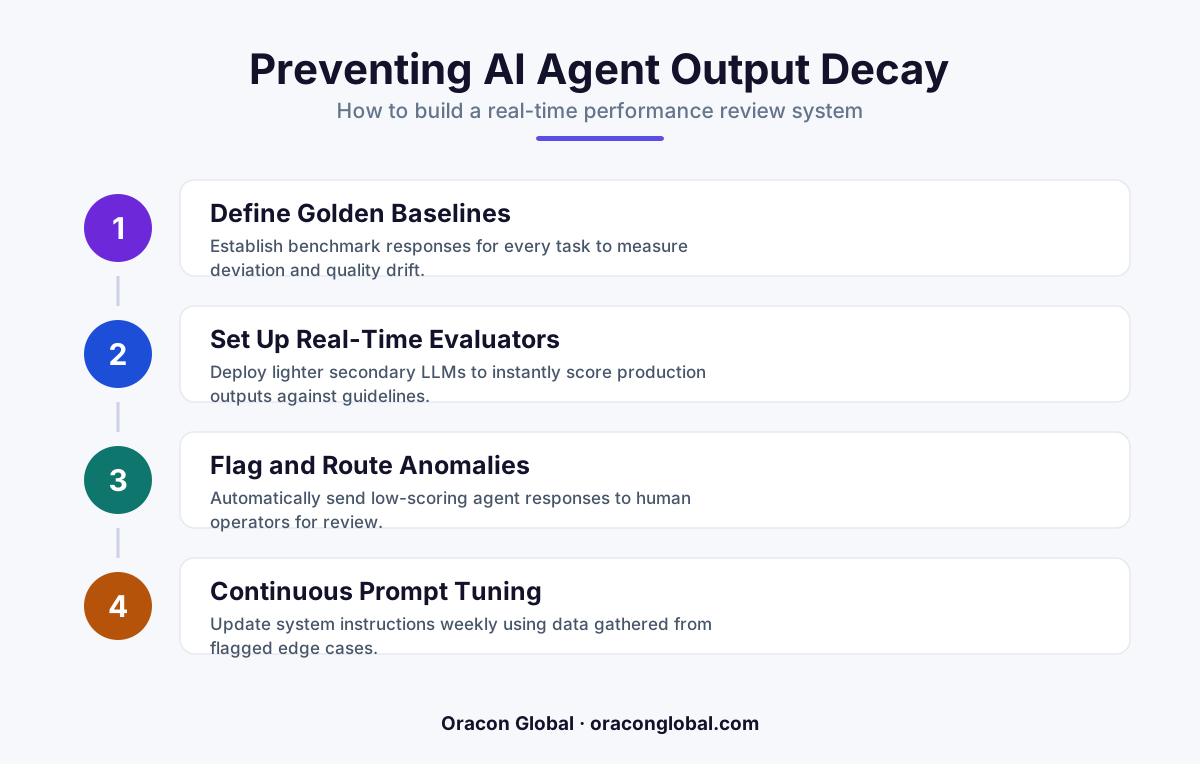
Unlike traditional software that throws a clear error code when it breaks, AI digital employees experience silent decay, gradually producing lower-quality work over time. To prevent this, operations teams must build a dedicated real-time performance review system that programmatically audits outputs against strict semantic, structural, and operational benchmarks before they impact your business.
When traditional software breaks, it does so loudly. A server crashes, an API throws a 500 error, or a database query times out. You get an immediate alert, and your team steps in to apply a patch. But when AI digital employees begin to fail, they do so in complete silence.
Your AI agents will continue to run on schedule. They will process customer support tickets, generate purchase orders, or draft contract reviews without missing a beat. The technical logs will show a perfect run of 200 OK responses. Yet, beneath the surface, the actual quality of the output is slipping. This is known as silent decay in AI—a slow drift where responses become slightly more generic, edge cases are quietly ignored, and subtle inaccuracies begin to creep into your core business operations.
To scale an automated workforce safely, you cannot rely on manual, spot-check quality assurance. You need a programmatic, real-time performance review system for AI that acts as a continuous supervisor, catching drift before it impacts your bottom line.
Why AI Digital Employees Suffer from Quality Drift
To stop silent decay, we must first understand why it happens. Unlike static code, an AI digital employee relies on a complex mix of prompts, dynamic data retrieval, and shifting model APIs. Quality degradation typically stems from three specific areas:
- Data and Context Drift: Your business rules, inventory, and customer language change over time. If your retrieval-augmented generation (RAG) systems or database inputs shift, the context provided to the AI changes, leading to outdated or mismatched responses.
- Upstream Model Updates: Third-party LLM providers constantly optimize their models behind the scenes. A subtle update to a model's weights can change how it interprets your prompts, suddenly altering its reasoning patterns or tone.
- Edge Case Fatigue: As your system processes thousands of transactions, it will inevitably encounter complex, multi-layered scenarios that were never tested during the initial development phase.
Without a dedicated monitoring layer, these shifts go unnoticed until a human operator or an unhappy customer points them out. By then, the damage to your operational efficiency has already been done.
The Architecture of a Real-Time AI Review System
A robust performance review system does not sit inside the AI agent itself. Instead, it operates as an independent evaluation layer that sits between the agent's output and your production databases or user-facing interfaces. Here is how we design this system at Oracon Global to keep digital employees running accurately.
1. The Structural and Deterministic Gateway
Before analyzing the subjective quality of an AI's work, the system must enforce hard, deterministic rules. This is the fastest and cheapest line of defense. The gateway verifies that the output conforms to your exact schema requirements. For example, if a logistics agent is supposed to output a clean JSON payload containing a shipping weight and a carrier ID, the gateway checks that those fields exist, contain the correct data types, and do not include markdown or conversational filler.
2. Semantic Similarity and Anchor Testing
To ensure your AI isn't drifting away from approved company policies, the review system compares live outputs against a database of "anchor cases." These are gold-standard, human-verified responses to common business scenarios. By using lightweight embedding models, the system calculates the semantic distance between the live output and the nearest anchor. If the similarity score drops below a specific threshold, it indicates that the agent is improvising too much, triggering an automatic flag.
3. Multi-Aspect Evaluator Agents
For more nuanced work, such as drafting legal contracts or resolving complex support escalations, you cannot rely on simple keyword matching. Here, we deploy small, highly specialized evaluator models. Instead of asking a single model if an output is "good," we break the evaluation down into distinct, objective questions:
- Factual Alignment: Does the output contain any claims or data points not present in the provided reference documentation?
- Tone Compliance: Does the language match the professional, helpful tone defined in your brand guidelines?
- Completeness: Did the agent address every single question or constraint raised in the original prompt?
Implementing Asynchronous Audits to Protect Latency
One of the biggest concerns for operations teams is that adding a performance review system will slow down their automated workflows. If every response must go through a secondary evaluation, response times could double.
To prevent this, the review system should run asynchronously. For user-facing applications where speed is critical, the response is delivered immediately, while a background queue processes the evaluation. If the evaluator detects a quality dip or a potential error, it logs the incident to an operations dashboard and routes it to a human supervisor for review.
For high-risk, back-office operations—such as automated invoicing or updating inventory records in an ERP—the review system runs synchronously as a blocking gate. The AI agent’s draft is held in a "pending approval" state until the evaluation system clears it, ensuring that invalid data never writes directly to your core systems.
Building the Human-in-the-Loop Feedback Loop
A performance review system is only as good as the action it triggers. When an AI digital employee consistently fails a specific metric, the system must route the flagged transaction to a human operator. This serves two vital purposes:
First, it provides an immediate safety net, allowing a human to correct the work before it reaches a client or a partner database. Second, the human's correction is captured and fed back into the system as new training data. This continuous feedback loop allows your development team to systematically refine the agent's prompts, fine-tune its retrieval pipelines, and update its anchor cases, ensuring that the AI grows smarter and more resilient over time.
Keep Your Automated Workforce Operating at Peak Efficiency
AI digital employees have the potential to handle massive operational volumes, but they require the same structured oversight, clear boundaries, and regular performance reviews as any human team member. By building a dedicated monitoring and evaluation layer, you protect your business from silent quality drift and ensure your automation scales safely.
At Oracon Global, our senior in-house team specializes in building robust, production-grade AI agents, workflow automations, and custom enterprise applications that are engineered for long-term stability. We design systems where clients retain 100% ownership of their code and intellectual property.
If you are ready to build reliable AI infrastructure that maintains its quality day after day, contact Oracon Global today to discuss your project.
Frequently asked questions
What is silent decay in AI digital employees?
Silent decay is when an AI agent continues to execute its tasks without throwing technical errors or crashing, but the actual quality, accuracy, or tone of its output gradually degrades over time due to data drift or shifting context.
How does a performance review system for AI work?
It acts as an automated, real-time supervisor that intercepts the AI agent's outputs, running them through programmatic checks, deterministic rules, and smaller evaluator models to verify quality before the work is finalized.
Can we monitor AI agents without high API costs?
Yes. By using smaller, open-source evaluator models or hardcoded validation logic on a sampling basis rather than running every single transaction through a massive frontier LLM, you can keep operational costs minimal.
Do we need to pause our AI systems to build this?
No. A real-time review system can be integrated as an asynchronous middle layer or a non-blocking queue, meaning your live processes continue running smoothly while the evaluation happens in the background.
Read next
Beyond Chatbots: How to Build AI Agents That Actually Do Work for Your Business
Most businesses use AI to answer questions. Here is how to build custom AI agents that actually take action, connect to your internal tools, and handle complex workflows.
Beyond the Wrapper: How to Build Custom AI Agents for Business That Actually Work
Many businesses invest in basic AI wrappers only to find they lack the security and context needed for real work. Here is how to build custom AI agents that integrate deeply with your workflows and databases.
Enterprise AI Maintenance Costs: Budgeting for Year Two and Beyond
Building an AI system is only half the battle. Discover the practical, ongoing operational costs of enterprise AI, including token management, model drift, and continuous security audits.
Oracon Global builds production-grade AI agents, automation and apps — and you own the code and IP. Tell us what you want to automate.
Book a call →See our work