

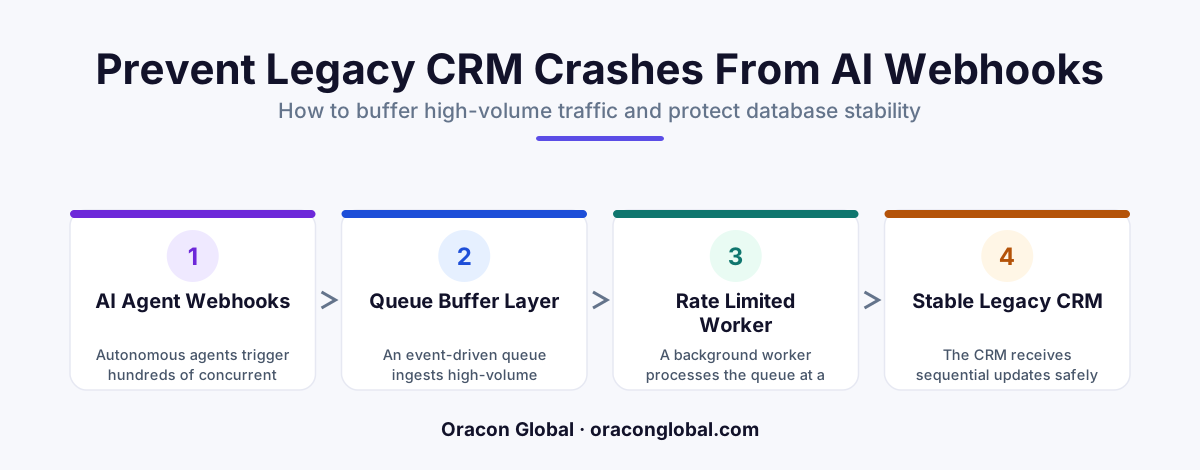
High-volume AI agents can easily overwhelm legacy CRMs by sending hundreds of concurrent webhook updates at once. Building an event-driven API buffer layer queue decouples your AI agents from your database, flattening traffic spikes into a steady, manageable stream that respects legacy rate limits.
Autonomous AI lead agents are changing the economics of outbound sales. Instead of a human SDR manually dialing leads and typing up notes, an AI agent can simultaneously research, email, and qualify hundreds of prospects in minutes. It is a massive operational win, right up until those agents try to write that data back to your legacy CRM.
Most traditional CRMs and legacy database systems were built for human data entry speeds. They expect a sales rep to click "Save" on a record, wait a few seconds, and move to the next. When dozens of autonomous AI lead agents trigger hundreds of concurrent webhook updates in a single second, the legacy system simply chokes. Database locks freeze, API rate limits are exceeded, and the CRM crashes, taking down your sales pipeline with it.
To scale your AI operations safely, you need a shock absorber. Here is how to build an event-driven API buffer layer that protects your legacy CRM integration while keeping your AI agents running at full speed.
The Core Problem: Machine Speed vs. Legacy Architecture
When an AI agent finishes qualifying a lead, it packages the conversation history, sentiment analysis, and next steps into a structured JSON payload. It then fires a webhook to update the lead record in your CRM. Because AI agents work in parallel, fifty conversations ending at the same time mean fifty heavy database write operations hitting your CRM API at the exact same fraction of a second.
This concurrent webhook onslaught creates three distinct failure points:
- Database Lock Contention: If multiple agents try to update different fields on the same parent account or related records simultaneously, the legacy database locks those rows, causing requests to time out.
- Hard API Rate Limits: Most SaaS CRMs enforce strict API thresholds (e.g., 100 requests per minute). A burst of AI activity will quickly trigger a 429 Too Many Requests error, dropping crucial lead data.
- Uncontrolled Retries: If the AI agent is programmed to retry failed webhooks immediately, it creates a self-inflicted Distributed Denial of Service (DDoS) attack on your own infrastructure.
To solve this, we must decouple the AI agents from the legacy CRM. The agents need to hand off their data instantly and move on to the next task, leaving the slow work of writing to the database to a dedicated middleware layer.
Step 1: Constructing the Ingestion Buffer
The first component of a robust API buffer layer is an ultra-fast, lightweight ingestion endpoint. This endpoint does not write directly to the CRM. Instead, its only job is to receive the incoming webhook from the AI lead agent, write the raw payload to a secure queue, and instantly return a 202 Accepted HTTP status to the agent.
Because the ingestion endpoint does zero heavy lifting, it can easily handle thousands of concurrent requests without breaking a sweat. Serverless cloud functions combined with a managed message broker (like RabbitMQ, Amazon SQS, or Redis) are ideal for this task.
The AI agent gets an immediate confirmation that its data is safe, freeing its execution thread to handle the next lead conversation. Meanwhile, the raw update payload sits securely in your queue, waiting to be processed.
Step 2: Implementing Controlled Rate Limiting
Once the lead update payloads are safely stored in the message queue, you need a worker service to pull them out and write them to the legacy CRM. This is where the event-driven magic happens. Instead of pushing updates as fast as possible, the worker service pulls updates at a strictly controlled rate.
We configure the worker system with a token bucket or leaky bucket rate-limiting algorithm. If your legacy CRM is comfortable handling five API writes per second, you configure your worker pool to never exceed that threshold. The buffer layer acts as a funnel, taking a massive, chaotic spike of concurrent webhooks and flattening it into a smooth, predictable stream of data that your legacy CRM can easily digest.
Step 3: Handling Errors with a Dead-Letter Queue
Even with controlled rate limiting, legacy CRM writes will occasionally fail due to expired session tokens, temporary network drops, or validation mismatches. In a direct integration, this failure means lost data.
Inside an event-driven buffer layer, you build a safety net called a Dead-Letter Queue (DLQ). If a worker tries to write an update to the CRM and receives a 500-series server error, the system does not drop the message. Instead, it follows a structured retry policy:
- Exponential Backoff: The worker waits 10 seconds before retrying, then 30 seconds, then 2 minutes, allowing temporary network blips to resolve.
- Dead-Letter Routing: If the update fails after a set number of attempts (e.g., 5 times), the message is moved to the DLQ.
- Alerting and Correction: Your ops team is notified of the payload in the DLQ. They can inspect the raw JSON, correct any formatting errors, and re-queue the update with a single click, ensuring zero lead data is ever lost.
The Benefits of an Event-Driven Architecture
Building a buffer layer might sound like an extra step, but it completely changes the reliability profile of your operations. By separating the high-speed intelligence of your AI agents from the rigid limitations of your legacy database, you protect your infrastructure and your budget.
Your AI agents run more efficiently because they never have to sit idle waiting for a slow CRM API to respond. Your CRM remains stable, preventing costly internal downtime for your sales and support teams. Most importantly, your customer data remains accurate and complete, no matter how fast your AI lead acquisition engine scales.
At Oracon Global, we build robust, production-ready AI agents and custom middleware layers that bridge the gap between cutting-edge automation and dependable legacy systems. Our senior in-house team designs, codes, and deploys scalable architectures tailored to your specific business needs, and you retain 100% ownership of the code and IP.
Want to build reliable AI infrastructure that doesn't threaten your core business systems? Reach out to the Oracon Global team today to discuss your architecture needs.
Frequently asked questions
Why do AI lead agents crash legacy CRMs?
AI agents operate at machine speed, qualifying prospects and triggering database writes concurrently. Legacy CRMs are designed for human data entry speeds and often fail when hit with hundreds of API requests in a single second.
What is an API buffer layer?
An API buffer layer is an intermediary queueing system that sits between your high-speed AI tools and your slow legacy databases, receiving incoming webhooks instantly and processing them at a rate the destination system can handle.
Do we need to rewrite our legacy CRM code to implement this?
No. The buffer layer acts as an external middleware, meaning your legacy CRM continues to receive standard, paced API requests without requiring any internal modifications or dangerous database overrides.
Can we track failed updates using a buffer layer?
Yes. Any updates that fail due to temporary network drops or validation errors are safely routed to a dead-letter queue (DLQ) for automated retry or human review, preventing data loss.
Read next
Beyond Chatbots: How to Build AI Agents That Actually Do Work for Your Business
Most businesses use AI to answer questions. Here is how to build custom AI agents that actually take action, connect to your internal tools, and handle complex workflows.
Beyond the Wrapper: How to Build Custom AI Agents for Business That Actually Work
Many businesses invest in basic AI wrappers only to find they lack the security and context needed for real work. Here is how to build custom AI agents that integrate deeply with your workflows and databases.
Enterprise AI Maintenance Costs: Budgeting for Year Two and Beyond
Building an AI system is only half the battle. Discover the practical, ongoing operational costs of enterprise AI, including token management, model drift, and continuous security audits.
Oracon Global builds production-grade AI agents, automation and apps — and you own the code and IP. Tell us what you want to automate.
Book a call →See our work