

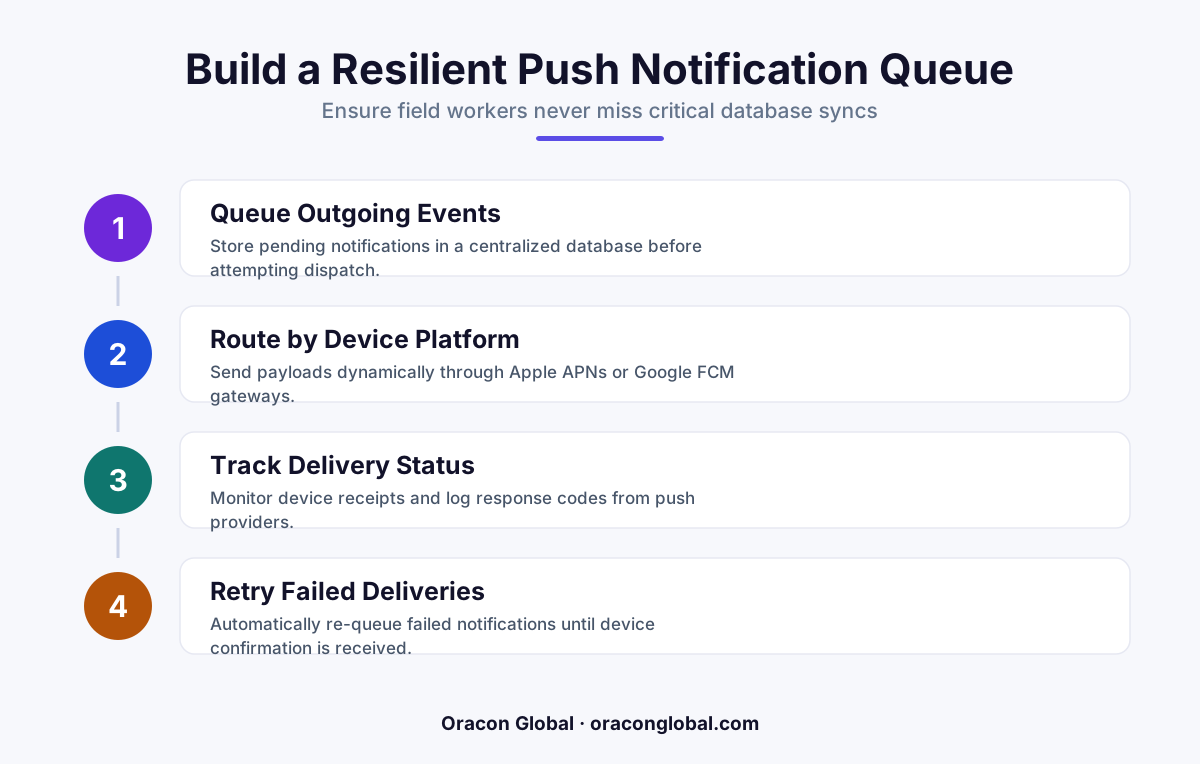
Standard push notifications are fire-and-forget, leading to missed database syncs when field devices go offline. Resolving this requires a custom database-backed push queue that tracks delivery state across APNs and FCM, automatically retrying and falling back to alternative channels until a client handshake confirms the sync is complete.
In the world of field operations, a mobile app is only as reliable as its last database sync. When technicians, surveyors, or logistics drivers work in areas with spotty network coverage, keeping the central database and the mobile device aligned is a constant struggle. Standard transactional updates work well when a phone is connected to high-speed 5G, but they fall apart when users enter concrete warehouses, rural sites, or underground facilities.
Many product teams rely on basic Apple Push Notification service (APNs) and Firebase Cloud Messaging (FCM) configurations to trigger silent background syncs. However, these native services operate on a "fire-and-forget" model. If a worker’s device is offline when the server broadcasts an update, the notification is frequently dropped. The user continues working on stale data, leading to scheduling conflicts, double-booked assets, and corrupted work orders. To solve this, B2B SaaS platforms must implement a custom, multi-vendor push notification queue that guarantees delivery through persistent state tracking and client-side handshakes.
The Hidden Failure Point of Native Push Networks
When an back-office operator updates a job description or assigns a new task, the server needs to tell the target mobile device to pull the fresh data immediately. Typically, the backend sends a silent push payload to APNs or FCM, assuming the device will receive it, wake up the background database sync engine, and update its local SQLite or Realm storage.
This assumption fails in several common scenarios:
- Aggressive OS Power Management: Modern iOS and Android operating systems routinely throttle or ignore background push notifications to preserve battery life, especially if the app has not been opened recently.
- Transient Network Outages: If a vehicle drives through a tunnel or a remote zone, the connection drops. Native push gateways only cache the "last" sent notification for a limited time before discarding it entirely.
- Out-of-Order Execution: If the server sends multiple updates while the device is disconnected, the native networks do not guarantee they will arrive in the correct sequence once the device reconnects.
To achieve absolute field app reliability, your engineering team must treat push notifications as stateful transactions rather than temporary alerts. This means building a dedicated queue layer that manages delivery confirmations, retries, and multi-vendor failover logic.
Architecting a Database-Backed Push Queue
A resilient push system shifts the responsibility of delivery tracking from the native platform gateways to your own backend database. Instead of broadcasting a notification directly to Apple or Google, your server inserts a sync record into a dedicated queue table.
This database table acts as the single source of truth for all pending mobile database syncs. It should track critical metadata, including a unique transaction ID, the target user ID, the device operating system, the payload structure, the current delivery status (such as pending, sent, or acknowledged), and a retry counter.
The Delivery Confirmation Handshake
The core mechanism of a reliable mobile database sync is the handshake. The server should never assume a push notification was successful just because Apple or Google returned a "200 OK" from their gateway API. The transaction is only complete when the mobile app explicitly confirms it.
- The backend creates a queued push record with a state of
PENDING. - The queue worker dispatches the payload via FCM or APNs, updating the state to
DISPATCHEDand logging a timestamp. - The mobile device receives the push notification in the background, parses the transaction ID, and executes the local database write.
- Once the local write is successful, the mobile app calls a lightweight confirmation API endpoint on the backend, passing the transaction ID.
- The backend marks the queue record as
COMPLETED, removing it from the active retry pipeline.
Building Multi-Vendor Redundancy for High-Stakes Operations
Relying on a single notification delivery path introduces a single point of failure. If Firebase experiences a localized routing delay, or if APNs credentials expire unexpectedly, your entire field force is cut off from live office updates. A robust architecture incorporates an abstract multi-vendor dispatch layer.
By wrapping FCM, APNs, and even alternative channels like transactional SMS within a unified interface, your backend can dynamically route notifications based on real-time feedback. If an urgent sync payload remains unacknowledged in the queue for more than five minutes, the system can automatically elevate the priority. It can retry the dispatch using an alternate gateway or send an encrypted SMS payload that a background receiver on Android can intercept and process.
This multi-channel approach ensures that even in degraded environments, critical data payloads find a path to the user's screen or local database.
Handling Edge Cases: Out-of-Order Messages and App Crashes
When you build a custom queue, you must account for the reality of asynchronous network traffic. If a device has been offline for twelve hours, it may have dozens of pending sync notifications waiting in your queue database.
Sending all of these updates to the device individually is inefficient and can cause performance bottlenecks on mobile processors. Instead, your queue worker should run a compaction algorithm before dispatching. If multiple updates modify the same database entity, the queue should merge them, delivering only the latest state to the mobile client.
Furthermore, each sync payload should include a sequential version number. When the mobile app receives a payload, it compares the incoming version with its local database state. If an older notification arrives out of order due to network routing delays, the client app can safely discard it, preventing newer local edits from being overwritten by stale server data.
Partnering with Experts to Build Resilient Mobile Architectures
Designing, scaling, and maintaining a custom multi-vendor push notification queue requires a deep understanding of background execution limits, database locking strategies, and native mobile development. For B2B SaaS founders and enterprise operators, getting this architecture wrong means dealing with constant data discrepancies, frustrated users, and lost field productivity.
At Oracon Global, our senior in-house development team specializes in building high-performance mobile architectures, custom API integrations, and robust offline-first synchronization layers. We deliver production-grade software globally from our India-based studio, giving our clients 100% ownership of their custom code and intellectual property from day one.
Whether you are building a new mobile application from scratch or resolving persistent sync failures in an existing React Native or native mobile deployment, we can help you build a reliable, scalable solution.
Ready to secure your mobile database synchronization pipelines? Reach out to the engineering team at Oracon Global today to discuss your architecture and design a system that keeps your field operations running smoothly under any network conditions.
Frequently asked questions
Why do standard Apple and Google push notifications fail during database syncs?
Apple Push Notification service (APNs) and Firebase Cloud Messaging (FCM) are designed for speed, not guaranteed delivery. If a field device is offline, in a dead zone, or operating in a low-power state, the notification is often discarded after a short survival window, leaving the local database out of sync.
What is a delivery confirmation handshake?
It is a design pattern where the mobile app sends an explicit API response back to your server immediately after receiving a push payload and successfully executing the database sync. The server keeps the push task in a pending state until this handshake is received.
Can we run this custom queue on React Native and native iOS/Android?
Yes. The backend queue architecture remains completely independent of the frontend framework. On the client side, you only need to register background event listeners to process the incoming payload and trigger the local database write.
How does a multi-vendor queue improve system reliability?
It prevents vendor lock-in and provides immediate redundancy. If Google’s FCM experience latency spikes or Apple’s APNs certificates encounter transient issues, the system can route critical operational alerts through alternative paths, including SMS fallbacks, to keep the field team moving.
Read next
Beyond Chatbots: How to Build AI Agents That Actually Do Work for Your Business
Most businesses use AI to answer questions. Here is how to build custom AI agents that actually take action, connect to your internal tools, and handle complex workflows.
Beyond the Wrapper: How to Build Custom AI Agents for Business That Actually Work
Many businesses invest in basic AI wrappers only to find they lack the security and context needed for real work. Here is how to build custom AI agents that integrate deeply with your workflows and databases.
Enterprise AI Maintenance Costs: Budgeting for Year Two and Beyond
Building an AI system is only half the battle. Discover the practical, ongoing operational costs of enterprise AI, including token management, model drift, and continuous security audits.
Oracon Global builds production-grade AI agents, automation and apps — and you own the code and IP. Tell us what you want to automate.
Book a call →See our work