

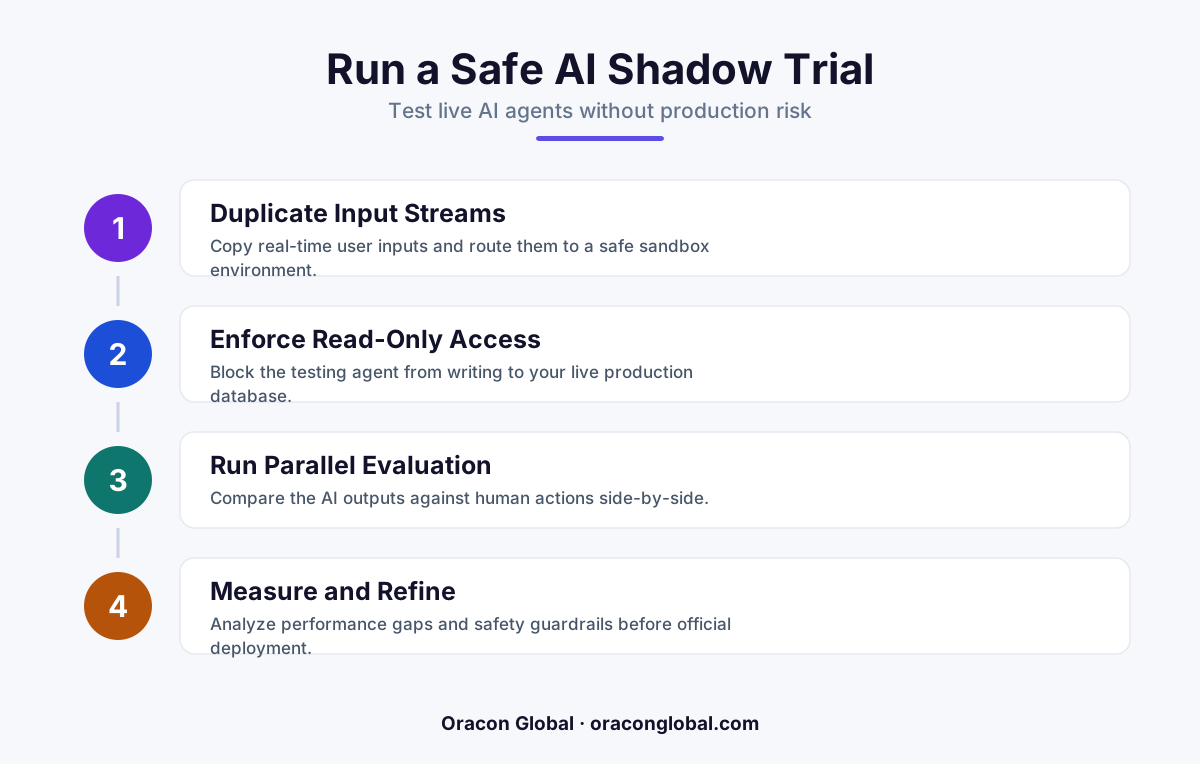
A silent AI shadow trial duplicates incoming system requests and feeds them to an offline AI agent without letting the agent write back to your production database. This allows you to evaluate real-world performance, latency, and accuracy under live conditions with zero risk to your existing operations.
Deploying an AI agent or a digital employee directly into a live business workflow is a massive leap of faith. Even after weeks of local prompt engineering and testing on synthetic data, real-world customer interactions are unpredictable. A single unexpected API payload or an unusual edge case can cause an unmonitored AI agent to write incorrect data back to your ERP, double-post financial ledger entries, or send confusing messages to active customers.
Yet, testing AI agents solely in a staging environment with fake data rarely reveals how they will behave when faced with the messy, high-volume reality of your daily operations. To bridge this gap safely, forward-thinking operators use a deployment strategy known as a silent AI shadow trial. By leveraging AI shadow testing methodologies, you can run your new AI tools in the background of your live business, letting them process real traffic without changing a single line of your core production code or risking live customer databases.
What is a Silent AI Shadow Trial?
A silent shadow trial is an architectural pattern where incoming production data, user requests, or system events are duplicated in real time. One stream of data goes to your existing human team or legacy software system to be processed as normal. The second stream is safely routed to your new AI agent running in a isolated sandbox environment.
During a silent AI trial, the agent operates in "read-only" mode relative to your business. It receives real-world context, runs its internal logic, fetches relevant vector data, and generates a response or an database update. However, the crucial step is that the agent's output is never written back to the production database, nor is it sent to the customer. Instead, the output is saved to a secure shadow log database where its accuracy, latency, and cost can be audited side-by-side with actual human work.
Why Traditional Staging Environments Fail for AI
In traditional software development, testing a new feature simply requires spinning up a staging server with a snapshot of the database. For deterministic code, this works perfectly. But AI agents are non-deterministic; their behavior changes based on the subtle nuances of human input, timing, and dynamic context retrieval.
Here is why conventional testing falls short when testing AI agents for enterprise use cases:
- Synthetic data lacks chaos: Human users write incomplete sentences, upload blurry PDFs, and input conflicting data that staging databases rarely replicate.
- Stale context windows: AI agents rely heavily on Retrieval-Augmented Generation (RAG) to fetch internal knowledge files. Staging environments lack the live, shifting context of a busy company wiki or ERP.
- Integration blind spots: A staging agent might look fast, but under real-world multi-user load, API rate limits and database locks behave entirely differently.
The Step-by-Step Architecture for a Safe Shadow Trial
Implementing a shadow trial does not require a massive overhaul of your existing legacy software. Instead, you introduce a lightweight middleware layer that acts as an observer. Here is how to structure the pipeline safely.
Step 1: The Asynchronous Event Splitter
To avoid modifying your production application code, you should avoid intercepting requests inside your primary web server. Instead, use an event-driven approach. If your system uses a message broker or database replication, you can listen for new database records or API calls. When a new event occurs, a lightweight background worker duplicates the payload and pushes it to a secure queue dedicated to the AI agent.
Step 2: Database Isolation and Read-Only Access
The AI agent must never have write access to your primary production database during the shadow phase. Instead, provision a read-only replica of your database for the AI agent to query. This ensures that even if the agent attempts to run a destructive database transaction, the database layer itself physically blocks the action without crashing your live application.
Step 3: The Mock API and Output Logger
If your AI agent is designed to take actions, such as sending emails, updating CRM fields, or creating shipping labels, you must mock these outbound APIs. The agent should call a simulated endpoint that records the payload it intended to send, along with its reasoning. This step is critical for evaluating enterprise AI safety before giving the agent live execution privileges.
Evaluating the Shadow Trial Results
Once your shadow trial is running, you will begin accumulating a rich dataset of how your AI agent would have acted in hundreds of real scenarios. Evaluating this data requires a structured framework to compare human actions against AI decisions.
- Semantic comparison: Compare the agent's drafted customer responses or invoice classifications against the actual actions taken by your human team. Look for discrepancies in tone, accuracy, and policy compliance.
- Latency and performance monitoring: Measure how long the agent takes to process complex multi-step workflows. Does it keep up with live traffic, or do slow LLM API calls create a bottleneck?
- API cost tracking: Calculate the precise token usage and platform costs generated during the trial. This allows you to project the exact unit economics of the AI digital employee before officially launching it.
"A shadow trial transforms your deployment process from a stressful launch day into a quiet, data-driven decision. You only turn the agent live when the shadow logs prove it is already matching or exceeding human accuracy."
Transitioning Safely to Active Production
After running a silent shadow trial for a few weeks, you will have the hard data needed to identify edge cases, refine your system prompts, and optimize database queries. When you are ready to transition the AI agent to active production, you do not need to rewrite your systems. You simply shift the agent's execution mode from "shadow" to "active" within your database state machine, allowing it to gradually take over low-risk tasks while keeping a human-in-the-loop buffer for complex cases.
At Oracon Global, our senior in-house engineering team builds custom AI agents, AI-native ERP systems, and workflow automations designed for safe, predictable enterprise scaling. We focus on building resilient software architectures that protect your data, secure your intellectual property, and integrate seamlessly with your legacy systems.
Ready to explore how custom AI agents can automate your manual workflows without risking your existing infrastructure? Contact Oracon Global today to discuss your project with our senior engineering team.
Frequently asked questions
What is a silent AI shadow trial?
It is a testing methodology where live business data or user requests are duplicated and sent to an AI agent running in a read-only environment, allowing you to observe its decisions without letting it affect your production systems.
Does a shadow trial require modifying my production database?
No. By using an asynchronous message queue or event listener to copy incoming data, the AI agent operates entirely on a decoupled sandbox database, leaving your primary production database untouched.
How do you evaluate the AI agent if it cannot write back to the system?
The agent's generated outputs, API calls, and database writes are captured in a dedicated shadow log, which is then programmatically compared against actual human decisions to measure accuracy and drift.
How long should a silent AI shadow trial run?
Most enterprise teams run shadow trials for two to four weeks to capture a representative sample of weekly business cycles, edge cases, and peak traffic periods before granting the agent live execution privileges.
Read next
Beyond Chatbots: How to Build AI Agents That Actually Do Work for Your Business
Most businesses use AI to answer questions. Here is how to build custom AI agents that actually take action, connect to your internal tools, and handle complex workflows.
Beyond the Wrapper: How to Build Custom AI Agents for Business That Actually Work
Many businesses invest in basic AI wrappers only to find they lack the security and context needed for real work. Here is how to build custom AI agents that integrate deeply with your workflows and databases.
Enterprise AI Maintenance Costs: Budgeting for Year Two and Beyond
Building an AI system is only half the battle. Discover the practical, ongoing operational costs of enterprise AI, including token management, model drift, and continuous security audits.
Oracon Global builds production-grade AI agents, automation and apps — and you own the code and IP. Tell us what you want to automate.
Book a call →See our work