

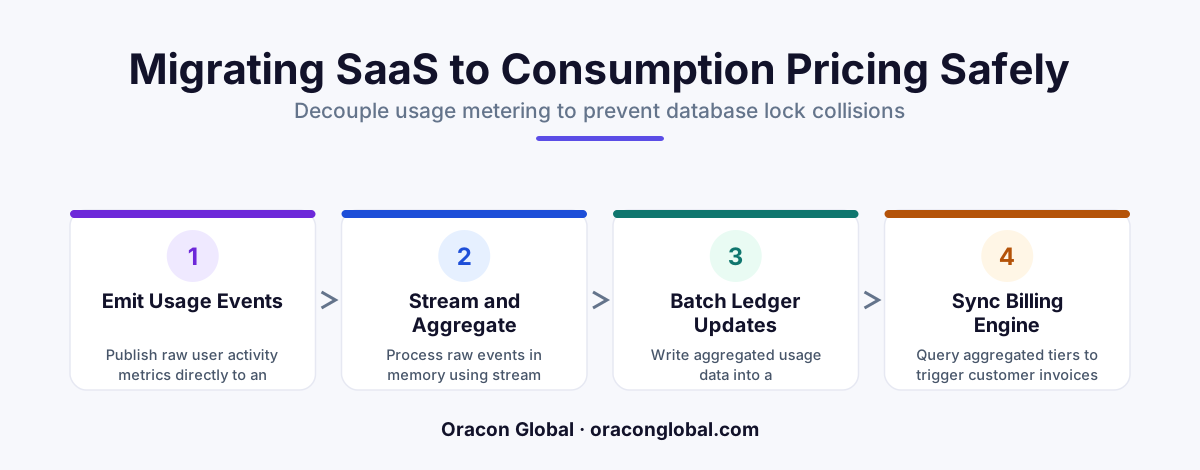
Transitioning to consumption-based pricing requires moving away from real-time synchronous writes to user balance tables, which cause severe database row locks during peak usage. By implementing an asynchronous event-driven metering pipeline using a write-ahead log and Redis buffer, platforms can process high-volume usage events without impacting operational database performance or user experience.
Shifting a enterprise B2B SaaS platform from predictable seat-based revenue to consumption-based usage tiers is one of the most effective ways to align price with value. However, moving from static user licensing to real-time billing metrics frequently exposes hidden technical debt in your database layer. When thousands of active workflows begin recording incremental billing events simultaneously, traditional relational databases quickly run into catastrophic database lock collisions.
In a standard seat-based application, account records are updated infrequently when new team members are invited or roles are modified. Under consumption-based usage tiers, every single operation—whether an API request, a workflow execution, or a processed document—requires an immediate update to an account's usage ledger. Attempting to execute synchronous updates directly on central customer tables creates massive database row contention, leading to application latency, transaction timeouts, and unexpected system downtime.
To safely execute this business model migration, software engineering teams must re-architect how billing events are captured, buffered, and aggregated behind the scenes. Here is how to transition your application to a consumption-based infrastructure without compromising database performance.
The Hidden Bottleneck of Direct Database Writes
When engineering teams first introduce consumption-based usage tiers, the simplest approach is often to add a current_usage counter column to the primary organizations or accounts table. Every time a background job or API call executes, the system runs an SQL update statement to increment that single integer value.
While this logic works flawlessly in staging environments, it creates severe bottleneck problems under production loads. Relational databases like PostgreSQL or MySQL rely on row-level locking to maintain transactional integrity. When dozens of concurrent microservices or user sessions attempt to execute UPDATE accounts SET usage_count = usage_count + 1 WHERE id = 123 at the same millisecond, the database forces those statements into a strict sequential queue.
As wait queues build up, database connection pools are rapidly exhausted. API endpoints stall waiting for database worker threads to clear, resulting in HTTP 504 gateway timeouts for end users. The platform is not crashing because of high CPU or memory load, but because operational threads are endlessly waiting for locked table rows to clear.
Architecting an Asynchronous Event-Driven Metering Pipeline
To prevent database lock collisions during high-throughput usage events, you must completely decouple the execution of your feature set from the financial accounting of that feature. The primary application workflow should never wait on an operational database transaction to verify or update a billing balance.
A modern, resilient usage-metering pipeline uses an event-driven architecture built around three distinct stages:
- Instant Event Emission: When an operational execution occurs, the microservice constructs an immutable usage payload containing the tenant ID, timestamp, feature metric, and execution context. This payload is fired asynchronously into an in-memory queue.
- High-Speed In-Memory Buffering: Instead of writing directly to disk or updating a relational table, events land in a dedicated key-value buffer such as Redis or a streaming platform like Apache Kafka. These memory stores handle hundreds of thousands of concurrent write operations per second with sub-millisecond latencies.
- Batch Aggregation and Reconciliation: A background worker service periodically reads the buffered usage logs, aggregates the total usage by tenant over a short window (such as every 60 seconds), and performs a single, optimized batch write to the main database ledger.
By shifting from thousands of isolated synchronous write requests to a single consolidated batch write per account, you reduce database write queries by over 99%, completely eliminating row lock contention on core system tables.
Designing an Audit-Proof Usage Schema
In a consumption-based model, accurate metering is directly tied to platform revenue and client trust. If a user disputes an overage charge at the end of a billing cycle, simply showing a total aggregated integer counter in a database column is insufficient. You need an append-only transaction ledger that provides immutable proof of every single usage event.
Replacing Mutable Counters with Event Streams
Instead of overwriting a shared row state, design your persistent billing schema as an append-only log table. Write operations should insert new event records rather than modifying existing entries:
CREATE TABLE usage_ledger_events (
 id UUID PRIMARY KEY DEFAULT gen_random_uuid(),
 tenant_id UUID NOT NULL,
 feature_key VARCHAR(64) NOT NULL,
 quantity INT NOT NULL,
 idempotency_key VARCHAR(128) UNIQUE NOT NULL,
 recorded_at TIMESTAMP WITH TIME ZONE DEFAULT NOW()
);
By enforcing an append-only pattern, database engines avoid heavy row-level lock contention because parallel INSERT operations writing unique keys do not block each other in the same way UPDATE statements on shared records do. Furthermore, incorporating an idempotency_key ensures that network retries or duplicated worker executions never result in double-billing customer accounts.
Enforcing Hard and Soft Quotas Without Blocking Main Threads
A major challenge when moving away from real-time, synchronous database writes is managing user usage limits. If usage metering is deferred and processed in asynchronous batches, how do you prevent an account from exceeding its allowed plan limit or exhausting a pre-funded credit balance?
This challenge is solved by storing cached account balances directly in the in-memory cache layer alongside the event ingestion queue:
- When a customer purchases credits or renews a monthly quota, the authorized allowance is cached in Redis with a long time-to-live (TTL).
- As usage events occur, the application performs atomic decrements directly within Redis using high-speed atomic operations or lightweight scripts.
- If the cached credit key falls below zero, the system immediately flags a soft limit, returning an out-of-credits response to the user without ever touching the primary SQL database.
- During the background batch aggregation process, the persistent SQL balance is synchronized with the cache, ensuring hard consistency across billing cycles.
This dual-layer approach provides instant, thread-safe limit enforcement at the edge while preserving your core relational database for complex analytical queries and master customer records.
Safely Scaling Your SaaS Monetization Model
Migrating your B2B SaaS platform from seat-based subscription tiers to dynamic consumption pricing does not require accepting platform instability or database performance degradations. By decoupling application execution from billing state synchronization, you protect your infrastructure from concurrency bottlenecks while creating a foundation for reliable, scalable monetization.
At Oracon Global, our senior in-house engineering team designs and builds high-throughput application architectures, modern event-driven pipelines, and bespoke SaaS platforms tailored to complex enterprise workflows. We deliver custom systems where our clients maintain 100% ownership of their IP, code, and infrastructure.
If you are planning a transition to usage-based pricing or need to overhaul your platform's backend performance, explore our live interactive demos on oraconglobal.com or reach out to our team today to discuss your technical architecture.
Frequently asked questions
Why does usage-based pricing cause database locks in traditional SaaS architectures?
In seat-based SaaS, user sessions are read-heavy with infrequent writes. Switching to usage pricing introduces thousands of concurrent write requests to update balance and account counters on central database tables, causing thread pool exhaustion and locking issues.
How do you track usage events accurately without real-time database writes?
You can record usage events asynchronously into a high-throughput, key-value buffer or streaming pipeline like Redis or Kafka, then aggregate those records into your relational database in batch intervals.
Will an event-driven metering queue slow down user response times?
No, asynchronous metering actually improves response times. By decoupling the primary application execution path from the billing write operation, API endpoints return success instantly after emitting an event to a fast background buffer.
How does this transition impact enterprise client compliance and IP ownership?
Building a custom, event-driven metering pipeline ensures your platform retains 100% control over its core IP, data schema, and compliance boundaries, avoiding expensive third-party billing dependencies that lock you into rigid pricing structures.
Read next
Beyond Chatbots: How to Build AI Agents That Actually Do Work for Your Business
Most businesses use AI to answer questions. Here is how to build custom AI agents that actually take action, connect to your internal tools, and handle complex workflows.
Beyond the Wrapper: How to Build Custom AI Agents for Business That Actually Work
Many businesses invest in basic AI wrappers only to find they lack the security and context needed for real work. Here is how to build custom AI agents that integrate deeply with your workflows and databases.
Enterprise AI Maintenance Costs: Budgeting for Year Two and Beyond
Building an AI system is only half the battle. Discover the practical, ongoing operational costs of enterprise AI, including token management, model drift, and continuous security audits.
Oracon Global builds production-grade AI agents, automation and apps — and you own the code and IP. Tell us what you want to automate.
Book a call →See our work