

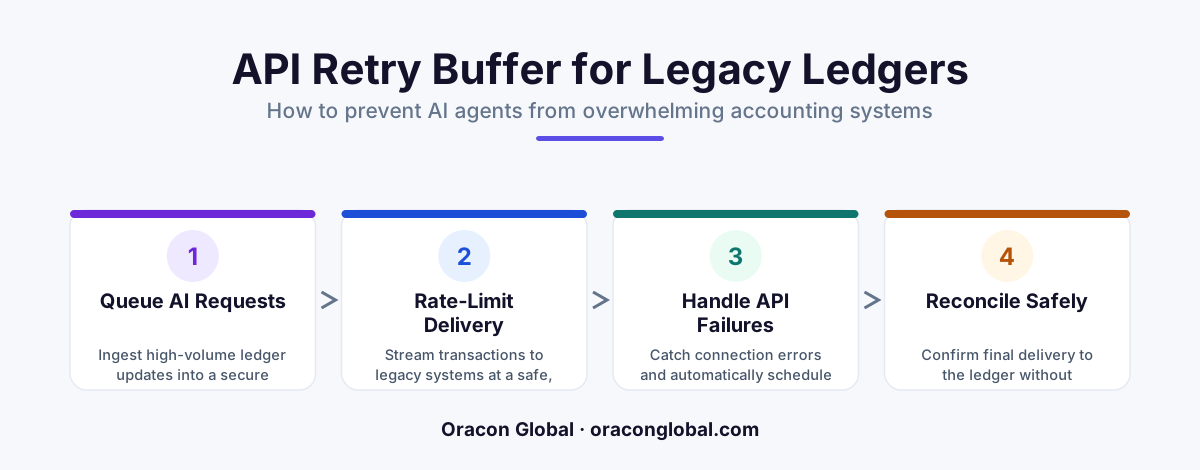
When AI agents write to legacy accounting ledgers at high speeds, they risk causing data corruption and lockouts. By implementing an event-driven API retry buffer, businesses can queue, throttle, and verify these writes to protect their core financial records.
Modern AI agents can analyze thousands of complex invoices, vendor bills, and expense receipts in minutes. They run through automated workflows at speeds that human teams could never match. But when you connect these high-velocity autonomous agents to legacy accounting ledgers, you quickly run into a physical limitation: old databases were never built for this kind of volume.
During a high-volume batch run, an AI agent might attempt to write hundreds of journal entries simultaneously. To a legacy ERP or an old SQL-based accounting system, this sudden burst of traffic looks like a distributed denial-of-service (DDoS) attack. The result is predictable but painful: database locks, timed-out connections, partial writes, and corrupted ledger balances that take your finance team days to untangle.
To safely bridge the gap between fast-moving AI agents and slow-moving financial systems, you need a dedicated buffer. Here is how to build an event-driven API retry buffer to protect your legacy accounting ledgers during high-volume batch runs.
The Problem: High-Volume AI Meets Rigid Legacy Systems
Legacy accounting systems rely heavily on strict database locking mechanisms to ensure financial integrity. When a human accountant enters an invoice, the system locks the relevant tables for a split second to update the balances. This works perfectly when entries are made at human speed.
AI agent integrations change the rules of engagement. Because agents execute tasks in parallel, they often send hundreds of ledger updates at the exact same moment. This triggers several critical failure points:
- Row and Table Locks: Multiple parallel writes try to update the same accounts receivable or accounts payable tables, causing the database to reject incoming connections.
- Out-of-Order Execution: Credits can be posted before debits, or invoices can be created before the corresponding vendor profile is fully saved in the system.
- Partial Writes: A connection drop mid-transaction can leave an entry half-written, throwing your general ledger out of balance.
Using a simple, immediate retry loop in your code does not solve this. In fact, it makes the problem worse. When twenty failed writes all retry at the exact same instant, they compound the database lock, crashing your accounting server entirely.
The Architecture of an Event-Driven API Retry Buffer
To solve this, we introduce an event-driven API retry buffer between your AI agents and your legacy ledger. Instead of writing directly to the accounting system, the AI agent posts its completed work as an "event" to a secure, intermediary queue.
This architecture consists of three primary components working in harmony:
1. The Ingestion Queue
When an AI agent finishes verifying an invoice, it generates a structured financial payload. Instead of calling the legacy accounting API directly, it writes this payload to a durable message queue. This queue acts as a shock absorber. It accepts writes from the AI agent instantly, allowing the agent to continue its work without waiting for the slow legacy database to respond.
2. The Rate-Limiting Worker Layer
Behind the queue sits a pool of dedicated worker processes. These workers pull transactions out of the queue one by one, or in controlled micro-batches, at a rate that your legacy accounting system can comfortably handle. If your legacy ledger can only process five writes per second, your workers are throttled to deliver exactly five writes per second, regardless of how fast the AI agent is generating data.
3. The Idempotency Ledger
This is your ultimate defense against double-posting. Before any write is sent to the legacy ledger, the buffer assigns it a unique, deterministic idempotency key based on the transaction details (such as invoice number, vendor ID, and amount). If a write fails halfway through and must be retried, the system checks this key to make sure the transaction does not already exist in the legacy database.
Step-by-Step Guide to Managing Failed Runs
High-volume batch processing on older systems will inevitably experience temporary dropouts. A robust API retry buffer does not just slow down traffic; it intelligently manages these failures using a structured recovery workflow.
- Detecting the Error Type: The buffer must distinguish between temporary errors (like a database lock or rate limit) and permanent errors (like a validation error or a missing account code).
- Applying Exponential Backoff: For temporary errors, the buffer schedules a retry using exponential backoff with jitter. Instead of retrying immediately, it waits 2 seconds, then 4 seconds, then 8 seconds, adding a small random delay to prevent synchronized retries from hitting the database all at once.
- Isolating Corrupted Payloads: If a transaction fails repeatedly after a set number of attempts (e.g., 5 times), it is likely a permanent data error. The buffer moves this specific transaction to a Dead-Letter Queue (DLQ).
- Alerting Human Operators: While the failed transaction sits in the DLQ, the main worker processes continue handling the rest of the queue, ensuring a single bad invoice does not halt your entire financial operation. An alert is sent to your operations team to inspect and fix the isolated error.
Ensuring Data Integrity and Compliance
When dealing with financial ledgers, compliance and auditability are non-negotiable. An event-driven retry buffer provides a complete paper trail of how data moved from the AI agent into your books.
"In financial systems, speed is secondary to accuracy. A robust retry buffer acts as an automated custodian, ensuring that every calculation made by an AI agent is written to your ledger with absolute precision."
By capturing the raw input from the AI agent, the state of the retry buffer, and the final confirmation payload from the legacy system, you create an immutable audit log. If your finance team ever needs to reconcile a balance, they can trace any journal entry back to the exact execution run of the AI agent that generated it.
Build Reliable AI Integrations with Oracon Global
Connecting modern, fast-moving AI agents to legacy business systems requires careful planning and custom engineering. Off-the-shelf automation tools often fail to handle the complex state management, rate limits, and safety guardrails that financial data demands.
At Oracon Global, our senior in-house engineering team designs and builds custom AI agents, workflow automations, and robust middleware layers that keep your operations running smoothly. We ensure your systems integrate seamlessly, without risking your database stability or data integrity. Best of all, you retain 100% ownership of the code and intellectual property we build for you.
Are you ready to scale your automated workflows without putting your legacy systems at risk? Get in touch with the team at Oracon Global today to discuss your integration needs.
Frequently asked questions
Why do AI agents corrupt legacy accounting ledgers during batch runs?
AI agents process and output data much faster than legacy databases can handle. When hundreds of parallel writes hit an old system at once, it leads to database locks, out-of-order execution, and partial writes that corrupt the general ledger.
What is an API retry buffer?
An API retry buffer is a dedicated middle layer that catches outbound API requests from your AI agents, holds them in a secure queue, and releases them to your legacy accounting system at a rate the legacy database can safely ingest.
How does an event-driven approach prevent double-posting?
An event-driven architecture uses unique transaction IDs and state tracking. If a network blip occurs, the system checks the exact state of the ledger before retrying, ensuring no financial transaction is recorded twice.
Do we need to rewrite our legacy accounting software to implement this?
No. The retry buffer lives as a middleware layer between your modern AI agent framework and your existing accounting system. Your legacy software remains completely unchanged while gaining robust protection from high-volume traffic.
Read next
Beyond Chatbots: How to Build AI Agents That Actually Do Work for Your Business
Most businesses use AI to answer questions. Here is how to build custom AI agents that actually take action, connect to your internal tools, and handle complex workflows.
Beyond the Wrapper: How to Build Custom AI Agents for Business That Actually Work
Many businesses invest in basic AI wrappers only to find they lack the security and context needed for real work. Here is how to build custom AI agents that integrate deeply with your workflows and databases.
Enterprise AI Maintenance Costs: Budgeting for Year Two and Beyond
Building an AI system is only half the battle. Discover the practical, ongoing operational costs of enterprise AI, including token management, model drift, and continuous security audits.
Oracon Global builds production-grade AI agents, automation and apps — and you own the code and IP. Tell us what you want to automate.
Book a call →See our work