

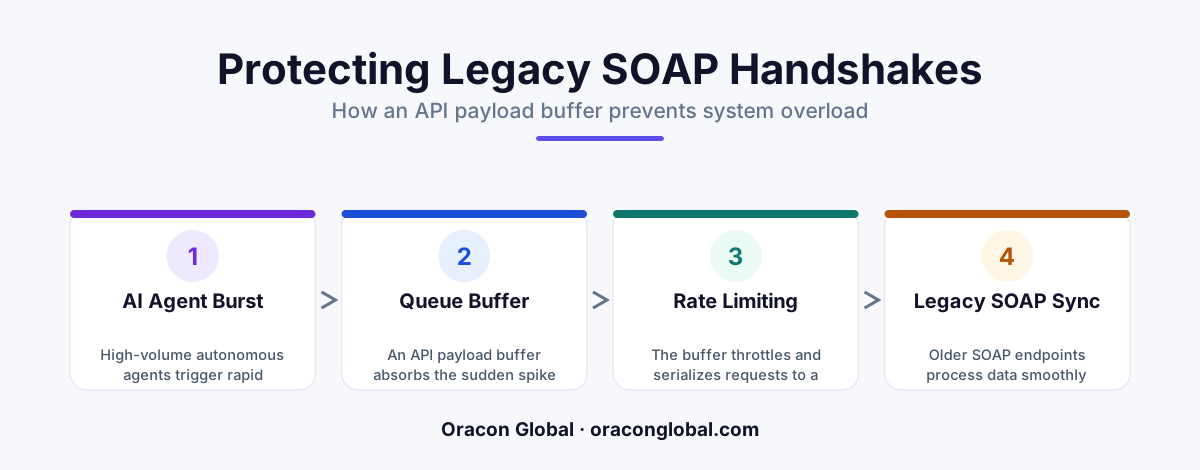
When high-velocity AI agents execute thousands of database updates, legacy systems using synchronous SOAP handshakes often fail or corrupt data. The solution is to decouple the systems using a resilient, asynchronous API payload buffer that queues, throttles, and translates database writes to match the legacy system's processing speed.
Deploying autonomous AI agents to automate data-heavy business workflows is one of the fastest ways to scale operations. However, a major architectural bottleneck often hides inside your legacy infrastructure. While modern AI agents can evaluate documents, process transactions, and trigger database updates in milliseconds, the systems of record they need to update are frequently built on older technology.
For organizations relying on enterprise resource planning (ERP) systems or databases that communicate via legacy SOAP integrations, a sudden surge in AI agent database writes can be disastrous. These older systems rely on synchronous, stateful XML connections that expect a predictable, human-scale pace of data entry. When an AI agent attempts to write thousands of updates simultaneously, the legacy SOAP handshakes fail, resulting in connection timeouts, dropped packets, and silent data corruption. To solve this, technical teams must implement a resilient, real-time API payload buffer to act as a protective shock absorber between modern AI speed and legacy stability.
The Friction Between Agentic Velocity and SOAP Handshakes
To understand why these failures occur, it helps to look at how legacy SOAP integrations handle communication. Unlike modern, stateless REST APIs or gRPC connections, SOAP web services are highly structured, strictly typed, and often stateful. A typical SOAP handshake requires a multi-step exchange: the client sends an XML payload, the server validates it against a strict schema, locks the relevant database rows, processes the transaction, and returns a verbose XML response.
This process works perfectly when human operators are typing data into a screen. However, when an AI agent runs a batch processing job—such as auditing thousands of supplier invoices or updating real-time inventory levels across hundreds of SKUs—it executes hundreds of parallel database writes. This causes several critical issues:
- Connection Pool Exhaustion: The legacy application server run out of available ports to handle incoming SOAP requests, locking out other users.
- Database Row Locking: Slow, synchronous legacy transactions hold database locks too long, causing subsequent AI writes to back up and time out.
- State Desynchronization: When a SOAP handshake drops mid-transaction due to a timeout, the AI database shows the write as complete, but the legacy system has no record of it, creating a silent audit nightmare.
Designing a Real-Time API Payload Buffer
Instead of attempting to rewrite your legacy SOAP web services—which is incredibly expensive, time-consuming, and operationally risky—the most elegant solution is to introduce an intermediary API payload buffer. This middleware layer decouples your fast-moving AI database writes from your slow legacy handshake processes.
The core concept of this architecture is simple: never let an AI agent write directly to a legacy endpoint. Instead, the agent writes to a high-speed, localized database or cache. This write triggers an event that is instantly captured by our buffer, which manages the delivery to the SOAP endpoint at a safe, controlled pace.
Step 1: The Event Ingestion Layer
When the AI agent updates a record, the change is written to your modern application database (such as PostgreSQL or MongoDB). A database trigger, or a change data capture (CDC) service, immediately publishes this change event to a high-throughput, in-memory message broker like Redis or RabbitMQ. This ingestion happens in microseconds, allowing the AI agent to continue its work without waiting for a legacy response.
Step 2: Durable Queueing and Rate Limiting
The message broker holds the payload in a durable queue. Durability is critical here: if your legacy server crashes, the queue ensures that no business data is lost. We then configure a worker service that pulls messages from this queue. This worker is governed by a strict rate limiter designed to match the exact processing threshold of your legacy SOAP service (for example, limiting transactions to no more than 5 per second).
Step 3: Schema Translation and XML Marshalling
Since AI agents work natively with modern, flexible JSON payloads, the buffer worker must translate the incoming JSON data into the precise, strictly typed XML format required by the legacy SOAP web service. The worker constructs the SOAP envelope, inserts the necessary security headers, and prepares the payload for transmission.
Handling Handshake Failures and Network Retries
Building a buffer isn't just about slowing down the traffic; it is also about handling the inevitable errors that occur when communicating with older infrastructure. A robust payload buffer must include built-in resiliency patterns to handle network drops and server timeouts.
When the worker attempts to send the translated XML payload to the legacy SOAP endpoint, it monitors the connection closely. If the legacy system returns an error code (such as a 500 Internal Server Error) or fails to respond within a designated timeout window, the buffer initiates a structured retry strategy:
- Exponential Backoff: Instead of retrying immediately—which would further overwhelm an already struggling legacy server—the buffer waits. The first retry occurs after 2 seconds, the second after 4 seconds, then 8 seconds, and so on.
- Circuit Breaker Pattern: If the legacy system fails repeatedly over a short window, the circuit breaker trips. The buffer stops attempting to send messages altogether, giving the legacy database time to recover while safely accumulating new incoming AI writes in the durable queue.
- Dead Letter Queue (DLQ): If a specific payload fails to process after a set number of attempts (often due to a malformed data field that violates the SOAP schema), it is moved to a Dead Letter Queue. This alerts your operations team for manual review without blocking the rest of the queue.
The Business Impact: Safe Scale and Zero Lost Transactions
By placing an API payload buffer between your modern AI initiatives and your legacy architecture, you protect your core business systems while giving your AI agents room to run at peak efficiency. Your operations team can deploy complex automation pipelines knowing that their legacy ERP, warehouse management system, or accounting platform will never be brought down by a sudden surge in database writes.
Furthermore, you avoid the multi-million dollar cost of a complete system migration. You get to keep your trusted, highly stable legacy systems of record while safely layering on the speed, efficiency, and intelligence of modern AI digital employees.
At Oracon Global, our senior in-house team specializes in building custom integrations that bridge the gap between high-velocity AI applications and legacy enterprise infrastructure. Whether you need to build custom middleware buffers, design resilient event-driven architectures, or launch dedicated AI agents, we deliver production-grade systems where you retain 100% of the code and intellectual property.
Are you planning to connect high-volume AI workflows to your legacy databases or ERP systems? Contact Oracon Global today to discuss how we can build a safe, scalable integration architecture for your business.
Frequently asked questions
Why do legacy SOAP integrations fail when connected to AI agents?
Legacy SOAP systems rely on synchronous, stateful handshakes that expect slow, predictable traffic. AI agents execute parallel database writes at a velocity and volume that overwhelm these legacy connections, leading to timeouts and data corruption.
What is an API payload buffer?
An API payload buffer is an intermediate software layer that captures high-volume incoming data writes, temporarily stores them in a resilient queue, and releases them to legacy systems at a controlled, safe rate.
Do we need to rewrite our legacy SOAP web services to support AI?
No, rewriting legacy systems is costly and risky. A custom middleware buffer handles the rate limiting, queueing, and XML schema translation, allowing your legacy system to remain untouched while safely receiving data.
How does this architecture ensure that no data is lost?
The buffer uses a durable message broker (like RabbitMQ or Redis) to persist payloads. If the legacy SOAP service goes offline or rejects a message, the buffer retains the payload, triggers a retry mechanism, or routes it to an exception queue for manual review.
Read next
Beyond Chatbots: How to Build AI Agents That Actually Do Work for Your Business
Most businesses use AI to answer questions. Here is how to build custom AI agents that actually take action, connect to your internal tools, and handle complex workflows.
Beyond the Wrapper: How to Build Custom AI Agents for Business That Actually Work
Many businesses invest in basic AI wrappers only to find they lack the security and context needed for real work. Here is how to build custom AI agents that integrate deeply with your workflows and databases.
Enterprise AI Maintenance Costs: Budgeting for Year Two and Beyond
Building an AI system is only half the battle. Discover the practical, ongoing operational costs of enterprise AI, including token management, model drift, and continuous security audits.
Oracon Global builds production-grade AI agents, automation and apps — and you own the code and IP. Tell us what you want to automate.
Book a call →See our work