

An automated least-privilege access gateway acts as an intelligent security guard between your AI digital employees and your corporate data. By decoupling the AI's system permissions from individual user accounts and evaluating every data request in real time, you can confidently run autonomous agents without risking data leaks.
Deploying AI digital employees to automate routine operational tasks is one of the fastest ways to scale your business. These autonomous systems can process invoices, draft client communications, and organize complex project databases in seconds. However, their sheer speed and capability present a quiet but severe vulnerability: if an AI agent is given broad access to your corporate file systems, it can easily read, process, and accidentally expose restricted internal HR documents, executive salary sheets, or private financial ledgers.
Most standard business software systems rely on human-centric permissions. When you connect an AI agent to these platforms, the agent often inherits overly broad access rights. To prevent catastrophic internal data leaks, forward-thinking operators are building a dedicated least-privilege access gateway. This specialized security middleware ensures that your AI agents only see the precise data points they need to execute their active tasks—and absolutely nothing else.
The Risk of the All-Access AI Employee
Traditional software security relies on user accounts. If a manager has access to financial reports, any automation script run under their account technically has access to those same reports. While a human manager knows not to share executive compensation spreadsheets with junior staff, an AI agent does not possess innate corporate discretion.
If an employee asks a customer support agent about general company policies, and that agent has index-level access to the entire company drive, it might pull answers from restricted HR files. To prevent this, businesses must shift from role-based access control to an automated least-privilege access gateway designed specifically for autonomous machine workflows.
How a Least-Privilege Access Gateway Protects Your Data
A least-privilege access gateway acts as a strict, automated security guard sitting between your AI digital employees and your physical data storage systems. Every time an agent attempts to search a folder, run a database query, or retrieve a document, the request is intercepted by the gateway.
Rather than letting the AI query your databases directly, the gateway evaluates the request against three core pillars of verification:
- Task-Based Context: Is the AI agent currently executing a task that requires this specific file? (e.g., An invoicing agent should never need access to employee healthcare records).
- User Session Verification: Did the human user who triggered the agent have the authorization to view this data in the first place?
- Dynamic Data Redaction: If a document contains both public and restricted information, can the gateway strip out the sensitive financial figures before passing the clean text to the AI?
The Core Architecture of an AI Security Gateway
Building an effective gateway does not require rewriting your entire legacy database. Instead, a custom middleware layer is introduced into your software architecture. This setup consists of three essential components:
1. The Semantic Policy Engine
This engine translates complex corporate data policies into hard rules that the gateway can enforce instantly. For example, you can write a policy stating: "No file containing the metadata tag 'Financial-Q4' or 'HR-Compensation' may be parsed by any agent unless the active session is explicitly approved by a designated financial controller."
2. The Session Token Validator
When a human operator prompts an AI digital employee to run a workflow, the gateway issues a temporary, short-lived session token. This token carries the precise scope of the current task. Once the task is completed, the token expires, preventing the AI from browsing other directories in its idle time.
3. The Real-Time Redaction Filter
Sometimes, an AI agent needs to read a document that contains a mix of public and private data. The gateway's redaction filter automatically scans the outbound data stream, stripping out credit card numbers, social security numbers, and internal cost structures before the text ever reaches the LLM context window.
Steps to Implement Least-Privilege Access in Your Business
If you are planning to build or scale your use of AI digital employees, you can secure your environment by following a structured implementation path:
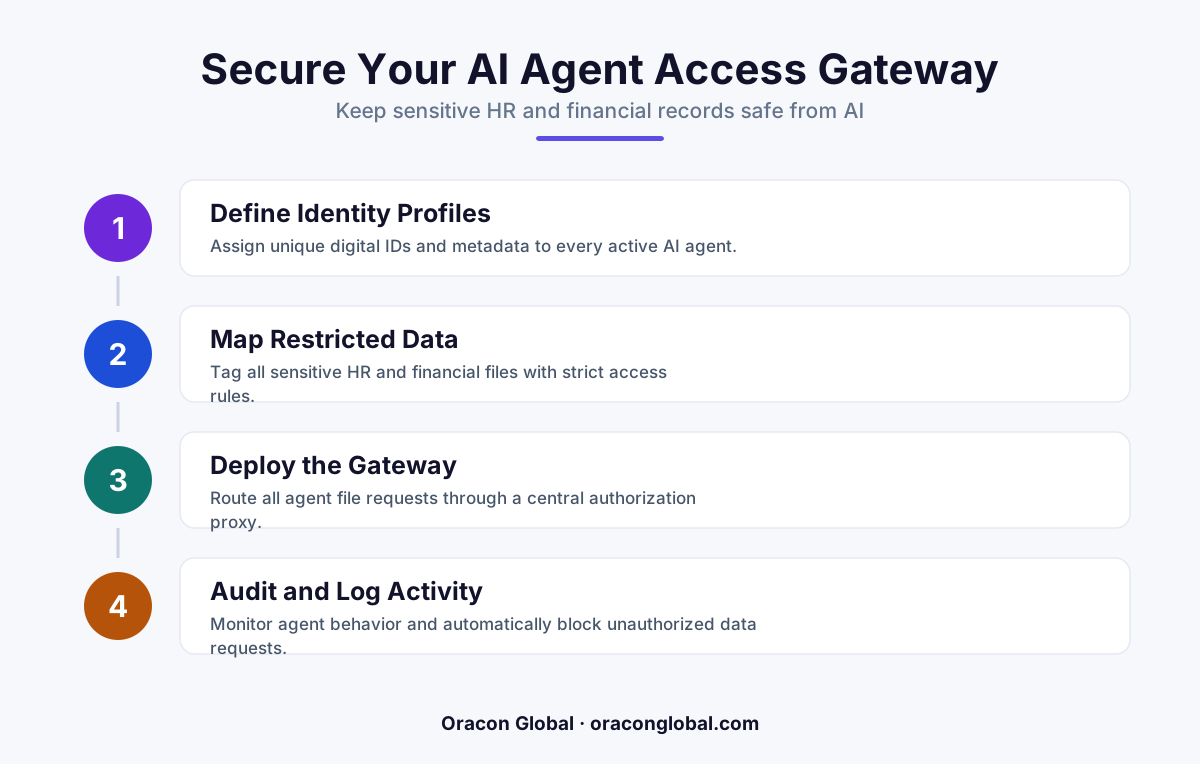
- Audit Your Data Landscapes: Group your company files into distinct sensitivity tiers. Ensure that HR, legal, and financial files are stored in directories clearly separated from general operational assets.
- Isolate Your Agent Toolkits: Do not give your AI agents general database connection strings. Instead, build specific, limited API endpoints that only return the narrow datasets required for their daily tasks.
- Deploy an Intermediary Middleware: Introduce a custom gateway layer that intercepts all vector database queries and document retrievals, validating every action against your live policy engine.
- Enable Comprehensive Security Logging: Maintain an immutable, real-time audit log of every file request made by your AI tools. This allows your security team to spot and block unusual query patterns before they become data breaches.
Building Secure, Production-Grade AI Systems
True operational efficiency comes from building systems you can trust implicitly. When your team knows that your AI digital employees are physically blocked from accessing sensitive salary data or private client financial files, you can deploy automation much faster and with complete peace of mind.
At Oracon Global, our senior in-house engineering team builds custom AI agents, robust workflow automations, and secure enterprise integrations with strict data governance built directly into the codebase. Best of all, you retain 100% ownership of your code and intellectual property from day one.
Want to secure your internal data while scaling your AI capabilities? Contact the team at Oracon Global today to discuss how we can build a secure, private AI infrastructure tailored to your business operations.
Frequently asked questions
Why can't I just use my existing database and folder permissions for AI agents?
Existing permissions are designed for human users and often lack the granular, real-time context required for autonomous agents. If an AI agent inherits a high-level manager's credentials, it may inadvertently query and expose restricted salary files during a routine task.
What is a least-privilege access gateway?
It is an intermediary security software layer that intercepts every database query, API call, and document request made by an AI agent, verifying that the agent has the absolute minimum clearance required to complete its specific task.
How does this gateway affect the performance of AI digital employees?
When built with efficient caching and optimized metadata lookup tables, a custom gateway adds negligible latency (often under 20 milliseconds), keeping your autonomous workflows fast and safe.
Do we need to rewrite our entire legacy database to implement this?
No. A custom access gateway is built as a middleware layer that sits between your AI agent and your existing databases, meaning you do not have to refactor your core legacy data structures.
Read next
Beyond Chatbots: How to Build AI Agents That Actually Do Work for Your Business
Most businesses use AI to answer questions. Here is how to build custom AI agents that actually take action, connect to your internal tools, and handle complex workflows.
Beyond the Wrapper: How to Build Custom AI Agents for Business That Actually Work
Many businesses invest in basic AI wrappers only to find they lack the security and context needed for real work. Here is how to build custom AI agents that integrate deeply with your workflows and databases.
Enterprise AI Maintenance Costs: Budgeting for Year Two and Beyond
Building an AI system is only half the battle. Discover the practical, ongoing operational costs of enterprise AI, including token management, model drift, and continuous security audits.
Oracon Global builds production-grade AI agents, automation and apps — and you own the code and IP. Tell us what you want to automate.
Book a call →See our work