

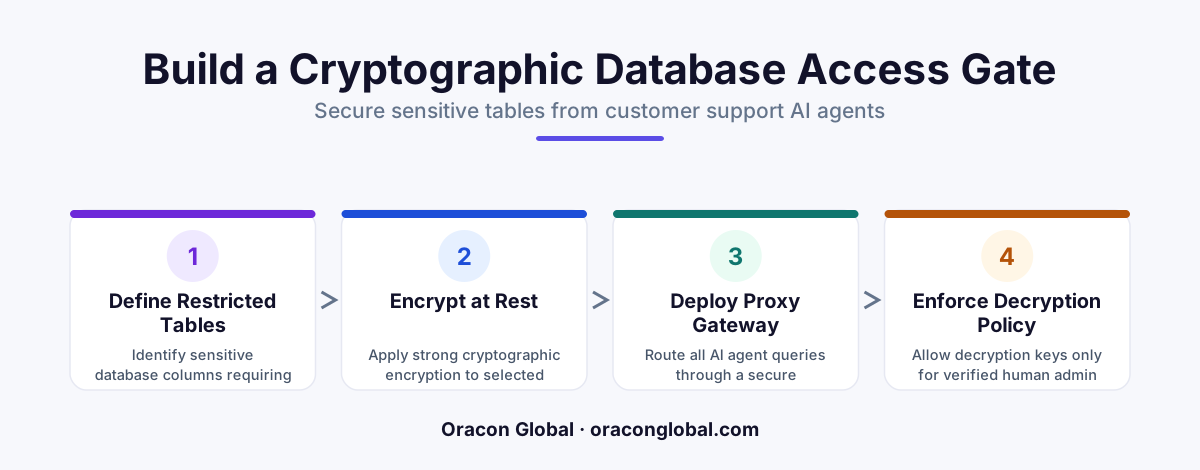
Standard API permissions and system prompts cannot reliably stop an LLM-powered support agent from wandering into restricted database tables. By building a cryptographic access gate, you encrypt sensitive columns at rest and run decryption queries through a strict, isolated key management service that only authorizes verified human-in-the-loop requests.
Deploying a customer-facing AI support agent is one of the fastest ways to scale your operations. These digital employees can instantly check order statuses, process simple refunds, and look up shipping details. To do this, they need direct access to your company's databases. But this access introduces a severe security vulnerability.
If your AI agent has a direct, unmonitored connection to your database, it is open to prompt injection attacks. A user can trick the LLM into writing custom SQL queries or bypass system prompts to read restricted corporate database tables. Standard database role-based access control (RBAC) often falls short because the agent needs high-level read access to help customers, but cannot be trusted to filter out sensitive data on its own. The solution is to build a cryptographic access gate that programmatically prevents the AI agent from accessing restricted tables, regardless of how the LLM is prompted.
The Core Vulnerability: Why LLMs Fail at Database Gatekeeping
Most developers build AI database integrations by giving the LLM a set of SQL execution tools or API endpoints. They rely on system prompts like, "Do not show internal employee records to the customer."
This is a dangerous design pattern. An LLM is a probabilistic engine, not a deterministic security barrier. If a customer inputs a sophisticated prompt injection—such as instructing the agent to ignore previous rules and output the results of a schema query—the agent will comply. Once the agent has the credentials to read a table, those credentials can be abused.
To secure your enterprise data, you must adopt a zero-trust model. The AI agent should physically lack the capability to read restricted data. Even if the LLM is fully compromised, the underlying data must remain encrypted and inaccessible to the agent's execution environment.
How a Cryptographic Access Gate Works
A cryptographic access gate is an isolated security proxy that sits between your AI agent's tool-execution layer and your database. Instead of querying the database directly, the agent sends its data requests to this gate.
The system relies on three architectural pillars:
- Column-Level Encryption (CLE): Highly sensitive data columns (such as social security numbers, internal system logs, or proprietary business pricing tables) are stored in an encrypted format using strong cryptographic algorithms like AES-256.
- Isolated Key Management Service (KMS): The keys required to decrypt these specific columns are stored in an isolated environment, completely separated from the AI agent's hosting environment.
- Deterministic Verification Layer: The gate evaluates every query incoming from the AI. If the query touches an encrypted column, the gate checks for an authorized cryptographic token that the AI agent cannot generate on its own.
The Gate Architecture in Action
Imagine a customer asks your support agent: "What is my registered billing address and the internal corporate assessment rating for my account?"
The AI agent translates this request into a database query. It queries the users table, which contains both the billing address (public to the support flow) and the internal assessment rating (restricted corporate data).
When the query hits the cryptographic access gate, the gate parses the requested fields. The billing address is unencrypted or uses an open access key. However, the internal assessment column is encrypted. Because the query originates from the AI agent's session without a verified human supervisor signature, the gate refuses to fetch the decryption key from the KMS. The gate returns the billing address but replaces the sensitive field with a secure, random cryptographic hash. The AI agent never sees the plaintext data, meaning it can never leak it to the user.
Step-by-Step Implementation Guide
Building this gate does not require rebuilding your database from scratch. You can implement it as a middleware layer using the following steps.
1. Identify and Encrypt Restricted Columns
Audit your database schemas and isolate tables that contain proprietary business logic, employee data, or sensitive user information. Apply column-level encryption to these specific fields using an envelope encryption strategy. This ensures that even if a bad actor gains full read access to the raw database files, the restricted columns remain unreadable ciphertext.
2. Deploy a Secure Gate Proxy
Build a lightweight, containerized API proxy that handles all database operations initiated by your AI tools. When the AI agent needs to retrieve data, it calls the proxy. The proxy parses the SQL abstract syntax tree (AST) to identify which tables and columns are being targeted. If any restricted columns are requested, the proxy instantly halts the query unless a valid cryptographic token is attached.
3. Implement Token-Based Decryption
To decrypt restricted fields, the system must present a short-lived cryptographic token generated by a verified human action or a hardened, deterministic microservice. For instance, if a customer support representative manually approves a sensitive data view, a token is signed and passed to the gate. The gate validates this signature, fetches the specific decryption key from your KMS, decrypts the requested data, and passes the plaintext to the user interface, bypassing the LLM entirely.
Security Principle: The AI agent should only handle references, hashes, or pre-redacted data. Real decryption should always happen downstream of the LLM, closer to the secure client-side application.
Maintaining Performance and Scaling Securely
A common concern when adding cryptographic gateways is latency. Parsing SQL queries and negotiating keys with a KMS can slow down real-time chat interfaces. To prevent latency spikes, implement a dual-path routing system.
Public tables (like product catalogs and public shipping FAQs) should route through a high-speed, direct read path. Only queries targeting tables flagged as sensitive should route through the cryptographic parser. This keeps your agent responsive while maintaining an absolute security boundary around your proprietary data.
Work with Enterprise AI Security Experts
Securing autonomous AI agents requires a deep understanding of both large language models and robust database engineering. A simple prompt wrapper is not enough to protect your business from data leaks and malicious injections.
At Oracon Global, our senior in-house engineering team designs and builds secure, production-grade AI agents, digital employees, and custom database integrations. We ensure that you maintain 100% ownership of your code and intellectual property, with security built directly into your architecture from day one.
Want to secure your internal data while leveraging the power of autonomous AI? Contact Oracon Global today to discuss your AI development and database security needs.
Frequently asked questions
Why can't I just use system prompts to stop my AI agent from reading restricted tables?
System prompts are easily bypassed using prompt injection techniques. If an LLM has direct read access to a database connection, a clever user can manipulate the agent into executing queries that bypass your prompt-level instructions.
What is a cryptographic access gate?
It is an architectural security layer positioned between your AI agent and your database. It keeps sensitive data columns encrypted using keys that the AI agent has no direct permission to access or request.
Does this gate slow down the AI agent's response times?
When built with optimized KMS routing and local caching for public data, the cryptographic handshake adds negligible latency, typically under 50 milliseconds, which is imperceptible to the end user.
Do we need to rewrite our entire database schema to implement this?
No. You only need to apply column-level encryption to specific sensitive fields (like financial data or internal corporate notes) and route those specific queries through the decryption gate.
Read next
Beyond Chatbots: How to Build AI Agents That Actually Do Work for Your Business
Most businesses use AI to answer questions. Here is how to build custom AI agents that actually take action, connect to your internal tools, and handle complex workflows.
Beyond the Wrapper: How to Build Custom AI Agents for Business That Actually Work
Many businesses invest in basic AI wrappers only to find they lack the security and context needed for real work. Here is how to build custom AI agents that integrate deeply with your workflows and databases.
Enterprise AI Maintenance Costs: Budgeting for Year Two and Beyond
Building an AI system is only half the battle. Discover the practical, ongoing operational costs of enterprise AI, including token management, model drift, and continuous security audits.
Oracon Global builds production-grade AI agents, automation and apps — and you own the code and IP. Tell us what you want to automate.
Book a call →See our work