

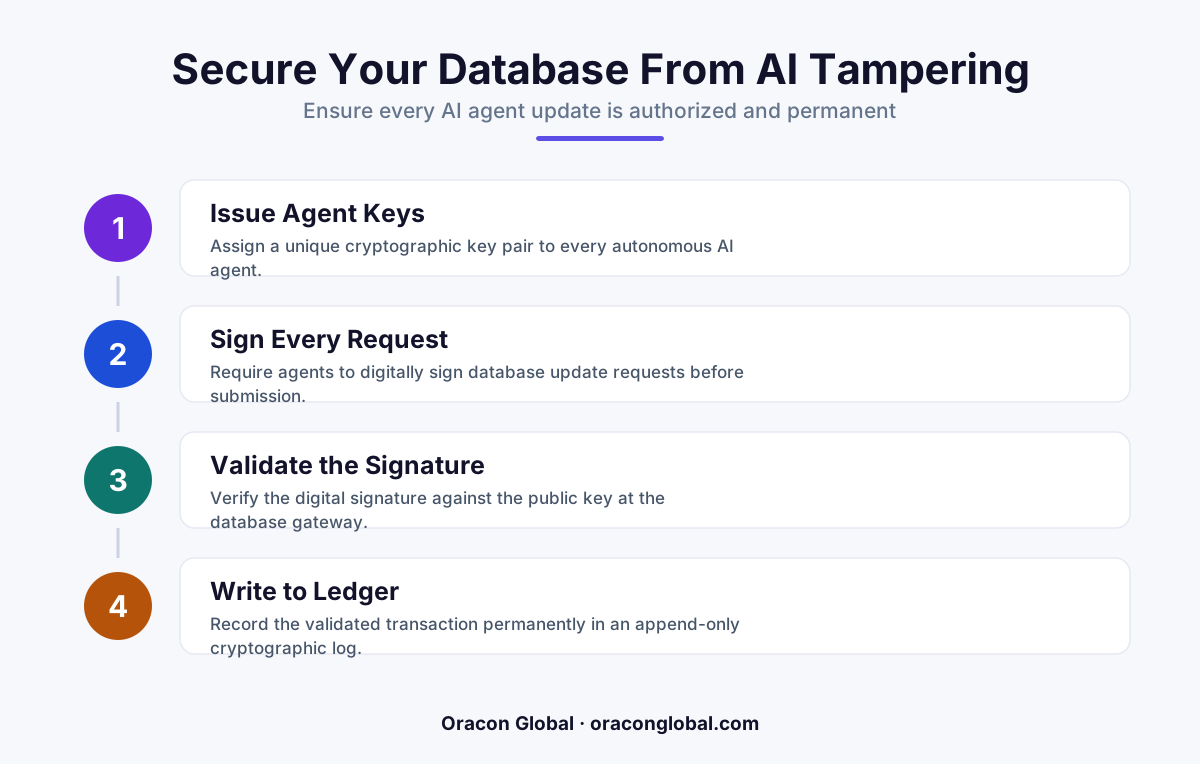
To prevent autonomous AI agents from corrupting or falsifying critical database records, you must decouple them from direct database access. By routing all agent actions through a real-time cryptographic ledger that requires validated digital signatures, your system can verify, audit, and block unauthorized writes before they commit to your production database.
As businesses transition from simple chatbots to autonomous AI agents, these digital employees are gaining the power to make real-world decisions. They can place inventory orders, modify customer accounts, update financial tables, and adjust shipping schedules. While this autonomy eliminates operational bottlenecks, it introduces a critical vulnerability: database corruption through unauthorized writes.
When an AI agent is connected directly to a traditional relational database, it typically uses a standard API key or database connection string. If the agent hallucinates, runs into an unexpected logical loop, or suffers a prompt injection attack, it can execute harmful database operations. Standard database permissions cannot tell the difference between a legitimate business decision made by an AI and a highly destructive hallucination. To solve this, technical teams must implement secure database writes governed by a real-time cryptographic ledger and digital signatures.
The Threat of Unchecked Agentic Database Access
Traditional software engineering relies on deterministic code. If a user clicks a specific button, a predictable SQL query runs. AI agents do not work this way. They interpret natural language, navigate dynamic environments, and generate their own tool parameters on the fly.
Giving an autonomous agent direct write access to your database creates several severe risks:
- Uncontrolled Hallucinations: An agent might incorrectly believe a contract has been signed and update a customer status to "Active," triggering automated onboarding services prematurely.
- Cascading Logic Loops: If an agent gets stuck in a recursive loop, it can write thousands of duplicate or conflicting rows to your transaction logs in seconds, exhausting database connections and locking tables.
- Security Exploits: Prompt injection attacks can bypass native system boundaries, tricking the agent into executing SQL writes that modify pricing, clear balances, or grant elevated user permissions.
To eliminate these risks, you must treat your AI agent as an untrusted client. Every single write command generated by an agent must be cryptographically signed, verified against strict structural rules, and permanently logged before it touches your production tables.
Architecting the Cryptographic Ledger Layer
To establish true agentic workflow security, we place a real-time cryptographic validation engine between your AI agents and your main database. This architecture consists of three core components: an Agent Signature Keypair, a Validation Engine, and an Append-Only Cryptographic Ledger.
1. Agent Signature Keypairs
When an AI agent is provisioned, it is assigned a unique cryptographic keypair (typically using lightweight, high-performance algorithms like Ed25519). The private key is securely stored in a hardware security module (HSM) or a secure secrets manager. The public key is registered with the validation engine. The agent cannot directly modify any database table; it can only request modifications by signing its payload with its private key.
2. The Validation Engine
The validation engine acts as a strict gatekeeper. When an agent attempts to write to the database, it must submit a payload containing the requested changes, a timestamp, a unique request identifier, and the cryptographic signature. The validation engine performs three instant checks:
- Signature Verification: It verifies that the payload was genuinely created by the designated agent key and has not been altered in transit.
- Schema and Boundary Audits: It checks the requested write against strict, hardcoded business boundaries (such as a maximum transactional value limit).
- State Sequence Checks: It ensures the write is happening in the correct sequential order, preventing replay attacks where a valid past request is executed a second time.
3. The Append-Only Cryptographic Ledger
Once a request passes validation, it is written to an append-only ledger before reaching the production database. Each ledger entry contains a cryptographic hash of the previous entry, creating an unbroken chain of custody. This ensures that even if an attacker gains root access to your database, they cannot alter the history of actions taken by your AI agents without breaking the cryptographic integrity of the entire ledger.
Step-by-Step Workflow: Processing a Secure Database Write
To understand how this works in a production environment, let us trace a single transaction from the moment an AI agent decides to make a change to the moment it is committed to your primary database.
- Action Generation: The AI agent determines that a customer record needs an update. It generates a JSON payload representing the proposed database change.
- Cryptographic Signing: The agent passes the payload to an isolated signing utility. This utility hashes the payload and signs it using the agent's private key.
- Payload Submission: The agent sends the payload alongside the digital signature to the database queue.
- Real-Time Verification: The validation engine interceptor grabs the message, pulls the agent's public key, and verifies the signature. If the signature is invalid or the payload has been tampered with, the transaction is rejected instantly.
- Ledger Recording: The verified action is logged in the cryptographic ledger. The ledger generates an immutable receipt.
- Database Execution: With the cryptographic receipt in hand, the system executes the write to the production database, linking the ledger transaction ID to the row metadata.
Maintaining Real-Time Database Performance
A common concern when introducing a cryptographic ledger is latency. If every write requires cryptographic hashing and signature validation, will it slow down your applications? The answer lies in proper architectural separation.
By using asynchronous event-driven queues, the validation process can happen in milliseconds. While the agent waits for confirmation, lightweight cryptographic operations are handled at the network edge or on dedicated validation workers. Your primary database only experiences a negligible microsecond delay to verify the pre-validated cryptographic token before executing the write. This design preserves the performance and responsiveness of your web and mobile applications while guaranteeing absolute database transaction integrity.
Building a Hardened Future for AI Systems
Relying on raw AI output to drive business databases without verification is a recipe for catastrophic system failure. By decoupling your autonomous agents from direct database writes and enforcing a cryptographic ledger validation model, you protect your business from hallucinations, logic errors, and security threats.
At Oracon Global, our senior in-house team builds highly secure, production-grade AI integrations, custom web and mobile applications, and AI-native ERP systems. We focus on building resilient backend architectures that ensure your data remains accurate, secure, and entirely under your control.
If you are planning to deploy autonomous agents and want to ensure your databases are secure, resilient, and audit-ready, get in touch with Oracon Global today to discuss how we can design and build a secure architecture for your business.
Frequently asked questions
Why can we not rely on standard database permissions for AI agents?
Standard database roles are binary; they either allow or block writes for a specific API key. They cannot inspect the cognitive path of an AI agent to verify if a specific database write was the result of a hallucination or an actual, valid business decision.
What is a cryptographic ledger in this context?
It is an append-only, tamper-proof data store running alongside your main database. Every state change requested by an AI agent is signed cryptographically, validated against a public key, and recorded in a sequence where any alteration breaks the chain.
Does this system slow down real-time database transactions?
By utilizing asynchronous validation queues and lightweight public-key cryptography (such as Ed25519), the signature verification process takes only a few milliseconds, keeping your production applications running at native speeds.
Do we need a public blockchain to implement this ledger?
No. A private, high-performance cryptographic ledger built directly into your own cloud infrastructure is safer, faster, cheaper, and fully under your control.
Read next
Beyond Chatbots: How to Build AI Agents That Actually Do Work for Your Business
Most businesses use AI to answer questions. Here is how to build custom AI agents that actually take action, connect to your internal tools, and handle complex workflows.
Beyond the Wrapper: How to Build Custom AI Agents for Business That Actually Work
Many businesses invest in basic AI wrappers only to find they lack the security and context needed for real work. Here is how to build custom AI agents that integrate deeply with your workflows and databases.
Enterprise AI Maintenance Costs: Budgeting for Year Two and Beyond
Building an AI system is only half the battle. Discover the practical, ongoing operational costs of enterprise AI, including token management, model drift, and continuous security audits.
Oracon Global builds production-grade AI agents, automation and apps — and you own the code and IP. Tell us what you want to automate.
Book a call →See our work