

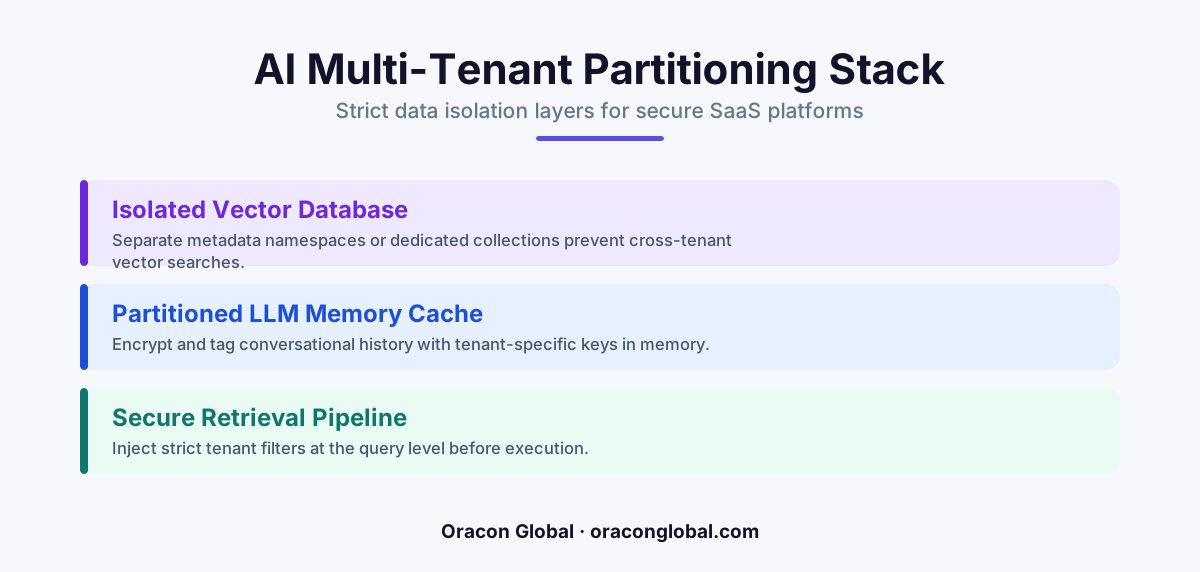
Traditional database partitioning is not enough for AI-native SaaS applications. To keep tenant data safe, software architects must implement zero-trust isolation layers at the ingestion, vector storage, and prompt orchestration levels to prevent cross-tenant data leaks.
When building a traditional software-as-a-service (SaaS) application, securing client data is relatively straightforward. Developers rely on proven relational database techniques, such as row-level security (RLS) or separate database schemas, to ensure Tenant A never glimpses the records of Tenant B. This structural boundary is the bedrock of enterprise trust.
However, when you transition to a multi-tenant AI platform, traditional security boundaries begin to fracture. AI-native applications do not just query structured tables. They ingest PDFs, run semantic searches across vector databases, store conversational histories, and pass raw data blocks into third-party large language models (LLMs). If your architecture relies solely on legacy database rules, you run a severe risk of one client's proprietary data accidentally leaking into another client's automated prompt or retrieval context.
To build a secure enterprise AI SaaS, you must design a dedicated tenant partitioning system. Here is a practical look at how to architect strict data isolation across every layer of your modern AI tech stack.
The Three Vulnerability Points in Multi-Tenant AI Systems
In a standard web application, data moves in a predictable circle: database to backend, backend to frontend. In an AI-native system, data flows through highly complex pipelines. Security vulnerabilities typically crop up in three distinct areas:
- The Vector Storage Layer: This is where unstructured corporate data is converted into numerical representations (embeddings) for fast search. If your vector database does not strictly enforce tenant boundaries, a semantic search run by User A could pull up matching document fragments belonging to User B.
- The Context Ingestion Pipeline: When an AI agent gathers information to answer a user's query, it packages data from various sources into a prompt context window. Without strict runtime checks, old or cached context from a different tenant can slip into the live model run.
- The Model Memory and Cache Layer: LLM orchestrators often cache previous interactions to save on API costs and reduce latency. If these caches are shared globally rather than partitioned by tenant, semantic fragments of private conversations can easily cross organizational boundaries.
Architecting Secure Vector Database Partitioning
Securing your vector database is the most critical step in establishing a robust multi-tenant AI platform security posture. Depending on your scaling needs, budget, and compliance requirements, there are three primary design patterns for partitioning vector data:
1. Logical Separation via Metadata Filtering
In this model, all tenants share a single vector index. Every time a document is embedded and saved, it is tagged with a secure, immutable tenant_id metadata field. When a user runs a search, the backend automatically appends a hardcoded filter constraint: tenant_id == current_tenant_id.
While highly cost-effective and simple to manage, this approach puts a heavy burden on your application code. A single developer error or a missing filter parameter in a new codebase update can result in a catastrophic cross-tenant leak.
2. Namespace Partitioning
Many modern enterprise vector databases support namespaces. Namespaces allow you to segment a single physical index into isolated virtual indexes. Queries run within a specific namespace are structurally incapable of searching or accessing vectors in another namespace.
This provides a much stronger layer of isolation without the massive infrastructure overhead of spinning up separate database instances for every small client signup.
3. Physical Instance Isolation
For high-security industries like healthcare, legal, or finance, logical separation is often not enough to satisfy compliance teams. In these cases, you must provision entirely separate vector database instances for each tenant.
While physically isolated databases are more expensive and complex to orchestrate, they guarantee that data cannot cross boundaries, even if an application-level bug occurs. This approach ensures total enterprise AI data privacy.
Securing the Retrieval-Augmented Generation (RAG) Pipeline
Even with a perfectly partitioned database, data can still leak during the retrieval-augmented generation (RAG) phase. When an AI agent fetches data to answer a user prompt, that data must be routed through an orchestration layer before hitting the LLM.
To prevent leaks during runtime, implement a zero-trust gateway between your retrieval pipeline and the LLM API. This gateway should run three vital validation steps on every single transaction:
- Cryptographic Token Validation: Ensure that the session token requesting the retrieval matches the exact
tenant_idtied to the retrieved documents. This validation must happen at the database driver level, completely independent of the main application logic. - Context Volume Sanitization: Implement automatic token limits and strict data parsing to strip out any structural system metadata before the payload is sent to the LLM. The model should only receive the raw text blocks it needs to answer the question, never backend database keys or system variables.
- Ephemeral Runtime Isolation: Run your agent execution steps inside stateless, isolated runtime containers. Once an agent completes its specific task for a user, the container should be instantly destroyed, wiping clean any local variables or dynamic cache files.
Managing LLM Memory and Third-Party API Privacy
Many founders overlook the risks associated with external LLM providers. When your application calls an external LLM API, you are sending proprietary tenant data outside your local network. To maintain a secure RAG architecture, you must configure your data pathways carefully.
First, always opt out of consumer-grade models. Ensure your commercial API agreements explicitly state that your data will not be used to train future public foundation models. Most major enterprise AI APIs offer zero-data-retention options, meaning they process the request in memory and immediately discard the inputs and outputs.
Second, if you run custom, fine-tuned models for specific enterprise clients, these must be hosted on dedicated inference endpoints. Never run a shared fine-tuned model that contains proprietary weight adjustments derived from multiple clients' private training sets.
Building for Long-Term Security and Trust
Implementing strict tenant partitioning is not just about writing clean code; it is about building an application architecture that can pass rigorous enterprise security audits. When large corporate clients evaluate your AI SaaS platform, their security officers will look closely at how vector embeddings, prompt templates, and agent logs are isolated.
By building a multi-layered security framework that physically or logically partitions data at rest, in transit, and during model inference, you create a foundation that easily scales from initial launch to enterprise-level distribution.
At Oracon Global, our senior in-house engineering team designs and builds secure, custom AI-native SaaS products and workflow automation systems. We ensure you own 100% of your code and intellectual property, allowing you to scale with absolute confidence. If you are planning your next enterprise software build, contact Oracon Global today to discuss how we can engineer a secure, highly scalable system for your business.
===Frequently asked questions
Why is traditional row-level security insufficient for multi-tenant AI platforms?
Row-level security works well for relational databases but fails to address the unique vulnerabilities of vector search, shared LLM context windows, and persistent agent memory layers.
How do you isolate tenant data in vector databases?
You can achieve isolation through metadata filtering, dedicated namespaces within a single index, or deploying physically separated vector indexes for each tenant.
What is a prompt-level data leak and how do you prevent it?
A leak occurs when retrieved context from Tenant A is injected into a shared LLM session and cached. It is prevented by stripping session cache and using isolated, stateless runtime containers.
Does strict tenant isolation impact AI application performance?
While physical isolation adds slight infrastructure overhead, using logical namespace separation with strict cryptographic access keys keeps latency low while maintaining robust security.
Read next
Beyond Chatbots: How to Build AI Agents That Actually Do Work for Your Business
Most businesses use AI to answer questions. Here is how to build custom AI agents that actually take action, connect to your internal tools, and handle complex workflows.
Beyond the Wrapper: How to Build Custom AI Agents for Business That Actually Work
Many businesses invest in basic AI wrappers only to find they lack the security and context needed for real work. Here is how to build custom AI agents that integrate deeply with your workflows and databases.
Enterprise AI Maintenance Costs: Budgeting for Year Two and Beyond
Building an AI system is only half the battle. Discover the practical, ongoing operational costs of enterprise AI, including token management, model drift, and continuous security audits.
Oracon Global builds production-grade AI agents, automation and apps — and you own the code and IP. Tell us what you want to automate.
Book a call →See our work