

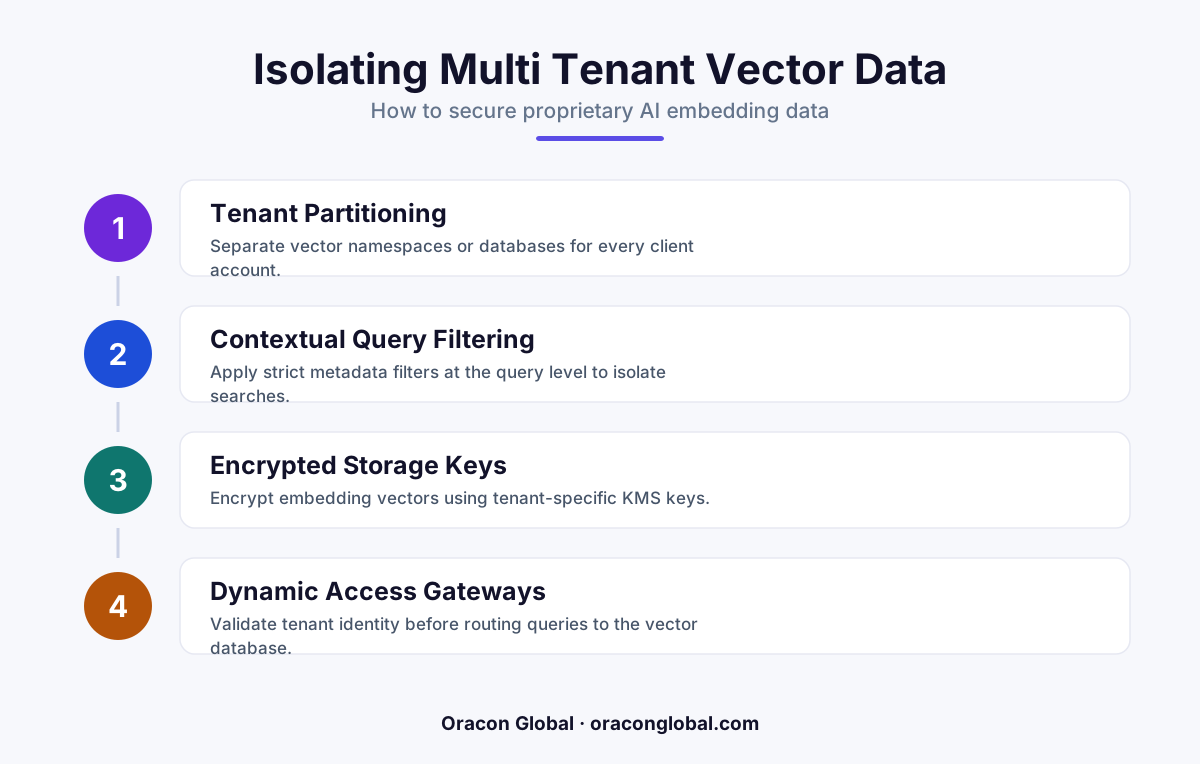
Standard relational database isolation does not automatically translate to high-dimensional vector spaces used by LLMs and RAG systems. To prevent cross-tenant data leaks, developers must implement cryptographic metadata filtering, namespace partitioning, or dedicated index strategies at the vector database layer.
For B2B software founders, multi-tenancy is the bedrock of business scalability. In traditional software-as-a-service (SaaS) platforms, keeping Tenant A from seeing Tenant B's invoice history is a solved problem. You write a standard SQL query with a tenant ID filter, enforce Row-Level Security (RLS) at the database layer, and move on.
But when you transition to building AI-native SaaS platforms, the underlying data changes. Instead of simple strings and integers, your application processes high-dimensional vector embeddings generated by Large Language Models (LLMs). These embeddings represent highly sensitive corporate knowledge bases, proprietary operational files, and internal strategy documents.
Simply applying old database isolation rules to a new multi-tenant vector database setup is a recipe for disaster. In the vector world, data leaks do not always look like an obvious SQL injection. They manifest as subtle semantic leakage, where an AI assistant answering a query for Tenant A accidentally references the conceptual knowledge, proprietary jargon, or private context belonging to Tenant B.
To scale a secure, enterprise-grade AI platform, you need a custom database architecture designed specifically to prevent vector data cross-contamination.
The Structural Vulnerability of Shared Vector Spaces
To understand why vector data leaks occur, we must look at how vector databases handle search operations. In a standard relational database, data is exact, indexed, and queried via deterministic rules. In a vector database, documents are chunked, transformed into mathematical coordinates (embeddings) by an embedding model, and placed into a high-dimensional space.
When an AI agent performs a Retrieval-Augmented Generation (RAG) query, it uses an Approximate Nearest Neighbor (ANN) algorithm to locate the vectors closest to the user's prompt. This mathematical search operates on spatial proximity, not structured columns. If your system relies solely on the LLM to filter out unauthorized data, or if it applies soft filters after the search is complete, you are running a massive security risk.
There are three primary architectural paths to solve this problem, each with trade-offs in security, performance, and cloud infrastructure cost.
Logical isolation partition hosts all tenant vectors within a single database instance but divides them into distinct, isolated namespaces. This is the logical equivalent of schema partitioning in standard SQL databases.
- How it works: Every write, update, and search query is strictly bound to a specific namespace string (typically a cryptographically secure tenant UUID). The database engine limits its ANN search graph to that namespace.
- The Pros: Highly cost-effective and easy to manage. You only run and pay for one database cluster, and provisioning a new tenant is as simple as creating a new namespace string on the fly.
- The Cons: You are relying on the database provider's internal software implementation to enforce the partition. If there is a bug in the database engine's namespace routing code, data can bleed across boundaries.
Instead of partitioning the database, this approach stores all customer vectors in a single global index. Every vector is tagged with a metadata payload containing the tenant ID. When a search is executed, the query includes a strict metadata filter.
"Security in AI-native systems must be enforced at the data retrieval layer, never left to the discretion of the LLM parser."
The implementation details here are critical. You must use single-stage filtering (also known as pre-filtering). In pre-filtering, the database engine resolves the metadata query to isolate the tenant's vectors first, and then performs the vector search within that subset.
If your system uses post-filtering, the database performs the vector search first across the entire global index, collects the top 100 matches, and then discards any matches that do not belong to the active tenant. If the top 100 matches all happen to belong to other tenants, post-filtering will return zero results to your user, causing the AI agent to fail or hallucinate.
For enterprise customers with strict regulatory compliance requirements, logical separation is not enough. They require physical isolation of their data assets.
This architecture provisions a completely separate physical database index, or a separate database instance, for each tenant. No two customers share the same memory space, index files, or search graphs.
- Complete Security Guarantee: Because the physical storage and memory footprints are isolated, it is mathematically impossible for a query from Tenant A to return a vector from Tenant B.
- No Performance Interference: High-volume vector indexing or search loads from one customer cannot exhaust the database resources or slow down queries for another customer.
- Custom Encryption Keys: You can encrypt each tenant's index with their own managed KMS keys, allowing them to revoke access instantly if needed.
The challenge with physical isolation is operational complexity and high infrastructure cost. Running thousands of individual database containers or indexes consumes substantial RAM, even when those tenants are idle.
Building the Custom Orchestration Layer
At Oracon Global, when we build custom AI-native SaaS platforms, ERP systems, and workflow automation suites, we design a custom gateway to sit between the application code and the vector database. This orchestration layer acts as an absolute security gate.
This gateway intercepts every incoming query, extracts the authenticated session tenant ID, and forces the injection of the tenant's namespace or pre-filter criteria before the query ever hits the vector database driver. This ensures that even if a developer writes an insecure application-level query, the database adapter will reject it or automatically inject the correct tenant isolation parameters.
By keeping this logic in a dedicated, in-house database adapter, your team avoids the risk of manual query-building mistakes as your product scales and introduces new features.
Choosing the Right Fit for Your SaaS Platform
If you are building an early-stage SaaS product with hundreds of small-to-medium business customers, a namespace-partitioned architecture or a robust pre-filtered metadata system provides the ideal balance of speed, low overhead, and secure separation.
If you are selling to enterprise clients, healthcare institutions, or financial firms, you should design a hybrid architecture. This allows your standard tier customers to run on a shared, namespace-isolated index, while high-value enterprise tiers are seamlessly provisioned onto their own dedicated, physically isolated vector database instances.
Planning your data storage strategy correctly from day one protects your platform from costly structural redesigns, guarantees compliance, and builds the trust your enterprise buyers expect.
If you are looking to build a secure, production-ready AI product, enterprise application, or workflow automation system, our senior team at Oracon Global can help. We design and deliver custom software worldwide from our India-based studio, giving you 100% ownership of your code and intellectual property. Reach out to Oracon Global today to discuss your architecture needs.
Frequently asked questions
Why is standard row-level security insufficient for vector databases?
Traditional row-level security (RLS) filters structured queries, but approximate nearest neighbor (ANN) search algorithms in vector databases construct complex high-dimensional index trees. Without hard cryptographic or namespace-level isolation, search queries can traverse index nodes belonging to other tenants, causing latent data exposure or index poisoning.
What is the difference between metadata filtering and hard isolation in vector stores?
Metadata filtering applies a tenant ID check during or after the vector search process, which is easier to set up but carries higher leakage risks if configured incorrectly. Hard isolation partitions data physically or logically using separate databases, distinct namespaces, or dedicated indexes per tenant, ensuring zero shared search paths.
How does multi-tenancy affect vector search performance and latency?
Hard partitioning, like using separate indexes per tenant, keeps search times fast because the query space is small. However, running thousands of individual indexes increases memory overhead and cost. Metadata filtering scales better for high tenant counts but can suffer from latency penalties if the system has to filter out millions of out-of-tenant vector matches post-query.
Should we build or buy our multi-tenant vector database layer?
While managed vector databases offer basic multi-tenancy features, building a custom orchestration layer on top of your database engine allows you to enforce business-specific compliance, dynamic key rotation, and automated tenant provisioning without being locked into a single cloud provider's proprietary security model.
Read next
Beyond Chatbots: How to Build AI Agents That Actually Do Work for Your Business
Most businesses use AI to answer questions. Here is how to build custom AI agents that actually take action, connect to your internal tools, and handle complex workflows.
Beyond the Wrapper: How to Build Custom AI Agents for Business That Actually Work
Many businesses invest in basic AI wrappers only to find they lack the security and context needed for real work. Here is how to build custom AI agents that integrate deeply with your workflows and databases.
Enterprise AI Maintenance Costs: Budgeting for Year Two and Beyond
Building an AI system is only half the battle. Discover the practical, ongoing operational costs of enterprise AI, including token management, model drift, and continuous security audits.
Oracon Global builds production-grade AI agents, automation and apps — and you own the code and IP. Tell us what you want to automate.
Book a call →See our work