

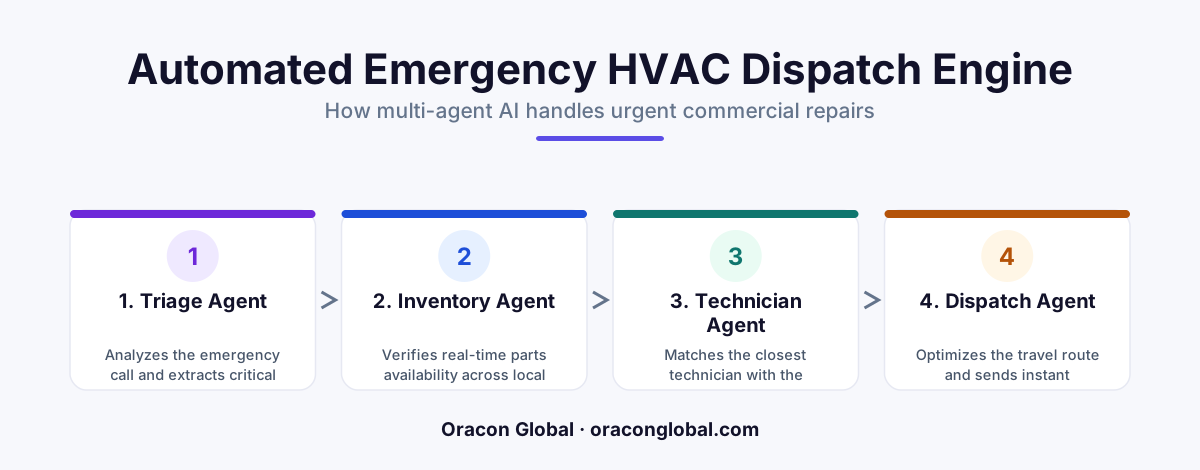
Commercial HVAC emergencies can cost businesses thousands of dollars per hour in spoiled inventory or halted operations. Building a custom multi-agent dispatch engine automates the triage, technician matching, inventory verification, and scheduling phases instantly, routing the right technician with the right tools before a human dispatcher can even finish reading the intake ticket.
When a commercial refrigeration rack fails in a cold-storage warehouse or the rooftop AC unit shuts down in a crowded retail center, every minute of delay costs money. Spoiled inventory, halted production, and violated lease agreements can quickly add up to tens of thousands of dollars. Historically, managing these high-stakes emergencies has fallen on human dispatchers who must manually balance incoming phone calls, scan technician GPS coordinates, check stock levels for specialized parts, and review complex service level agreements (SLAs).
Even the most experienced dispatchers struggle to process all of these variables during peak seasonal rushes. By building a custom commercial HVAC dispatch software engine driven by multi-agent AI orchestration, commercial service providers can automate the entire triage and scheduling pipeline. This system processes emergency requests, matches the optimal technician, verifies truck inventory, and routes the team in under sixty seconds.
The Limits of Static HVAC Dispatching Software
Traditional dispatch systems are glorified digital calendars. They rely on manual data entry and basic, rule-based logic—such as routing the closest technician on a map. However, emergency HVAC dispatching is rarely that simple. A technician might be geographically closest to a job site, but lack the specific EPA certifications required to handle the refrigerant on that particular system. Or they might have the certification but lack the specialized diagnostic tools or replacement components in their truck inventory.
When a legacy system makes an incorrect match, it results in wasted travel time, multiple truck rolls, and frustrated customers. A custom multi-agent engine solves this by splitting the complex decision-making process into dedicated, cooperative digital specialists. Each agent focuses on a single aspect of the dispatch challenge, communicating in real time to reach a mathematically optimal decision.
How a Multi-Agent HVAC Dispatch Engine Works
Rather than relying on one massive, slow-moving AI model, a modern automated dispatch engine uses a network of specialized, lightweight AI agents. Each agent has access to specific databases and operates under strict business guardrails. Here is how the workflow executes during an emergency intake:
- The Triage Agent: Reads incoming emergency requests via email, SMS, client portals, or phone transcriptions. It extracts key details—such as system type, error codes, and failure symptoms—and instantly determines the severity and priority of the call.
- The SLA and Contract Agent: Queries your client database or ERP to pull up the customer's contract. It identifies guaranteed response windows, preferred labor rates, and any pre-approved spending limits to ensure compliance with the customer's agreement.
- The Inventory and Fleet Agent: Checks live GPS telemetry data and cross-references the diagnosed issue with truck stock manifests and regional warehouse inventories to ensure the dispatched technician has the required parts.
- The Coordinator Agent: Synthesizes the data from the other agents, ranks the best available technicians, drafts the optimal route, and presents the completed dispatch ticket to your human dispatcher for final approval.
Designing the Agentic Communication Loop
To prevent these agents from conflicting or creating scheduling loops, the system utilizes a state machine architecture. When a new emergency ticket enters the queue, it is assigned a unique state. The agents work sequentially or in parallel depending on the requirements, updating the central state machine. This event-driven design ensures that no technician is double-booked, and no inventory item is allocated to two jobs simultaneously.
Step-by-Step Architecture for Custom Dispatch Automation
Building a resilient system for field service automation requires a clean separation between your AI decision layer and your operational database. Here is how we design and deploy these custom systems:
1. Data Intake and Semantic Analysis
Emergency calls rarely come in structured formats. A property manager might send a frantic, misspelled email, or an on-site facility technician might leave a chaotic voicemail. The Triage Agent uses natural language processing (NLP) to parse unstructured text, mapping the request to your standardized asset database. It identifies the specific make and model of the failing compressor, evaporator, or chiller, and flags the issue as a critical priority.
2. Real-Time Telemetry and Skill Matching
Once the system understands the problem, the Fleet Agent queries your telematics and HR databases. It filters available technicians based on their physical distance, shift hours, overtime limits, and specialized skills. If a technician is already on a high-priority call or is close to exceeding their maximum legal driving hours, the agent automatically bypasses them in favor of the next best candidate.
3. Parts Availability and ERP Verification
One of the biggest causes of delayed resolution is a technician arriving on-site without the correct components. The Inventory Agent runs a parallel search across your ERP system and the technician's mobile inventory. If the required fan motor or control board is missing from their truck, the agent calculates whether it is faster to route them past a central warehouse or dispatch a runner to deliver the part directly to the site.
4. The Human-in-the-Loop Safeguard
While the AI engine is fully capable of dispatching technicians autonomously, emergency operations run smoothest when experienced human dispatchers maintain oversight. The system compiles its findings into a simple, clean card on your dispatch dashboard. The human dispatcher sees the recommended technician, the proposed travel route, and the reasoning behind the choice (e.g., "Technician A chosen due to EPA Universal certification and matching truck stock"). With a single click, the human approves the ticket, triggering an automated SMS notification to the technician's mobile app.
"An AI agent is only as powerful as the systems it can write to. By wrapping your existing legacy databases in secure API layers, we allow autonomous agents to execute complex logistics tasks without risking your underlying data integrity."
The Long-Term Value of Custom AI Infrastructure
Investing in custom IP pays immediate dividends. Unlike off-the-shelf software packages that charge high per-user monthly seat fees and restrict how you use your own data, a custom-built dispatch engine belongs entirely to your business. You own 100% of the code and intellectual property.
As your business grows, your custom engine can scale alongside you. You can easily plug in new AI agents to handle automated billing, generate compliance reports for regional environmental protection agencies, or predict future equipment failures based on historical maintenance logs. Your software becomes a proprietary asset that increases the enterprise value of your service firm.
Partner with Oracon Global to Build Your Custom AI Fleet
At Oracon Global, our senior in-house engineering team specializes in building production-grade AI agents, workflow automation, and custom web and mobile applications for clients worldwide. We do not build superficial wrappers or brittle demos; we design robust, event-driven software architectures that integrate seamlessly with your existing ERPs and operational workflows.
If you are ready to eliminate dispatch bottlenecks, reduce truck rolls, and provide your commercial clients with lightning-fast response times, we are here to help. Reach out to Oracon Global today to schedule a practical, hype-free conversation about building your custom multi-agent dispatch system.
Frequently asked questions
Why is custom AI dispatching better than off-the-shelf HVAC scheduling software?
Off-the-shelf software relies on static rules and manual drag-and-drop actions. A custom multi-agent engine reasons through complex, real-time variables—like technician certifications, live traffic, inventory levels across multiple warehouses, and client SLA contracts—to make optimal dispatch decisions in seconds.
How do AI agents verify that a technician has the right parts before dispatching?
An inventory agent queries your ERP and warehousing databases to check real-time stock levels. If a specific compressor or valve is required, the agent matches the work order with a technician whose truck inventory is already stocked with that part, or routes them to the nearest branch for pickup.
Can human dispatchers override the AI agent's routing decisions?
Yes. We build custom multi-agent systems with explicit human-in-the-loop validation gates. The AI calculates the optimal route, assigns the technician, and prepares the work order, but holds the final dispatch for a one-click human approval in your dispatch dashboard.
How does this system integrate with our legacy ERP and GPS tracking systems?
We build custom API middleware wrappers around your legacy ERP, accounting, and telematics systems. This allows the AI agents to securely read and write data—such as pulling GPS coordinates or updating billing records—without requiring you to replace your existing software stack.
Read next
Beyond Chatbots: How to Build AI Agents That Actually Do Work for Your Business
Most businesses use AI to answer questions. Here is how to build custom AI agents that actually take action, connect to your internal tools, and handle complex workflows.
Beyond the Wrapper: How to Build Custom AI Agents for Business That Actually Work
Many businesses invest in basic AI wrappers only to find they lack the security and context needed for real work. Here is how to build custom AI agents that integrate deeply with your workflows and databases.
Enterprise AI Maintenance Costs: Budgeting for Year Two and Beyond
Building an AI system is only half the battle. Discover the practical, ongoing operational costs of enterprise AI, including token management, model drift, and continuous security audits.
Oracon Global builds production-grade AI agents, automation and apps — and you own the code and IP. Tell us what you want to automate.
Book a call →See our work