

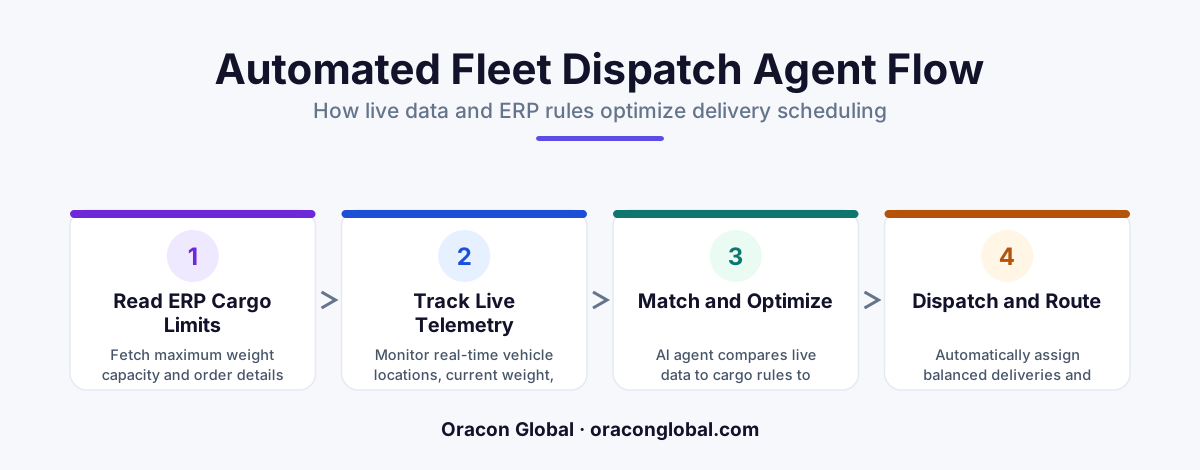
A custom AI dispatch agent acts as an automated scheduler for delivery fleets. By comparing real-time GPS and weight data from trucks with official inventory limits in your ERP, the agent automatically assigns jobs to the right vehicles without human error.
Imagine running a busy delivery business where you use several different trucking companies to move your goods. Every day, your office team has to figure out which truck should carry which delivery. They have to check how heavy the cargo is, look at where the trucks are currently driving, and make sure they do not load a vehicle past its legal weight limit.
When done by hand using spreadsheets and phone calls, this process is incredibly slow. It is very easy to accidentally put too much weight on a truck, which leads to safety fines, or to send a driver who is too far away, which wastes fuel and time.
A custom AI dispatch agent solves this problem. It acts like a highly organized, automated office assistant that works 24 hours a day to match the right delivery job with the right truck instantly.
What Is a Custom AI Dispatch Agent?
To understand how this technology works, let us break down the key parts in simple terms.
- AI Agent: A smart software program designed to perform a specific task from start to finish without a human having to click every button.
- Multi-Vendor: This means you work with many different external transport companies, rather than just your own trucks.
- Telemetry: Real-time data sent wirelessly from a vehicle, such as its live GPS location, speed, and fuel level. Think of it like the fitness tracker on your wrist, but for a truck.
- ERP: Short for Enterprise Resource Planning. This is your company's main digital filing cabinet where you store official business records, such as inventory lists, order details, and maximum truck cargo limits.
A custom AI dispatch agent connects these different systems together. It constantly reads the live data from your trucks and compares it to the rules in your digital filing cabinet to make smart scheduling decisions.
The Everyday Analogy: Packing a Smart Suitcase
To see how this works in real life, imagine you are packing a suitcase for a trip, but you have a strict weight limit from the airline.
Normally, you would pack the bag, lift it onto a bathroom scale, realize it is too heavy, take items out, and try again. This is how manual dispatching works: loading trucks and hoping they do not get stopped at a highway scale for being overweight.
Now, imagine you have a smart suitcase that knows exactly how much space is left inside and how much every item weighs before you even put it in. As you walk around your house, a smart assistant on your phone looks at your packing list, checks the airline rules, and tells you exactly which bag to use. That is what smart fleet dispatch does for your business.
How the AI Agent Makes Decisions in Real Time
The beauty of a custom AI dispatch agent is that it does not guess. It follows a clear, step-by-step process to ensure every delivery is safe and on time.
Step 1: Listening for New Orders
The moment a customer places a delivery order, it appears in your central system. The AI agent immediately spots this new order and looks at what needs to be shipped, including its total weight and volume.
Step 2: Checking the Fleet's Live Status
The agent looks at the live telemetry data from all available trucks. It checks where they are currently located and how much physical space they have left on their current route.
Step 3: Verifying the Legal Limits
Before assigning the job, the agent looks inside your ERP database. It checks the specific cargo limits for that exact type of truck. For example, it confirms that a specific delivery van cannot legally carry more than 2,000 pounds.
Step 4: Making the Perfect Match
The agent combines all this information. If Truck A is closest to the pickup point but is already carrying 1,800 pounds of cargo, the agent knows it cannot take a new 500-pound order. Instead, it bypasses Truck A and automatically assigns the job to Truck B, which is slightly further away but has plenty of empty space.
A Real-World Example: Cold Chain Food Delivery
Let us look at how a real business benefits from this system. A food distributor delivers fresh produce and frozen meals to dozens of grocery stores every day. They use three different local trucking vendors.
Frozen foods must go into refrigerated trucks, and they cannot exceed strict weight limits because heavy trucks burn more fuel, which warms up the cooling units.
With a custom AI dispatch agent, the distributor no longer has to manually call each trucking vendor to ask who has an empty refrigerated truck nearby. The AI agent automatically detects a new order for frozen strawberries, finds a nearby vendor truck that has its refrigerator turned on to the correct temperature, confirms the truck is not overloaded, and sends the driving route directly to the driver's phone.
Why Custom Software Beats Off-the-Shelf Apps
Many pre-made logistics apps exist, but they often fail because they cannot talk to your unique systems. Your business might use a specific database from ten years ago, while your trucking vendors might use three different GPS tracking brands.
Building a custom solution means the AI agent is designed to fit your exact business. It glues your existing tools together without forcing you to buy all-new software or hardware. Best of all, when you build a custom solution, you own 100% of the code and intellectual property.
Ready to Automate Your Operations?
Managing a fleet does not have to involve endless phone calls, overloaded trucks, and scheduling headaches. By letting a smart AI agent handle the heavy lifting, your team can focus on growing your business while your trucks stay safe, legal, and on time.
At Oracon Global, our senior in-house team builds custom AI agents, web applications, and mobile apps that solve complex business challenges. Contact Oracon Global today to discuss how we can build a custom dispatch system tailored to your business operations.
Frequently asked questions
What is a custom AI dispatch agent?
It is a smart software helper that automatically assigns delivery jobs to different transport companies and trucks based on real-time data.
How does the AI agent know if a truck is too full?
The agent connects to your ERP system to read the weight and size limits of each cargo item, then compares this to the live space available in the truck.
Do we need to replace our existing fleet tracking hardware?
No, a custom AI agent can connect directly to your existing GPS and vehicle tracking systems using standard software connections.
How does this help save money on shipping?
It stops you from overfilling trucks, prevents costly safety fines, and ensures you always choose the closest, most cost-effective vehicle for every delivery.
Read next
Beyond Chatbots: How to Build AI Agents That Actually Do Work for Your Business
Most businesses use AI to answer questions. Here is how to build custom AI agents that actually take action, connect to your internal tools, and handle complex workflows.
Beyond the Wrapper: How to Build Custom AI Agents for Business That Actually Work
Many businesses invest in basic AI wrappers only to find they lack the security and context needed for real work. Here is how to build custom AI agents that integrate deeply with your workflows and databases.
Enterprise AI Maintenance Costs: Budgeting for Year Two and Beyond
Building an AI system is only half the battle. Discover the practical, ongoing operational costs of enterprise AI, including token management, model drift, and continuous security audits.
Oracon Global builds production-grade AI agents, automation and apps — and you own the code and IP. Tell us what you want to automate.
Book a call →See our work