

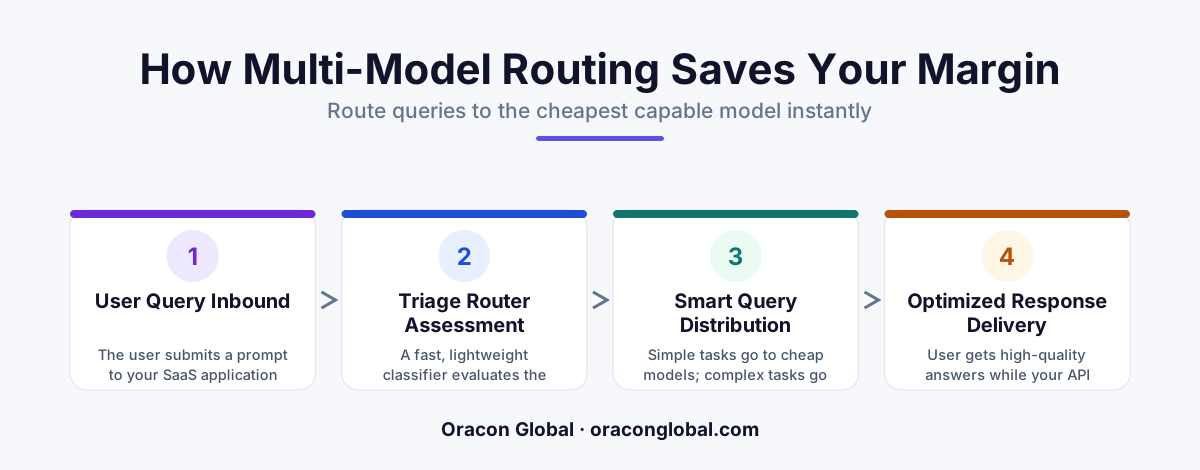
A custom multi-model router acts as an automated traffic controller for your AI features, sending simple formatting or extraction tasks to lightning-fast, low-cost models while saving expensive frontier models for complex reasoning. By dynamically triaging incoming user queries, your SaaS platform can slash API overhead and maintain healthy, predictable unit economics.
In the rush to ship AI features, many B2B SaaS companies make a quiet, margin-killing engineering assumption: they route every single user prompt to the most powerful frontier model available. While using a top-tier model ensures excellent outputs during early product demonstrations, it creates a massive financial bottleneck when your platform begins to scale. Running complex, high-reasoning models for simple text formatting, classification, or basic data extraction is the software equivalent of hiring a rocket scientist to sort mail.
Every time a user inputs a routine query that could be solved by a model costing a fraction of the price, your product margins take a direct hit. To build a sustainable, scalable AI product, you need a mechanism that evaluates query complexity in real time. Building a custom multi-model router is the most reliable way to protect your SaaS profit margins and optimize your LLM API costs without compromising the user experience.
Why Single-Model Architectures Drain SaaS Profit Margins
When you rely on a single premium model for your entire application, your unit economics are tied directly to the vendor's pricing structure. This setup works fine when your user base is small, but it breaks down under the weight of real-world production traffic. User interactions in a typical B2B SaaS application follow a predictable power-law distribution. A small percentage of queries require heavy conceptual reasoning, while the vast majority are simple, repetitive operational tasks.
Consider a customer relationship management (CRM) platform with built-in AI features. A user might ask the AI to:
- Task A: "Format this messy list of ten phone numbers into standard E.164 format."
- Task B: "Analyze this 50-page contract, compare it to our historical compliance guidelines, and draft a custom amendment."
Using a premium frontier model for Task A costs exactly the same per token as Task B, yet Task A requires zero conceptual reasoning. When thousands of users run simple formatting and cleanup tasks daily, your platform bleeds capital on unnecessary API overhead. A multi-model router solves this by inspecting the intent of the incoming query before any external API is called.
The Architecture of a Custom Multi-Model Router
A custom router acts as a traffic cop sitting between your application's user interface and your LLM integration layer. Instead of sending the raw user prompt directly to an external API provider, the prompt is first analyzed by a lightweight, high-speed classification layer inside your own infrastructure.
This classification process must be incredibly fast, ideally adding fewer than 20 to 50 milliseconds of latency to the overall round trip. To achieve this, engineers typically use one of three main routing strategies:
1. Keyword and Pattern Matching
The simplest approach relies on deterministic rules. If a user query matches specific patterns—such as requesting a JSON conversion, raw text formatting, or a simple yes/no classification—the router immediately sends the payload to a fast, cost-effective utility model. This method requires virtually zero computational overhead and runs instantly.
2. Embedding-Based Semantic Classification
For more nuanced queries, the router converts the incoming prompt into a lightweight vector embedding. This embedding is compared against a pre-mapped index of sample queries representing different complexity levels. If the semantic similarity score indicates a routine task, the query is routed to a smaller, specialized model. This provides highly accurate custom AI routing with minimal latency.
3. Low-Cost LLM Triage
In this scenario, a tiny, fast open-source model is trained or prompted solely to classify incoming queries into difficulty buckets (e.g., "Simple," "Medium," or "Complex"). While this adds a micro-transaction to your execution path, the speed and low cost of these micro-models still yield massive net savings compared to default premium routing.
Step-by-Step: Implementing the Routing Logic
Building a production-ready router requires establishing clear boundaries for where queries should land. Below is the typical workflow for an enterprise-grade routing system:
- Ingest the Prompt: The user submits a query through your SaaS interface.
- Run the Classifier: The routing engine analyzes the text structure and semantic intent.
- Evaluate the Complexity: The engine checks if the task requires deep logical reasoning, multi-step planning, or advanced mathematics.
- Select the Destination: Simple tasks go to a fast, hyper-optimized local or open-source model. Strategic, creative, or highly complex tasks are routed to premium frontier models.
- Process and Return: The selected model executes the task, and the response is sent back to the user seamlessly.
By implementing this tiered approach, your engineering team can treat model selection as a dynamic resource allocation problem. You only pay for premium computing power when the task genuinely demands it.
Operational Benefits Beyond Cost Reduction
While protecting your bottom line is the primary driver for building a router, this architecture offers several critical operational advantages for B2B SaaS platforms:
Redundancy and Reliability
If a primary API provider experiences an outage or severe latency spikes, your router can automatically fall back to alternative models. This keeps your application online and functional, protecting your reputation for uptime and reliability.
Latency Optimization
Smaller models are inherently faster. By routing simple tasks to lighter models, your users experience near-instantaneous load times for everyday tasks, which dramatically improves the overall feel and responsiveness of your software.
Data Privacy and Compliance
A router can inspect queries for sensitive data, such as personally identifiable info (PII). If a query contains sensitive operational data, the router can direct it to a self-hosted, secure open-source model running within your private cloud, ensuring you never leak sensitive customer data to public APIs.
Taking Control of Your AI Unit Economics
Building a successful AI-powered SaaS product requires a shift in focus from "what is possible" to "what is commercially viable." Relying entirely on external premium models without an intermediary routing layer leaves your margins vulnerable to user behavior and vendor pricing changes. A custom multi-model router puts control back in your hands, ensuring your software remains profitable as it scales.
At Oracon Global, our senior in-house team designs and builds high-performance AI engines, workflow automations, and custom apps designed to scale efficiently. If you are ready to optimize your AI infrastructure and protect your margins, get in touch with Oracon Global today to discuss how we can help you build a robust, cost-effective system.
Frequently asked questions
What is a multi-model router?
A multi-model router is an intelligent software layer that inspects incoming user queries and programmatically decides which language model is best suited to handle the request based on complexity, cost, and latency requirements.
How much can a router reduce our API bill?
By directing routine tasks like data extraction, formatting, and simple classification to smaller, highly optimized models, most SaaS platforms see their aggregate LLM API costs drop by 40% to 70% without any loss in output quality.
Will adding a router slow down my application?
No. When built correctly using lightweight semantic classifiers or fast utility models, the routing decision takes only a few milliseconds, which is often offset by the faster processing times of the smaller downstream models.
Can we build a router using open-source tools?
Yes, you can build a highly effective router using open-source routing libraries, custom semantic classification arrays, or lightweight vector embeddings that run locally on your own cloud infrastructure.
Read next
Beyond Chatbots: How to Build AI Agents That Actually Do Work for Your Business
Most businesses use AI to answer questions. Here is how to build custom AI agents that actually take action, connect to your internal tools, and handle complex workflows.
Beyond the Wrapper: How to Build Custom AI Agents for Business That Actually Work
Many businesses invest in basic AI wrappers only to find they lack the security and context needed for real work. Here is how to build custom AI agents that integrate deeply with your workflows and databases.
Enterprise AI Maintenance Costs: Budgeting for Year Two and Beyond
Building an AI system is only half the battle. Discover the practical, ongoing operational costs of enterprise AI, including token management, model drift, and continuous security audits.
Oracon Global builds production-grade AI agents, automation and apps — and you own the code and IP. Tell us what you want to automate.
Book a call →See our work