

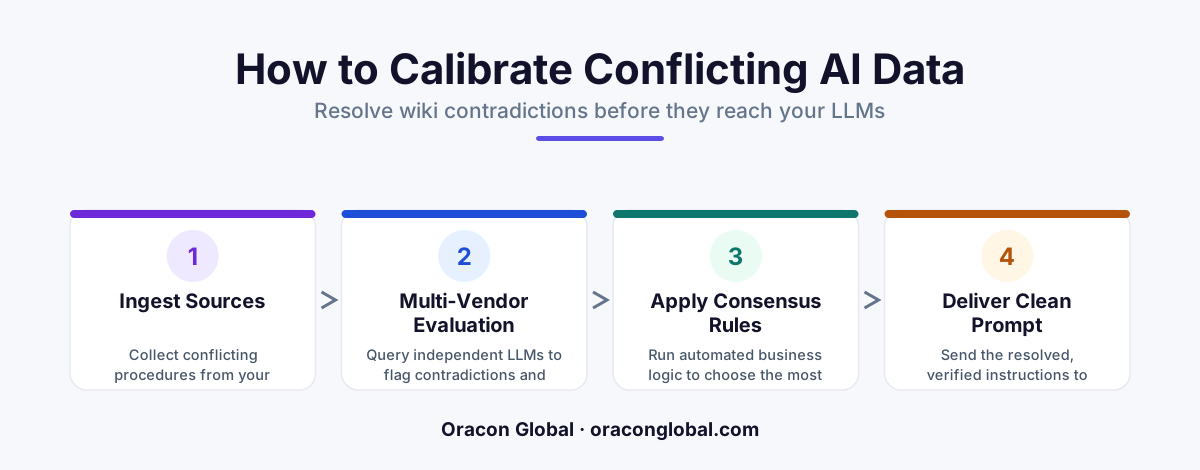
AI digital employees fail when internal documentation contradicts itself across different departments or legacy wikis. By implementing a custom multi-vendor calibration layer, companies can programmatically resolve these documentation conflicts using deterministic logic and consensus models before the AI executes a task.
Deploying AI digital employees to handle customer support, internal operations, or complex workflows can dramatically lower operational costs. However, these systems are only as reliable as the data they access. In most growing enterprises, knowledge is scattered across legacy intranets, shared drives, and departmental wikis. Often, these sources actively contradict each other.
When your customer support wiki says refunds require manager approval, but the sales operations portal says refunds under fifty dollars are automated, a human employee uses intuition or asks a teammate. An AI agent, when confronted with conflicting wiki data, will often try to split the difference, leading to LLM hallucination prevention failures and incorrect actions. To make your AI digital employees truly autonomous and safe, you need a programmatic way to resolve these contradictions before they turn into real-world errors.
The Root of the Problem: Vector Search Lacks Contextual Authority
Most modern AI agents rely on Retrieval-Augmented Generation (RAG) to find answers within your company documentation. When an agent receives a query, it converts the question into a mathematical vector, searches your database for matching paragraphs, and feeds those snippets to the Large Language Model (LLM) to write a response.
While highly efficient, vector search has a major structural flaw: it only measures semantic similarity, not accuracy or authority. If your vector database finds two highly relevant documents that give completely different instructions, it passes both to the LLM. The LLM is then forced to decide which document to trust. Without hardcoded guardrails, the LLM will guess, combine the two conflicting workflows, or hallucinate a new procedure entirely.
What is a Custom Calibration Layer?
To prevent these failures, we build a custom calibration layer directly into the data retrieval pipeline. This layer acts as an automated mediator. Instead of allowing retrieved documents to go straight to the LLM, the calibration layer inspects the retrieved text for logical contradictions, scores them based on custom business rules, and delivers a single, verified source of truth to the agent.
By decoupling knowledge retrieval from knowledge execution, you ensure that your AI digital employees never have to guess which corporate policy is active.
Step 1: Implementing Metadata-Driven Authority Scoring
The first line of defense in a calibration layer is a strict metadata hierarchy. Every document indexed in your vector database must be tagged with specific structural attributes. When the retrieval system pulls potential answers, the calibration layer evaluates these tags to resolve conflicts programmatically without needing a second LLM call.
- Temporal Priority (Recency): Newer documents automatically receive a higher trust score than older documents unless explicitly marked as archival.
- Departmental Ownership: A billing query should prioritize documents tagged to the Finance department over documents tagged to General Support.
- Verification Status: Documents explicitly reviewed and signed off by a human subject-matter expert receive a trust multiplier.
Step 2: Building the Semantic Conflict Detector
Not all contradictions are obvious. To catch subtle conflicts—like one document saying "ship via ground" and another saying "ship via priority air"—the calibration layer utilizes a lightweight, fast local model specifically trained for Natural Language Inference (NLI).
This model compares the top-retrieved text snippets against each other to evaluate whether they entail, contradict, or are neutral to one another. If a high-probability contradiction is flagged, the system pauses the generation process and triggers your predefined resolution rules.
Step 3: Executing the Multi-Vendor Consensus Protocol
If the metadata scores are tied and a contradiction is detected, the calibration layer runs a multi-vendor consensus check. This involves sending the conflicting snippets to two distinct, highly capable LLM engines (such as models from Anthropic and OpenAI) with a highly specific system prompt: "Identify the contradiction between these two policies and output the logical divergence."
By comparing the structured analysis from two different model families, the calibration layer can isolate the exact point of failure and apply fallback logic, such as routing the query to a human operator or defaulting to the safest possible corporate action.
Handling Fallbacks and the Human-in-the-Loop Safeguard
No automated system is completely infallible. When the calibration layer encounters a direct conflict that cannot be resolved via metadata or consensus models, it must not allow the AI digital employee to proceed with a guess. Instead, the system gracefully triggers a human-in-the-loop workflow.
The calibration layer flags the conflicting wiki pages, generates a ticket for the internal operations team to update the documentation, and routes the immediate customer inquiry to a human representative. This process guarantees that every technical conflict identified by your AI actively improves your corporate knowledge base over time, turning your AI implementation into a self-cleaning data engine.
Designing a Reliable AI Architecture
Building reliable AI digital employees requires moving past simple API wrappers and basic chat interfaces. To handle complex, real-world business operations, your software architecture must be built with deterministic boundaries, strict validation steps, and intelligent middleware like calibration layers.
At Oracon Global, our senior in-house development team specializes in building production-ready AI agents, custom workflow automation, and robust enterprise applications. We build custom software tailored to your operational realities, and our clients retain 100% ownership of their code and intellectual property. If you are ready to deploy AI that works reliably without hallucination risks, reach out to Oracon Global to discuss your architecture.
Frequently asked questions
Why do conflicting internal wikis cause AI digital employees to hallucinate?
When an AI agent retrieves two different procedures for the same task from separate wikis, it cannot intuitively know which is correct, causing it to merge the instructions or hallucinate a middle ground.
What is a multi-vendor calibration layer?
It is an architectural middle layer that intercepts retrieved knowledge-base documents and uses deterministic rules and consensus-checking LLMs to resolve contradictions before generating an answer.
Can this system work with our existing knowledge management tools like Notion or Confluence?
Yes, the calibration layer sits between your vector databases (which index tools like Confluence, Google Drive, or Notion) and the LLM execution environment.
How do we determine which document wins when a conflict is detected?
The system uses a prioritized metadata matrix (such as document age, department authority, and verified expert tags) to programmatically rank and select the source of truth.
Read next
Beyond Chatbots: How to Build AI Agents That Actually Do Work for Your Business
Most businesses use AI to answer questions. Here is how to build custom AI agents that actually take action, connect to your internal tools, and handle complex workflows.
Beyond the Wrapper: How to Build Custom AI Agents for Business That Actually Work
Many businesses invest in basic AI wrappers only to find they lack the security and context needed for real work. Here is how to build custom AI agents that integrate deeply with your workflows and databases.
Enterprise AI Maintenance Costs: Budgeting for Year Two and Beyond
Building an AI system is only half the battle. Discover the practical, ongoing operational costs of enterprise AI, including token management, model drift, and continuous security audits.
Oracon Global builds production-grade AI agents, automation and apps — and you own the code and IP. Tell us what you want to automate.
Book a call →See our work