

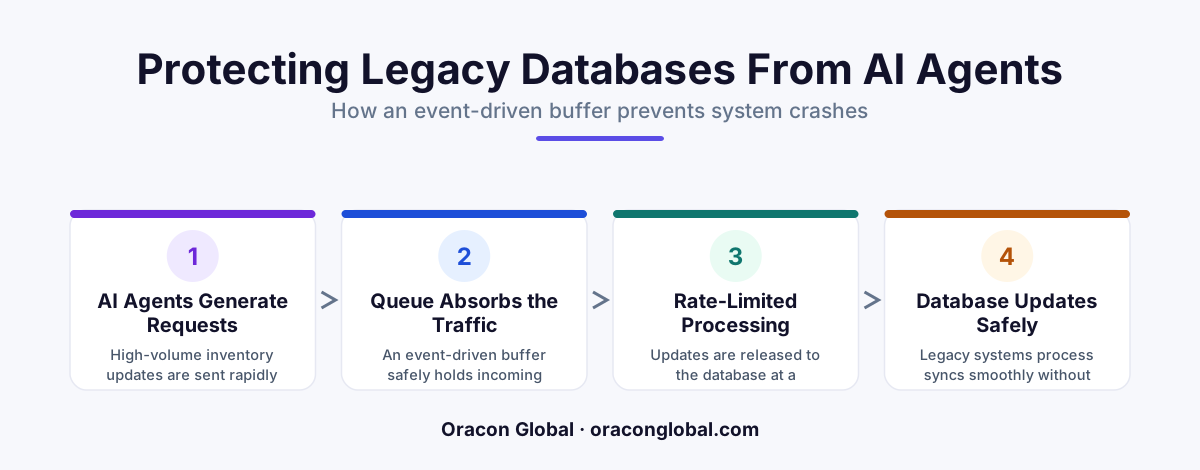
AI agents work at super-human speeds, which can easily overwhelm and crash older company databases during inventory updates. By building an event-driven API buffer, you create a digital waiting room that organizes these requests and feeds them to your database at a safe, steady pace.
Imagine your business just hired a super-human assistant. This digital helper can scan thousands of emails, spreadsheets, and supplier PDFs in seconds. It instantly figures out that you need to update the stock levels for 5,000 different products across your warehouses. The assistant gets to work, sending all 5,000 updates to your company database at the exact same microsecond.
Suddenly, your computer screen freezes. Your sales team cannot log orders, your website stops processing checkouts, and your main system goes completely dark. Your new, intelligent assistant just accidentally crashed your company database.
This is a incredibly common problem for growing businesses. In this guide, we will explain why this happens and how a simple tool called an event-driven API buffer acts as a digital waiting room to keep your systems safe, online, and perfectly synced.
The Clash of Speeds: Fast AI vs. Slow Databases
To understand why systems crash, we need to look at the two players involved: your modern AI agent and your legacy database.
An AI agent (sometimes called a digital employee) is software designed to think, make decisions, and execute tasks autonomously. It operates at lightning speed. A legacy database is your company's digital filing cabinet. It is the master record of your inventory, customer details, and sales. Many businesses rely on legacy databases that were built ten or fifteen years ago.
These older systems were designed for "human speed." They expect a few staff members to type in updates one by one throughout the work day. They are not built to receive thousands of digital knocks on the door at the exact same instant. When an AI agent tries to update them all at once, the database gets confused, runs out of memory, and locks up to protect itself.
What is an Event-Driven API Buffer?
Instead of letting your AI agent talk directly to your fragile database, we place a smart middleman between them. This middleman is called an event-driven API buffer.
Let us define those terms simply:
- API (Application Programming Interface): A digital doorway that allows two different software programs to talk to each other.
- Event-Driven: A system that reacts instantly to "events" or actions, like a new shipment arriving or an item selling out.
- Buffer: A temporary storage space or waiting room.
Think of it like a popular local bakery. If fifty hungry customers try to squeeze through the front door at the exact same second, they will block the entrance, drop the display cases, and cause total chaos. To fix this, the bakery puts a host at the front door. The host hands out numbered tickets and asks everyone to wait in a polite line. The baker can then serve each customer calmly and efficiently, one by one.
The buffer is that polite host. It catches the thousands of rapid updates from your AI agent, saves them safely in a digital queue, and feeds them to your older database at a steady, gentle pace that will never cause a crash.
A Real-World Example: The Midnight Inventory Sync
Let us look at how this works in real life for a wholesale distributor. Every night, three major suppliers email updated product lists in different formats (PDFs, Excel sheets, and CSV files).
Without a buffer, the process is risky:
- The AI agent reads the supplier files at midnight and extracts 8,000 inventory changes.
- The agent floods the main database with 8,000 simultaneous requests to change stock numbers.
- The database locks up, causing the morning shift to wake up to broken screens, failed customer logins, and inaccurate inventory counts.
With an event-driven API buffer, the story changes completely:
- The AI agent extracts the 8,000 inventory updates.
- The agent dumps all 8,000 updates into the buffer in less than three seconds. The AI's job is now done safely.
- The buffer holds the 8,000 updates in a secure line.
- The buffer feeds the updates to the legacy database at a safe rate of, for example, 20 updates per second.
- The database easily processes the changes without sweating, and the business opens the next morning with perfectly accurate stock levels.
The Benefits of Keeping Your Systems Steady
Building this simple waiting room does more than just prevent crashes. It changes how your business handles data. First, it guarantees data safety. If your database does go offline for scheduled maintenance, the buffer simply holds onto the updates and waits. Once the database is back online, the buffer resumes sending the data without losing a single line of inventory.
Second, it saves you from costly system upgrades. Many business owners assume they need to spend hundreds of thousands of dollars replacing their entire legacy software stack just to use modern AI. A buffer allows you to keep using your reliable, paid-for systems while still enjoying the massive productivity gains of autonomous AI agents.
How to Start Building Safely
You do not need to be a software engineer to recognize when your business needs a buffer. If you are planning to automate your inventory, order processing, or shipping workflows using AI, protecting your core database should be your very first step.
At Oracon Global, our senior in-house team builds robust AI agents, workflow automations, and custom software integrations that respect your existing technology. We ensure your digital employees work in harmony with your legacy systems, giving you all the power of AI without any of the downtime risks. Best of all, you own 100% of the custom code and intellectual property we build for you.
Want to see how we build safe, reliable AI tools? Explore the live, interactive AI demos on our website, or send us a message today to talk about your automation goals.
Frequently asked questions
Why do AI agents crash legacy databases during inventory syncs?
AI agents can make thousands of database updates at the exact same time. Older legacy databases are built for human speeds and get overwhelmed by this sudden flood of information, causing them to freeze or crash.
What is an event-driven API buffer?
It is a digital waiting room that sits between your fast AI agent and your slow database. It catches all incoming data requests instantly, lines them up in order, and feeds them to the database at a speed the database can safely handle.
Do we need to rewrite our entire database software to fix this?
No. You do not need to replace your legacy database. The buffer acts as an external middleman, protecting your existing software without requiring a costly and risky system rewrite.
How does this help our business operations?
It keeps your inventory numbers 100% accurate across all online stores and warehouses without risking system downtime, frozen screens, or lost sales data.
Read next
Beyond Chatbots: How to Build AI Agents That Actually Do Work for Your Business
Most businesses use AI to answer questions. Here is how to build custom AI agents that actually take action, connect to your internal tools, and handle complex workflows.
Beyond the Wrapper: How to Build Custom AI Agents for Business That Actually Work
Many businesses invest in basic AI wrappers only to find they lack the security and context needed for real work. Here is how to build custom AI agents that integrate deeply with your workflows and databases.
Enterprise AI Maintenance Costs: Budgeting for Year Two and Beyond
Building an AI system is only half the battle. Discover the practical, ongoing operational costs of enterprise AI, including token management, model drift, and continuous security audits.
Oracon Global builds production-grade AI agents, automation and apps — and you own the code and IP. Tell us what you want to automate.
Book a call →See our work