

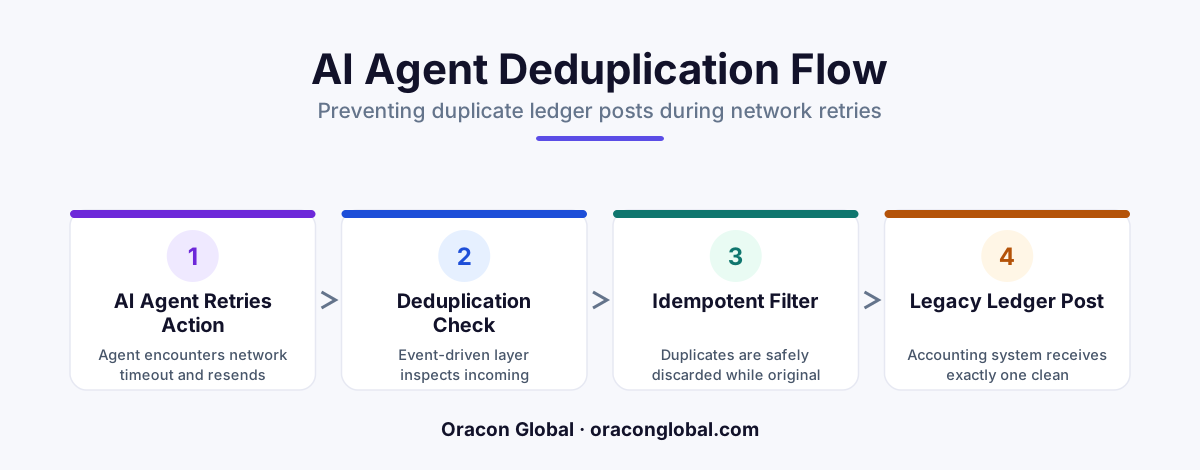
AI agents operating on legacy systems will eventually experience network timeouts, leading to automated retries that cause double-posted transactions. Building an event-driven deduplication layer with deterministic transaction hashing and distributed locking is the only way to guarantee transactional consistency without modifying your legacy accounting database.
Autonomous AI agents are incredibly efficient at processing unstructured data, matching purchase orders, and drafting ledger entries. However, when you connect these fast-moving digital employees to slow, legacy accounting systems, a structural mismatch occurs. Legacy systems were designed for deliberate, human-paced data entry. AI agents operate at machine speed, frequently running multiple tasks in parallel.
The danger begins when a network timeout occurs. If an AI agent submits an invoice to your legacy accounting system and the API connection drops, the agent has no way of knowing if the transaction succeeded. Designed to be thorough, the agent will naturally retry the API call. Without a protective API deduplication layer, your legacy ERP will process that retry as a brand-new transaction, resulting in double-posted expenses, duplicate vendor payments, and hours of manual cleanup for your finance team.
To prevent these costly bookkeeping errors, you do not need to rewrite your legacy software. Instead, you need to build a lightweight, event-driven middle layer that intercepts, validates, and cleanses every write request before it ever touches your accounting database.
The Root of the Problem: Why Retries Equal Duplicates
Most modern SaaS platforms use a concept called idempotency. An idempotent API allows you to send the exact same request multiple times without changing the result. If you send a payment request with a unique tracking key three times, a modern API processes it once and simply returns the cached success message for the next two attempts.
Legacy accounting systems and custom on-premise ERPs rarely support native idempotency keys. They treat every incoming POST request as a unique command. When an AI agent encounters a standard network hiccup or a five-second database lag, it assumes the request failed. It instantiates a retry loop, sending the same payload again. To prevent AI agent accounting errors, we must insert a deterministic validation gate between the agent and the destination API.
How an Event-Driven Deduplication Layer Works
An event-driven deduplication layer acts as a traffic controller. Instead of allowing your AI agent to talk directly to your legacy ledger, the agent sends all write requests to your custom middleware. The middleware processes the request through a three-step pipeline before passing it to the accounting database.
1. Deterministic Payload Hashing
The first step to duplicate transaction prevention is identifying whether a request has been seen before. Because AI agents generate JSON payloads dynamically, we cannot rely on the agent to generate a reliable transaction ID. Instead, the deduplication layer runs the raw payload through a deterministic hashing algorithm (such as SHA-256).
By stripping out whitespace and sorting the JSON keys alphabetically before hashing, the middleware guarantees that any identical transaction payload will generate the exact same hash signature, regardless of when or how many times it is sent.
2. In-Memory Distributed Locking
Once a hash signature is generated, the middleware attempts to acquire a short-lived distributed lock using an in-memory database like Redis. This step is critical for managing high-volume parallel operations.
- If the lock is successfully acquired, it means this is a new transaction. The middleware marks the hash as "processing" in the cache.
- If the lock cannot be acquired because the hash already exists in the cache, the middleware blocks the duplicate request. It tells the AI agent to pause and wait for the original transaction to finish processing.
3. The Event Queue and Callback Buffer
Instead of writing directly to the slow legacy database, the deduplication layer pushes the validated transaction into an asynchronous event queue (like RabbitMQ or AWS SQS). This isolates your legacy system from sudden spikes in AI agent activity, ensuring that write operations are queued and executed one at a time, protecting your database from load spikes.
Architecting the Deduplication Workflow
To successfully deploy an event-driven API architecture for your accounting systems, the communication flow must be strictly decoupled. Here is the step-by-step lifecycle of a safe transaction write:
- Intake: The AI agent sends a transaction payload (e.g., a bill creation command) to the deduplication middleware.
- Hash Check: The middleware hashes the payload and checks the in-memory cache.
- New Transaction Flow: If the hash is unique, the middleware writes the hash to the cache with a status of "PENDING" and a TTL (Time-To-Live) of 30 minutes. The transaction is queued for execution.
- Duplicate Transaction Flow: If the hash is found in the cache with a "PENDING" status, the middleware returns a HTTP 202 (Accepted) status to the AI agent, advising it to poll for completion. If the status is already "SUCCESS", it returns the original success response instantly without hitting the legacy database.
- Execution & Sync: A background worker pulls the transaction from the queue, writes it to the legacy accounting software, receives the database confirmation ID, updates the cache status to "SUCCESS", and saves the legacy ID in the cache.
"By shifting the responsibility of transaction tracking from the legacy database to an intelligent middle layer, you protect your system of record while allowing your AI tools to operate at maximum speed."
Protecting Edge Cases: Failed Writes and Partial Success
In real-world software development, legacy integrations fail in complex ways. What happens if the background worker attempts to write to the legacy system, but the legacy database genuinely rejects the transaction due to a validation error?
If a transaction fails at the database level, the deduplication layer must immediately transition the cached hash status from "PENDING" to "FAILED" and release the distributed lock. This allows your AI agent to receive the explicit error message, adjust its parameters or prompt guidelines, and safely try a corrected version of the transaction without being locked out by the deduplication filter.
Building Resilient Enterprise Integrations
Connecting modern, autonomous workflows to legacy enterprise systems requires custom software that understands the limitations of both environments. Designing a robust legacy ERP integration ensures your business enjoys the massive productivity gains of autonomous AI agents without risking the integrity of your financial ledgers.
At Oracon Global, our senior in-house team of engineers and architects builds stable, production-grade AI integrations, custom ERP middlewares, and intelligent agents that keep your workflows moving smoothly worldwide. If you are planning to connect custom AI tools to your legacy software systems and want to ensure your databases remain safe, consistent, and error-free, contact Oracon Global today to discuss your architecture.
Frequently asked questions
Why do AI agents cause double-posting in legacy accounting systems?
When an AI agent submits a transaction to a legacy system and the network connection drops or times out, the agent does not know if the write succeeded. Following its programming, it retries the API call. Without a deduplication layer, the legacy system treats the retry as a brand-new transaction.
Can we solve double-posting by editing our legacy accounting software?
Usually no. Legacy ERPs and accounting systems often lack native idempotency keys or request validation. Modifying these legacy codebases is incredibly expensive, risky, and sometimes impossible, making an external deduplication layer the safest and fastest solution.
What is the core technology behind an API deduplication layer?
The layer relies on a fast, in-memory database like Redis to handle distributed locking, a deterministic hashing algorithm to generate unique transaction IDs, and an event-driven message queue to process incoming write requests sequentially.
How does this layer affect the performance of our AI agents?
By moving the deduplication logic to a lightweight, fast middleware layer, AI agents receive near-instant responses. It prevents the agents from stalling or timing out while waiting for slow legacy databases to process and reconcile transactions.
Read next
Beyond Chatbots: How to Build AI Agents That Actually Do Work for Your Business
Most businesses use AI to answer questions. Here is how to build custom AI agents that actually take action, connect to your internal tools, and handle complex workflows.
Beyond the Wrapper: How to Build Custom AI Agents for Business That Actually Work
Many businesses invest in basic AI wrappers only to find they lack the security and context needed for real work. Here is how to build custom AI agents that integrate deeply with your workflows and databases.
Enterprise AI Maintenance Costs: Budgeting for Year Two and Beyond
Building an AI system is only half the battle. Discover the practical, ongoing operational costs of enterprise AI, including token management, model drift, and continuous security audits.
Oracon Global builds production-grade AI agents, automation and apps — and you own the code and IP. Tell us what you want to automate.
Book a call →See our work