

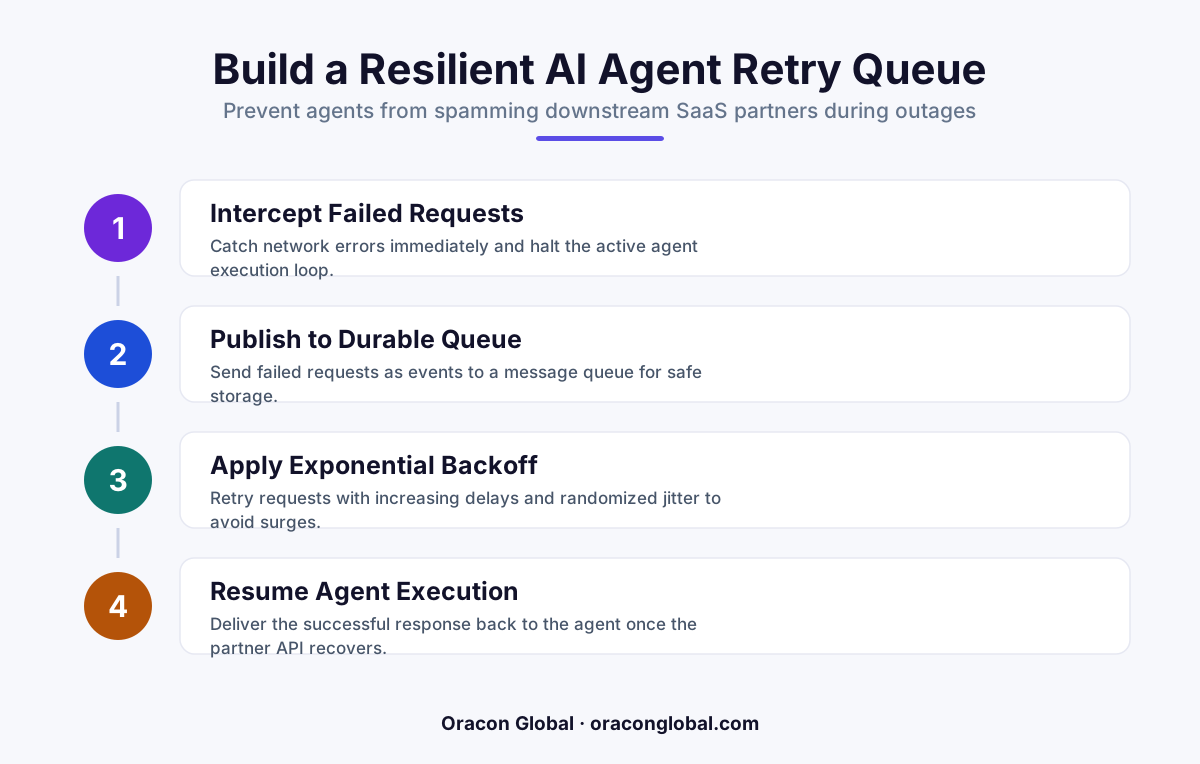
Standard software retries fail when applied to autonomous AI agents, leading to API rate limits, blocked IPs, and wasted cloud budgets during outages. By implementing an event-driven retry queue with exponential backoff, circuit breakers, and semantic state preservation, your agents can pause and resume work safely without spamming partners.
When an autonomous AI agent encounters a network glitch or a down partner API, it does not react like a human employee. A human stops, checks the status page, and waits. An autonomous agent, driven by a loops-of-thought execution model, often assumes the failure is a reasoning error. It rewrites the request, changes the parameters, and tries again. And again. And again.
Within minutes, a single temporary network hiccup at a downstream SaaS partner can cause your AI agent to send thousands of rapid-fire API requests. This behavior does more than just burn through your LLM token budget. It triggers rate limits, gets your server IPs blocked by your partners, and corrupts the internal state of your automated workflows. To build production-grade AI tools, you need a dedicated API retry queue for AI that enforces order when third-party systems go dark.
The Anatomy of an Agentic API Storm
In traditional software development, handling a failed API call is straightforward. You write an exponential backoff loop, try three times, and throw an error if it still fails. This approach breaks down completely when applied to generative AI agents and digital employees.
AI agents use loops to evaluate their own progress toward a goal. When a tool execution fails due to AI agent network outages, the agent receives an error message as tool output. Because the agent is programmed to solve problems autonomously, it often interprets this network error as a puzzle to be solved. It may decide to:
- Modify the payload structure to see if a different format bypasses the error.
- Spam parallel tool requests to alternative endpoints, hoping one goes through.
- Generate rapid, recursive loops that ask the LLM how to resolve the connection timeout.
This behavior transforms a simple infrastructure blip into an expensive, self-inflicted denial-of-service attack against your own integration partners.
Step 1: Implementing a Circuit Breaker Registry
The first line of defense against agentic API spamming is a centralized circuit breaker pattern. Instead of letting individual agent runs decide when to retry a call, all external tool executions must pass through an API gateway layer that monitors downstream health.
The circuit breaker operates in three states:
- Closed: Normal operations. Requests flow directly to the downstream SaaS API.
- Open: The partner API is failing. All requests are immediately redirected to the retry queue without hitting the downstream server or triggering new LLM steps.
- Half-Open: The system sends a limited number of trial requests to check if the partner API has recovered.
By decoupling the network state from the LLM’s reasoning loop, you prevent the agent from ever seeing raw connection errors. The agent is simply told by the execution gateway that the action has been safely queued, pausing its execution path until the circuit closes again.
Step 2: Designing the Event-Driven Queue Structure
When a circuit breaker trips, you cannot simply drop the agent's task. You must capture the execution state so the agent can resume its work later. This requires an event-driven message broker like Redis, RabbitMQ, or AWS SQS to act as a buffer.
A resilient queue payload must store more than just the target URL and headers. To resume work smoothly, the queue needs to serialize:
- The Agent State Hash: A snapshot of the agent’s memory, past execution steps, and current goal.
- The Target Tool Payload: The exact arguments generated by the LLM for the tool call.
- The Callback Topic: The unique pub/sub channel where the agent is listening for its response.
- The Attempt Metadata: The current retry count and timestamp of the next allowed attempt.
This structure allows the execution engine to put the agent's thread to sleep, freeing up system resources and preventing unnecessary LLM token spend while waiting for the partner API to come back online.
Step 3: Applying Exponential Backoff and Jitter
Once failed API calls are safely stored in the queue, a worker service must retry them systematically. Using a simple static delay (like retrying every 10 seconds) can cause a "thundering herd" problem when the partner API recovers, instantly crashing their servers again.
Instead, your queue worker should utilize exponential backoff combined with randomized jitter. This ensures that retries are spread out over time. The formula for the retry delay is calculation-based:
Delay = Min(Max_Delay, Base_Delay * (2 ^ Attempt) + Random_Jitter)
By introducing random jitter, you stagger the retry attempts across your queued tasks, ensuring a smooth, gradual ramp-up of traffic once the downstream service is fully operational.
Step 4: Safe Agent Resumption via Webhook Callbacks
The final piece of the puzzle is waking the agent back up once the queued API call succeeds. Because the agent thread was suspended, you need a clean, event-driven way to inject the successful API response back into the agent's context.
When the background queue worker successfully executes the delayed API call, it publishes the result back to the callback topic. The orchestration engine listens for this event, updates the agent's memory with the tool output, and signals the LLM to resume its processing loop. To the agent, the delay looks like a slightly slow tool response, rather than a system-level failure that requires error handling.
Production-Ready AI Integrations
Building AI agents that work flawlessly in perfect sandboxes is easy. Building agents that survive the messy reality of the modern web—where APIs go down, rate limits change, and networks drop—requires robust engineering.
By isolating your AI agents from raw network errors using a structured retry queue and circuit breakers, you protect your partnerships, control your cloud costs, and build automated systems that remain stable under any conditions.
If you are looking to deploy resilient AI digital employees, custom integrations, or robust SaaS platforms, our senior in-house team at Oracon Global can help you build production-ready systems from the ground up. Get in touch with us to discuss your project.
Frequently asked questions
Why do standard API retry libraries fail when used with autonomous AI agents?
Traditional retry libraries expect static, linear workflows. AI agents generate dynamic, multi-step execution paths where a single failed downstream API call can trigger a loop of repeating thoughts, duplicate tool executions, and redundant network requests.
What is a circuit breaker pattern in agentic architecture?
A circuit breaker monitors API error rates. If a downstream partner's service goes offline, the breaker trips to an open state, immediately failing or queuing subsequent requests instead of letting the AI agent continue sending futile, expensive API requests.
How does a semantic queue preserve the context of an AI agent's work?
Instead of just saving raw JSON payloads, a semantic queue stores the agent's current prompt context, memory state, and progress of the execution chain so the agent can resume exactly where it left off once the API recovers.
Does implementing a retry queue increase LLM token costs?
No, it drastically reduces them. Without a centralized retry queue, a stalled agent will continually query the LLM to figure out why a step failed, burning prompt and completion tokens on repetitive loop logic.
Read next
Beyond Chatbots: How to Build AI Agents That Actually Do Work for Your Business
Most businesses use AI to answer questions. Here is how to build custom AI agents that actually take action, connect to your internal tools, and handle complex workflows.
Beyond the Wrapper: How to Build Custom AI Agents for Business That Actually Work
Many businesses invest in basic AI wrappers only to find they lack the security and context needed for real work. Here is how to build custom AI agents that integrate deeply with your workflows and databases.
Enterprise AI Maintenance Costs: Budgeting for Year Two and Beyond
Building an AI system is only half the battle. Discover the practical, ongoing operational costs of enterprise AI, including token management, model drift, and continuous security audits.
Oracon Global builds production-grade AI agents, automation and apps — and you own the code and IP. Tell us what you want to automate.
Book a call →See our work